On this page
Organic Compounds Containing Halogens is a short unit. Learn one idea well, how a polar C–X bond breaks, and most of the chapter follows.
What does the NEET-UG syllabus include in this unit?
NEET-UG 2027 has not been notified, so this guide follows the National Medical Commission's NEET (UG)-2026 syllabus, dated 22 December 2025. There, Chemistry Unit 16 is Organic Compounds Containing Halogens. It lists:
General methods of preparation, properties and reactions.
Nature of the C–X bond.
Mechanisms of substitution reactions.
Uses, and the environmental effects of chloroform, iodoform, freons and DDT.
The matching chapter is NCERT Class 12 Chemistry Part II, Unit 6 Haloalkanes and Haloarenes (Reprint 2026-27). It still covers everything the syllabus names: preparation (Finkelstein, Swarts and Sandmeyer reactions included), SN1 and SN2 with optical activity, Zaitsev elimination, Grignard and Wurtz reactions, haloarenes, and the polyhalogen compounds in section 6.8. Nothing in it was cut: NCERT's list of rationalised content for Class XII drops chapters such as Polymers but names no deletion from this one. Dichloromethane and carbon tetrachloride appear in the chapter, not the syllabus; read them once.
How should you practise it for NEET?
As in NEET-UG 2026, the NTA information bulletin sets 180 compulsory questions in 180 minutes, 45 of them in Chemistry, each a multiple-choice question with four options and a single correct or best answer, marked +4, −1 for a wrong answer and 0 if left blank. That is about a minute a question, so:
Decide the mechanism (SN1, SN2 or elimination) before the product.
Keep one page of named reactions and their reagents.
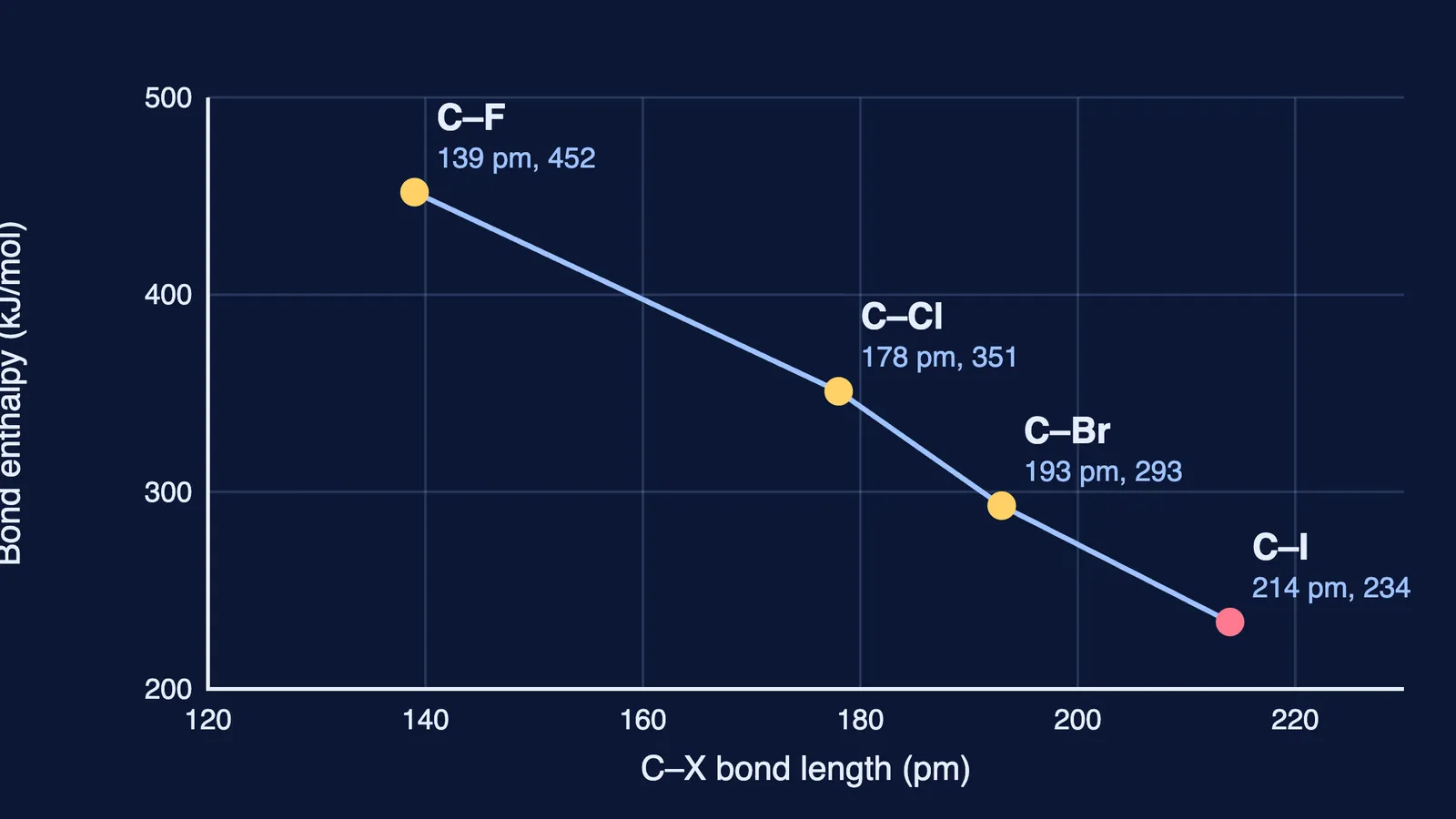
In NCERT Table 6.2, the C–X bond lengthens from 139 pm in CH3–F to 214 pm in CH3–I while its bond enthalpy falls from 452 to 234 kJ/mol. So, for one alkyl group, iodides react fastest and fluorides slowest, by SN1 or SN2.
Three worked examples, solved the NEET way
Example 1 (rate laws). An alkyl halide reacts with OH⁻ at 2.0 × 10⁻⁴ mol L⁻¹ s⁻¹. You triple [RX] and halve [OH⁻]. What is the new rate if the reaction is SN2, and if it is SN1?
SN2 is second order: rate = k[RX][OH⁻], so 2.0 × 10⁻⁴ × 3 × 0.5 = 3.0 × 10⁻⁴ mol L⁻¹ s⁻¹. SN1 depends only on [RX]: 2.0 × 10⁻⁴ × 3 = 6.0 × 10⁻⁴ mol L⁻¹ s⁻¹.
Example 2 (stereochemistry). (S)-3-bromohexane reacts with NaCN by SN2. Name the product.
Cyanide attacks opposite bromine, so the configuration inverts. The product is CH3CH2CH2CH(CN)CH2CH3, 2-ethylpentanenitrile. Priorities: CN (carbon bonded to N, N, N) > propyl > ethyl > H, so CN takes bromine's top rank. The label flips: (R)-2-ethylpentanenitrile.
Example 3 (Wurtz). (a) 2.18 g of bromoethane reacts fully with sodium in dry ether. What mass of butane can form? (b) How many alkanes form from a mixture of bromoethane and 1-bromopropane?
(a) Bromoethane, C2H5Br, is 109.0 g/mol, so 0.0200 mol. Two molecules give one butane: 0.0100 mol × 58.1 g/mol = 0.581 g. (b) Three: butane, pentane and hexane.
What are the common traps?
Highest dipole moment. In Table 6.2 it is CH3–Cl (1.860 D), not CH3–F (1.847 D).
KCN vs AgCN. KCN gives alkyl cyanides; AgCN gives isocyanides.
Haloarenes and NaOH. Chlorobenzene needs 623 K and 300 atmospheres to give phenol; nitro groups at ortho or para positions make it easier.
Halogens on benzene. They deactivate the ring yet direct ortho and para.
Chloroform storage. Air and light oxidise it to phosgene, so it is kept in dark bottles filled to the top.
Mechanisms stick better as one connected idea. The Fermi Concept Library covers every concept in physics, chemistry, biology, mathematics and computing, each with its own lesson and its place in the map.
A seven-day practice plan
Day 1: nomenclature, classification, the C–X bond.
Day 2: preparation from alcohols, alkenes and halogen exchange.
Day 3: SN2 and SN1, rate laws, reactivity orders.
Day 4: optical activity, inversion, racemisation.
Day 5: elimination, Grignard, Wurtz and Wurtz-Fittig.
Day 6: haloarenes; polyhalogen compounds and their effects.
Day 7: 20 mixed questions, a minute each; name every miss's trap.
Stuck on a step? The Fermi Problem Library has worked problems with a step-by-step solver that explains the reasoning rather than printing an answer.
Try these in four minutes:
Which reacts fastest with NaI in dry acetone: 1-chlorobutane, 1-bromobutane, 2-bromobutane or 2-bromo-2-methylpropane?
Arrange CH3F, CH3Cl, CH3Br and CH3I by decreasing dipole moment (Table 6.2).
1-Bromopropane is treated with AgCN. What is the main product?
Assertion: chlorobenzene does not react with aqueous NaOH at room temperature. Reason: its C–Cl bond has partial double bond character.
Answers: 1. 1-Bromobutane. 2. CH3Cl > CH3F > CH3Br > CH3I. 3. Propyl isocyanide. 4. Both true; the reason explains the assertion.
Sitting JEE Main too? See our Haloalkanes and Haloarenes guide for JEE Main. For boards, read the Haloalkanes and Haloarenes Class 12 board exam answer guide.