On this page
Haloalkanes and haloarenes reward reasoning over memory. Once you can say why a halide reacts as it does, most questions become a short chain of decisions.
What does the JEE Main 2027 syllabus say about haloalkanes and haloarenes?
The topic is chemistry Unit 16, "Organic Compounds Containing Halogens", in the official Syllabus for JEE (Main) - 2027 that NTA links from jeemain.nta.nic.in. It lists general methods of preparation, properties and reactions, the nature of the C–X bond, mechanisms of substitution reactions, and the uses and environmental effects of chloroform, iodoform, freons and DDT.
Your textbook chapter is Unit 6, Haloalkanes and Haloarenes, in NCERT Class 12 Chemistry Part II (the 2026-27 reprint). Sections 6.7.1 (haloalkanes) and 6.7.2 (haloarenes) hold the reactions and substitution mechanisms the syllabus names. For preparation routes, see our guide to making haloalkanes from alcohols and alkenes.
How do you tell SN1 from SN2?
Ask three questions: what is the substrate, the nucleophile and the solvent?
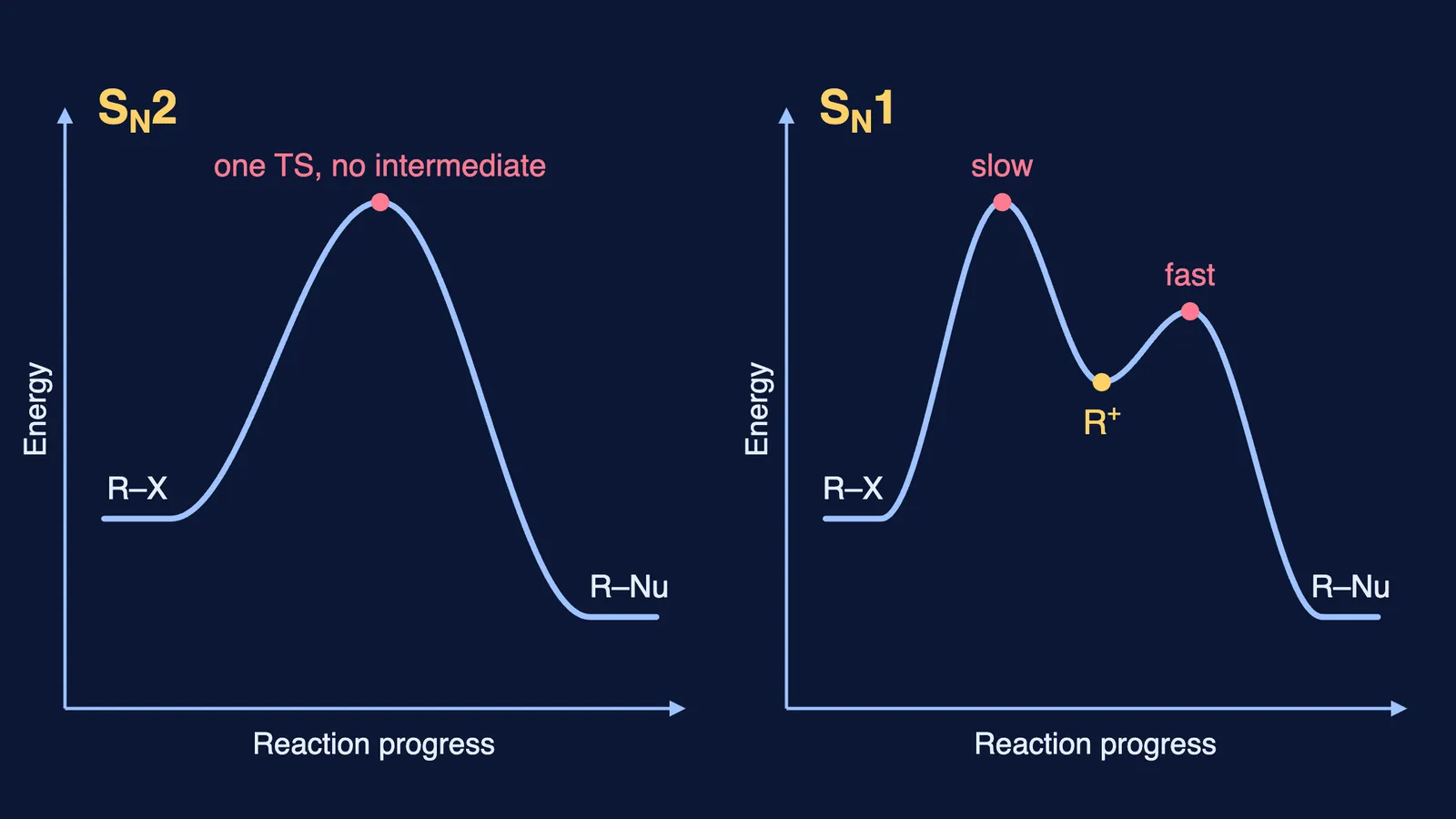
SN2 happens in one step. The nucleophile attacks from the side opposite the halogen, so a chiral carbon comes out with its configuration inverted, like an umbrella turned inside out. Crowding slows it, so the order is methyl > primary > secondary > tertiary (NCERT Unit 6).
SN1 happens in two steps. The C–X bond breaks slowly to give a flat carbocation, which the nucleophile can attack from either face, so an optically active halide gives a racemised product. The order reverses: tertiary > secondary > primary, and allylic and benzylic halides are fast because their cations are resonance-stabilised (same source).
Solvent. SN1 is run in polar protic solvents such as water and alcohols, which help pull the halide ion away. SN2 is faster in polar aprotic solvents such as acetone, DMF and DMSO that do not cage the nucleophile in hydrogen bonds (LibreTexts, Characteristics of the SN2 Reaction).
Worked example. (R)-2-bromobutane reacts with hydroxide by SN2. The OH ends up opposite where Br was. Priorities around the carbon keep the same order (OH and Br both rank first, then ethyl, methyl, hydrogen), so the label flips too: you get (S)-butan-2-ol.
When does elimination beat substitution?
Heat a haloalkane that has a hydrogen on the neighbouring (beta) carbon with alcoholic KOH and you lose HX to form an alkene. Aqueous KOH usually gives the alcohol instead. When more than one alkene can form, Saytzeff's (Zaitsev's) rule picks the major product: the alkene with more alkyl groups on the double-bond carbons. So 2-bromobutane gives mainly but-2-ene, with but-1-ene as the minor product.
NCERT sums up the competition: primary halides favour SN2, secondary halides go SN2 or elimination depending on the base, and tertiary halides go SN1 or elimination. A bulky base prefers to pull off a proton rather than reach a crowded carbon.
Why are aryl halides so unreactive, and what changes that?
Chlorobenzene resists nucleophilic substitution for four reasons given in NCERT Unit 6:
A halogen lone pair is shared with the ring, giving the C–Cl bond partial double-bond character.
The carbon is sp2, with more s-character, so it holds the bond tighter: C–Cl is 169 pm in chlorobenzene against 177 pm in a haloalkane.
A phenyl cation would not be resonance-stabilised, so SN1 is ruled out.
An electron-rich nucleophile is repelled by the electron-rich ring.
That is why turning chlorobenzene into phenol with NaOH needs 623 K and 300 atmospheres. An ortho or para nitro group changes this: the intermediate's negative charge can reach the carbon carrying the nitro group, which stabilises it. A meta nitro group cannot, so it has no such effect. See why ortho and para nitro groups make chlorobenzene reactive for every resonance structure.
Which named reactions should you know cold?
Finkelstein: an alkyl chloride or bromide with NaI in dry acetone gives the alkyl iodide. NaCl or NaBr precipitates, which drives the reaction forward.
Swarts: heating an alkyl chloride or bromide with a metal fluoride such as AgF, Hg2F2, CoF2 or SbF3 gives the alkyl fluoride.
Wurtz-Fittig: an alkyl halide plus an aryl halide with sodium in dry ether gives an alkylarene, for example bromobenzene and bromoethane giving ethylbenzene. Two aryl halides alone give a biaryl (the Fittig reaction).
All of these are in NCERT Unit 6. Also, halogens on benzene are deactivating but ortho/para-directing for electrophilic substitution.
What is a good two-week plan?
Days 1-2: re-read 6.3 and 6.7.1; build an SN1/SN2 table from memory.
Days 3-5: twenty mechanism questions a day, writing substrate, nucleophile and solvent before each answer.
Days 6-7: stereochemistry; draw every product in 3D.
Days 8-10: haloarenes, nitro activation and named reactions.
Days 11-14: mixed timed sets, then rework every mistake.
For days 3-5, the Fermi Problem Library has worked problems with a step-by-step solver that explains the reasoning rather than printing an answer. If the electronic effects behind carbocation stability feel shaky, go back to our GOC guide for JEE Main first.