

On this page
Your textbook lists several ways to make a haloalkane (an alkyl halide, R–X), and exam questions check whether you know when each one fails.
How do you make an alkyl halide from an alcohol?
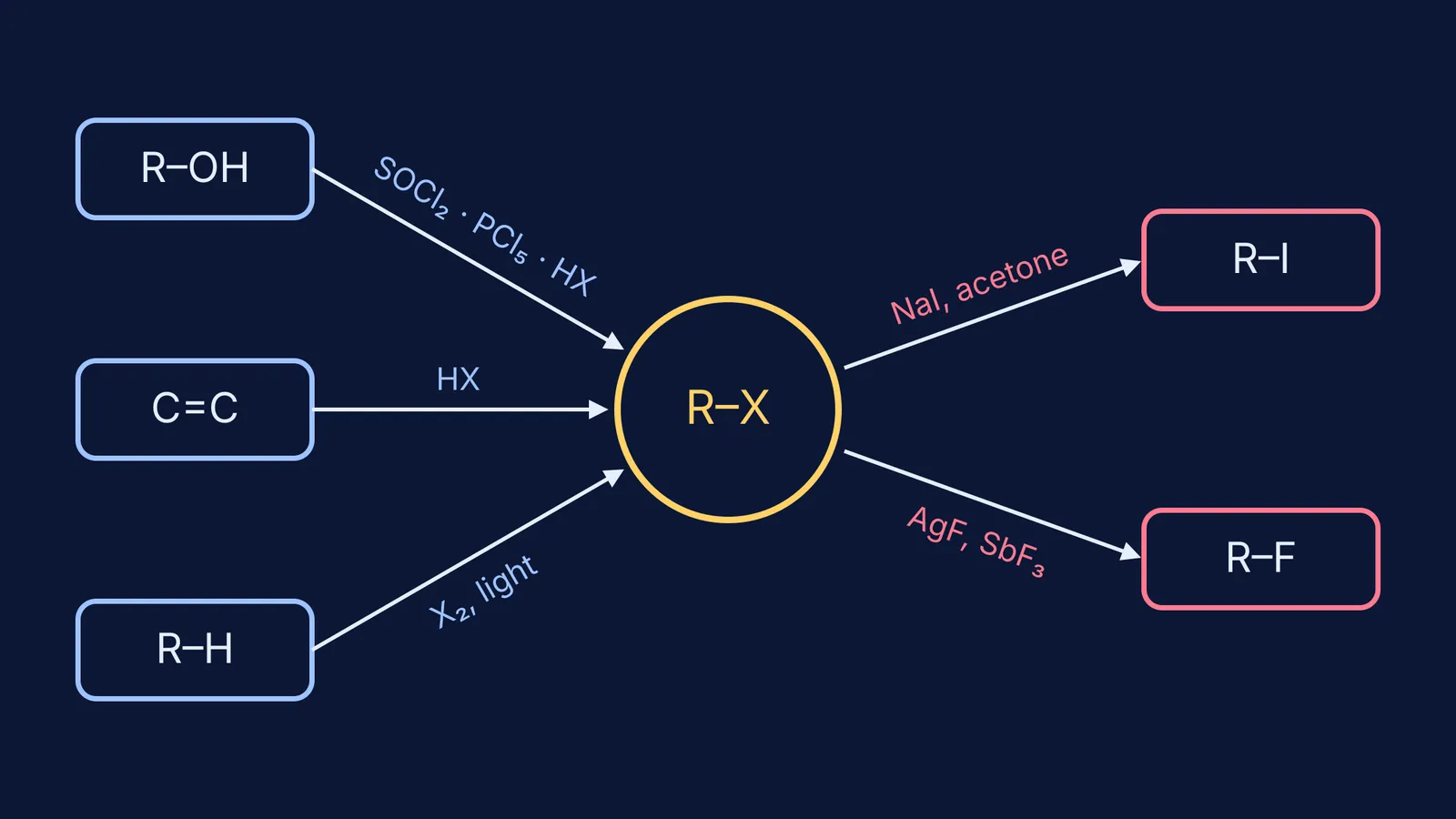
You replace –OH with a halogen. There are four reagents to know.
HX (HCl, HBr, HI). Alcohol reactivity with HX runs tertiary > secondary > primary > methyl, so the method works best for tertiary alcohols (OpenStax Organic Chemistry, via LibreTexts/10%3A_Organohalides/10.05%3A_Preparing_Alkyl_Halides_from_Alcohols)). A tertiary alcohol reacts when shaken with concentrated hydrochloric acid at room temperature, but primary and secondary alcohols react too slowly for the method to be of much use (Chemguide). Drawbacks: it is slow for 1° and 2° alcohols, and the carbocation can rearrange.
PCl₃ or PBr₃. 3 R–OH + PCl₃ → 3 R–Cl + H₃PO₃. For bromides and iodides, the alcohol is usually refluxed with red phosphorus and bromine or iodine, which make the phosphorus(III) halide in the flask (Chemguide). Drawback: the phosphorous acid by-product is not a gas, so it has to be separated from the product.
PCl₅. R–OH + PCl₅ → R–Cl + POCl₃ + HCl. Chemguide says PCl₅ reacts violently with alcohols at room temperature, isn't a good choice for making chloroalkanes, and its POCl₃ can react further with the alcohol. It is better known as a test for –OH groups.
SOCl₂ (thionyl chloride). R–OH + SOCl₂ → R–Cl + SO₂ + HCl. Both by-products are gases, so they leave the reaction mixture on their own (Chemguide). SOCl₂ and PBr₃ are less acidic than HX and less likely to cause rearrangements, and their yields are generally high (OpenStax via LibreTexts/10%3A_Organohalides/10.05%3A_Preparing_Alkyl_Halides_from_Alcohols)). Drawbacks: it only makes chlorides, and the acidic gases have to be vented. More in why thionyl chloride is preferred for making alkyl chlorides.
How do you make an alkyl halide from an alkene?
Add HX across the double bond. Markovnikov's rule: "In the addition of HX to an alkene, the H attaches to the carbon with fewer alkyl substituents and the X attaches to the carbon with more alkyl substituents" (OpenStax, section 7.8). For example, 2-methylpropene and HCl give only 2-chloro-2-methylpropane.
There are two drawbacks. First, the carbocation can rearrange: 3-methyl-1-butene with HCl gives about 50% 2-chloro-3-methylbutane and 50% 2-chloro-2-methylbutane, because of a hydride shift (OpenStax, section 7.11). Second, to put the halogen on the less substituted carbon, you need HBr with peroxides. The reversal does not work with HCl or HI, as explained in our post on the Kharasch peroxide effect.
Why is free-radical halogenation a poor way to make haloalkanes?
In light, chlorine replaces hydrogens on an alkane. OpenStax calls alkane halogenation "a poor synthetic method for preparing alkyl halides because mixtures of products invariably result" (OpenStax, section 10.2). Methane doesn't stop at CH₃Cl, but goes on to di-, tri- and tetrachloro products.
In the same source, chlorinating butane gives 1-chlorobutane and 2-chlorobutane in a 30:70 ratio. A secondary hydrogen reacts 3.5 times as often as a primary one, and a tertiary hydrogen 5 times as often. To check it, multiply number of H × relative reactivity. Butane has 6 primary and 4 secondary hydrogens, so 6 × 1 : 4 × 3.5 = 6 : 14, which is 30:70.
What is halogen exchange, and when do you use it?
The Finkelstein reaction is an SN2 reaction in which one halogen replaces another, typically R–Cl or R–Br with NaI in acetone. NaCl doesn't dissolve in acetone, so it precipitates and pulls the equilibrium towards the iodide (UCLA Illustrated Glossary of Organic Chemistry). The Swarts reaction replaces chlorine with fluorine using metal fluorides such as AgF, Hg₂F₂, CoF₂ or SbF₃ (Wikipedia: Swarts fluorination). Drawback: you need an alkyl chloride or bromide first, and Finkelstein carries the usual SN2 limits. See Finkelstein and Swarts reactions for worked equations.
Which method should you choose? A worked example
Suppose you need pure 2-chloro-3-methylbutane.
Alkene route: 3-methyl-1-butene with HCl gives about half the rearranged product. Reject it.
Alcohol with HCl: 3-methylbutan-2-ol is a secondary alcohol. It reacts slowly through a secondary carbocation that can undergo the same hydride shift. Reject it.
Radical chlorination of 2-methylbutane gives a mixture. Reject it.
Alcohol with SOCl₂ is less acidic, less prone to rearrangement and gives gaseous by-products. Choose this.
Before you pick a reagent, ask yourself four questions:
Which halogen? Use SOCl₂ for Cl, PBr₃ or red P/Br₂ for Br, Finkelstein or red P/I₂ for I, and Swarts for F.
Is the alcohol tertiary? Then HX works well.
Could a carbocation shift to a more stable one? If so, avoid the HX routes.
Do you need the anti-Markovnikov product? Only HBr with peroxide gives it.
For more questions like this, the Fermi Problem Library has worked problems with a step-by-step solver that explains the reasoning rather than printing an answer. If carbocation stability itself feels shaky, the Fermi Concept Library gives each chemistry concept its own lesson and its place in the map.
Try this question next: which reagent turns 2-methylpropan-2-ol into its chloride most simply, and why is that one safe from rearrangement?


