On this page
Chlorobenzene barely reacts with hydroxide ions. Put nitro groups in the right places on the ring and the same swap of Cl for OH runs below the boiling point of water. The reason is one intermediate and where it can put its extra negative charge. Once you see that, most ranking questions on this reaction become a counting exercise.
How much do nitro groups change the conditions?
The NCERT Class 12 chemistry chapter Haloalkanes and Haloarenes gives the conditions for replacing chlorine by OH with sodium hydroxide:
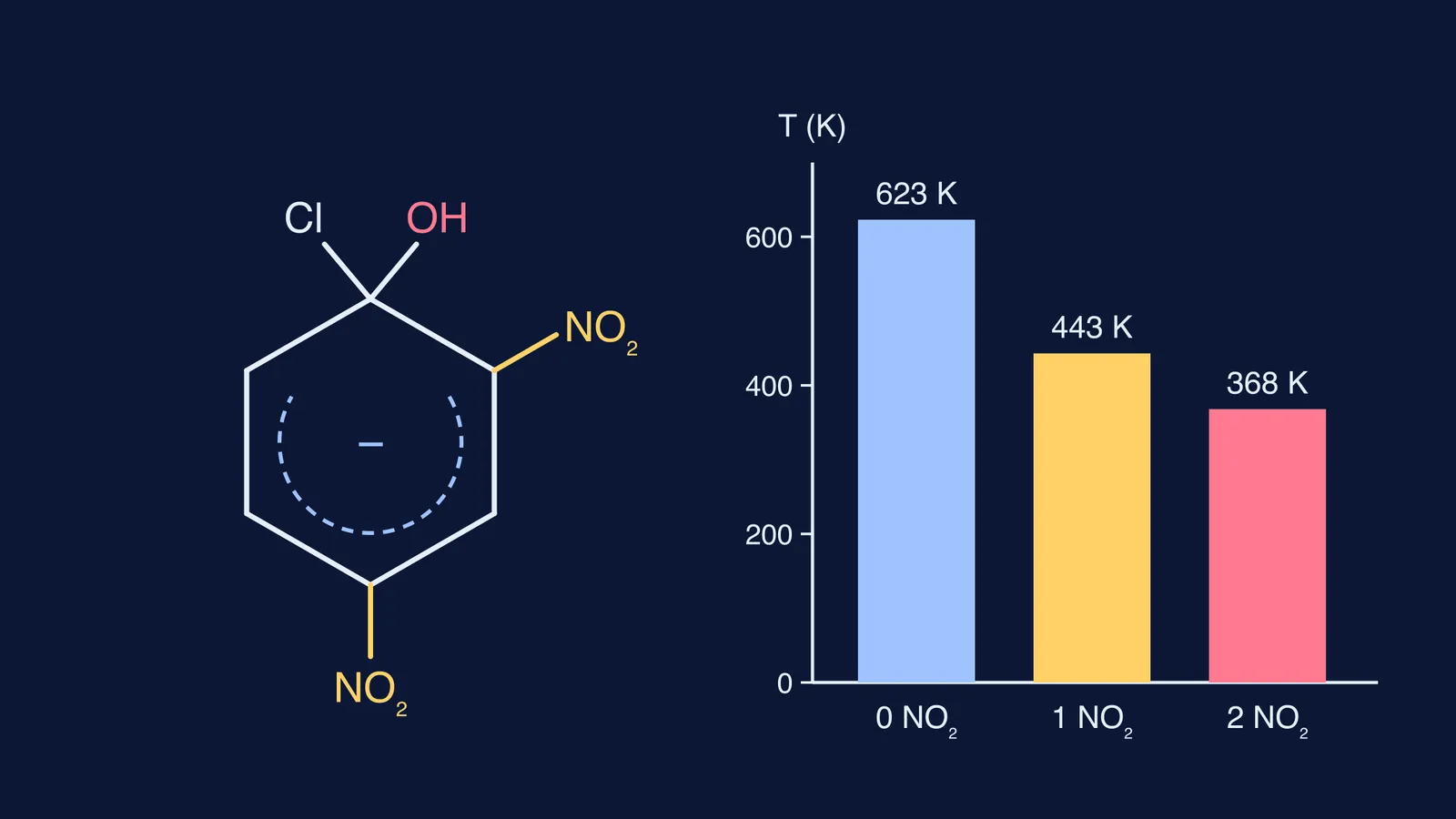
Chlorobenzene: aqueous NaOH at 623 K and 300 atmospheres.
1-Chloro-4-nitrobenzene: NaOH at 443 K.
1-Chloro-2,4-dinitrobenzene: NaOH at 368 K.
2,4,6-Trinitrochlorobenzene: warm water.
The same chapter says a nitro group at the meta position has no effect on reactivity. So position matters, not just the presence of a nitro group. For why plain chlorobenzene is so stubborn in the first place, see our explainer on why haloarenes resist nucleophilic substitution.
Why does a nitro group at ortho or para increase reactivity?
The reaction is neither SN1 nor SN2. The NCERT mechanism has two steps:
Addition (slow): OH⁻ attacks the carbon carrying Cl. That carbon becomes sp3, holding both Cl and OH, and the ring now carries a negative charge.
Elimination (fast): Cl⁻ leaves and the ring becomes aromatic again.
The slow step makes a carbanion, so anything that stabilises that charge speeds the whole reaction up.
Draw the resonance structures of the carbanion and the charge lands on three ring carbons: the two ortho carbons and the para carbon, counted from the carbon that was attacked. A nitro group on one of those carbons can take the charge onto its own oxygen, which holds it far better than carbon does. That extra resonance structure is the stabilisation.
This adduct is called a Meisenheimer complex: a 1:1 adduct between an arene carrying electron-withdrawing groups and a nucleophile (Wikipedia: Meisenheimer complex). It is also called a Jackson–Meisenheimer complex, after the American chemist Charles Loring Jackson and the German chemist Jakob Meisenheimer, whose 1902 paper on reactions of aromatic nitro compounds appeared in Justus Liebigs Annalen der Chemie (DOI 10.1002/jlac.19023230205).
Why does a meta nitro group not help?
In the meta isomer, none of the resonance structures puts the negative charge on the carbon holding the nitro group, as the boxed explanation in the NCERT chapter shows. The nitro group cannot take the charge onto oxygen, so NCERT treats it as giving no effect on reactivity.
With nitro groups at 2 and 4, both sit on charge-bearing carbons, and the charge spreads over two NO2 groups. Add a third at 6 and every charge-bearing carbon has one, which fits NCERT showing the trinitro compound reacting with just warm water.
Worked example: how do you rank four chlorides?
Question: arrange in increasing order of reactivity towards aqueous NaOH: chlorobenzene, 1-chloro-3-nitrobenzene, 1-chloro-4-nitrobenzene, 1-chloro-2,4-dinitrobenzene.
Call the carbon carrying Cl C1. The charge-bearing carbons in the intermediate are C2, C4 and C6.
Count nitro groups on those carbons: chlorobenzene 0, 3-nitro 0, 4-nitro 1, 2,4-dinitro 2.
More counted nitro groups means a more stable intermediate and a faster slow step.
Answer, following NCERT: chlorobenzene ≈ 1-chloro-3-nitrobenzene < 1-chloro-4-nitrobenzene < 1-chloro-2,4-dinitrobenzene. The NCERT temperatures back the order: 623 K for chlorobenzene, 443 K for the 4-nitro compound and 368 K for the 2,4-dinitro compound, NCERT gives the meta compound no temperature and says a meta nitro group has no effect, so it sits level with chlorobenzene on this account.
For a three-mark reason, write three lines an examiner can tick:
The addition of OH⁻ is the slow step and forms a carbanion.
An NO2 group ortho or para to Cl stabilises this carbanion by resonance, putting the negative charge on oxygen.
At meta, no resonance structure puts the charge on the carbon bearing NO2, so there is no such stabilisation.
Then draw the para-isomer intermediate with the charge on the nitro oxygen. To see the same ring chemistry used in a synthesis, read how to convert chlorobenzene to p-nitrophenol.
Which mistakes cost marks?
Writing SN1 or SN2. This reaction is addition to the ring, then elimination.
Confusing it with the sodamide reaction of chlorobenzene, which goes through a different intermediate; see the benzyne mechanism with NaNH2.
Reusing electrophilic substitution logic. There, NO2 deactivates the ring; here the attacker is a nucleophile, so the same electron pull helps.
If resonance structures still feel shaky, the Fermi Concept Library gives every chemistry concept its own lesson, so you can close that gap first. For practice, the Fermi Problem Library has worked problems with a step-by-step solver that explains the reasoning rather than printing an answer.