

On this page
In Class 12 chemistry and JEE preparation, haloarenes present an immediate puzzle. While haloalkanes undergo nucleophilic substitution readily as shown in SN1 vs SN2 in haloalkanes, chlorobenzene is exceptionally inert. Under ordinary laboratory conditions, boiling chlorobenzene with aqueous sodium hydroxide produces no detectable phenol.
Four electronic factors explain this inertness:
Partial double-bond character: Chlorine delocalises its lone pair into the aromatic ring, shortening the carbon-chlorine bond to 169 picometres compared to 177 picometres in chloroethane, as measured by Brockway and Palmer in the Journal of the American Chemical Society.
Hybridisation: Chlorine bonds to an sp² carbon with 33% s-character, which holds electrons more tightly than an sp³ carbon.
Phenyl cation instability: Spontaneous ionisation would leave a positive charge trapped in an sp² orbital orthogonal to the pi system, an energetically prohibitive state.
Electrostatic repulsion: The approaching nucleophile faces repulsion from the aromatic pi cloud.
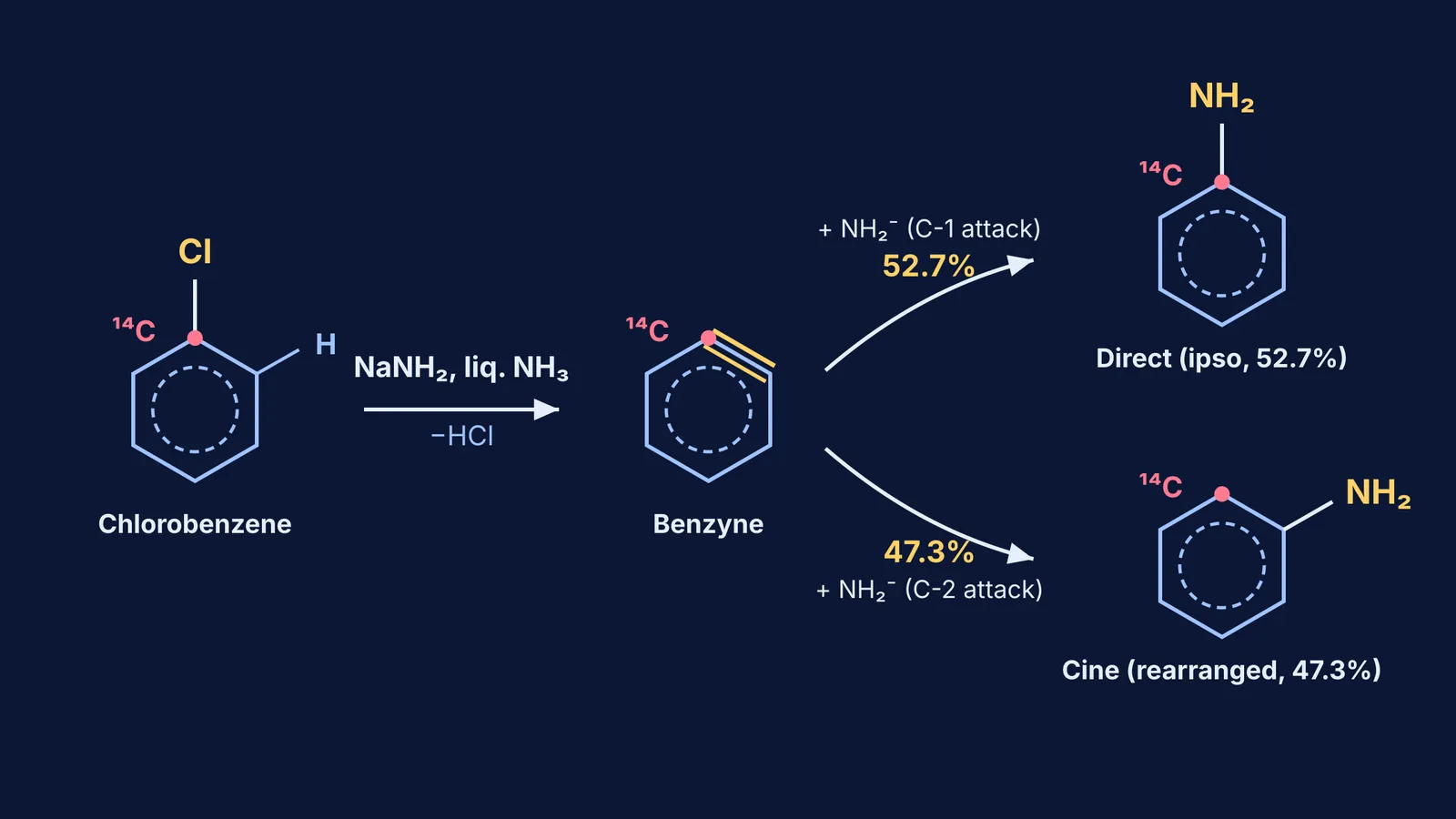
Converting chlorobenzene historically required harsh industrial forcing: the Dow process uses aqueous sodium hydroxide at 623 K and 300 atmospheres, documented by Hale and Britton in Industrial and Engineering Chemistry. Yet when chlorobenzene is treated with sodamide (NaNH₂) in liquid ammonia at −33 °C (240 K), reaction occurs rapidly. The reaction succeeds because sodamide initiates an elimination-addition mechanism via a transient benzyne intermediate.
How does sodamide convert chlorobenzene to benzyne?
Sodamide in liquid ammonia provides the amide anion (NH₂⁻), an exceptionally strong base. As detailed in the IUPAC compendium on arynes, strong bases promote an elimination-addition pathway by abstracting an acidic ring proton ortho to the halogen, rather than attacking the ring carbon directly.
This transformation occurs in two sequential steps:
Elimination: Removing the ortho proton forms an ortho-chlorophenyl carbanion, which ejects chloride to produce benzyne (1,2-didehydrobenzene).
Addition: An amide ion attacks either carbon of the strained triple bond, creating an aryl carbanion that takes a proton from liquid ammonia to complete aniline.
Benzyne retains its aromatic six-pi-electron sextet intact. Its additional formal bond comes from sideways overlap of two sp² hybrid orbitals in the ring plane. Because these orbitals diverge by 120°, overlap is weak and introduces severe ring strain. Georg Wittig first proposed dehydrobenzene in his 1942 study in Die Naturwissenschaften to explain organolithium reactions, recognising that its instability makes benzyne impossible to isolate.
Why does carbon-14 labelled chlorobenzene yield two anilines?
Decisive proof for benzyne came from an isotopic tracer experiment by John D. Roberts and his team at MIT, first reported in the 1953 Journal of the American Chemical Society and detailed in their 1956 follow-up paper.
Roberts prepared chlorobenzene labelled with carbon-14 specifically at C-1, the carbon attached to chlorine. Direct nucleophilic substitution (ipso substitution) would yield 100% 1-¹⁴C-aniline. Instead, chemical degradation of the product revealed:
Direct product (ipso): 52.7% of aniline had the amino group at C-1.
Rearranged product (cine): 47.3% carried the amino group at C-2.
The IUPAC Gold Book defines cine-substitution as entering at a position adjacent to the leaving group. In symmetrical benzyne, amide attack at C-1 or C-2 is nearly equally probable; the slight 52.7:47.3 deviation reflects a small ¹⁴C kinetic isotope effect.
When can you expect the benzyne mechanism in exam problems?
In JEE Advanced, recognise the aryne pathway through three diagnostic signs:
Unactivated ring with strong base: An aryl halide lacking ortho or para nitro groups meets a strong base like NaNH₂ in liquid NH₃ or potassium tert-butoxide.
Ortho hydrogen required: The substrate must have a hydrogen adjacent to halogen; blocked substrates like 2,6-dimethylchlorobenzene do not react.
Regioisomeric mixtures: While routes like reducing nitrobenzene to aniline or protecting aniline by acetylation produce single isomers, benzyne generates isomeric mixtures.
How can you predict regioselectivity in substituted benzynes?
In their 1956 systematic study, Roberts and co-workers demonstrated that substituents direct nucleophilic addition across the aryne bond by controlling which adjacent carbon best stabilises the resulting sp² carbanion:
Alkyl substituents (+I effect): 4-Chlorotoluene forms 4-methylbenzyne (3,4-dehydrotoluene). Amide attack at C-4 gives p-toluidine (38%) while attack at C-3 gives m-toluidine (62%), because the methyl group's inductive donor effect destabilises adjacent negative charge. Similarly, 2-chlorotoluene yields a 45:55 mixture of ortho- and meta-toluidine.
Electron-withdrawing substituents (−I effect): 2-Chloroanisole forms 3-methoxybenzyne. Amide attacks C-3 so negative charge sits at C-2 adjacent to methoxy, whose strong −I inductive pull stabilises the planar sp² carbanion. This yields meta-anisidine almost exclusively (>95%).
When tackling multi-step synthesis, the Fermi Problem Library provides worked problems with a step-by-step solver that explains the reasoning rather than printing an answer. For a clear overview of how electronic effects direct substitutions across aromatic chemistry, the Fermi Concept Library maps every concept across chemistry, each with its own lesson and its place in the map.


