On this page
Board marks in this unit go to naming the mechanism, giving the NCERT reason and writing conditions over every arrow. For JEE, see our JEE Main guide to haloalkanes and haloarenes; this post is about board answers.
How many marks is Haloalkanes and Haloarenes in the Class 12 board exam?
The CBSE Chemistry curriculum for 2026-27 prints Unit 6, Haloalkanes and Haloarenes, at 6 marks out of 70 in the Class XII theory paper. Its question paper design also says no chapter-wise weightage is provided, so treat 6 as a guide.
In the 2026-27 sample paper, the questions on this unit add up to exactly that: Q10 (1 mark) on SN2 and inversion, Q20 (2 marks) on nitro versus methoxy in chlorobenzene, and Q27 (3 marks): a 1-mark IUPAC name, then AgCN versus KCN, or allyl chloride hydrolysis.
Which SN1 and SN2 reasons and reactivity orders come up most?
Most "give reasons" answers in NCERT Unit 6 rest on three ideas:
SN2 is one step with no intermediate. The nucleophile attacks opposite the halogen, so an optically active halide gives inversion of configuration.
SN1 is two steps. The slow step makes a planar carbocation, attacked from either face, so an optically active halide gives racemisation.
Carbocation stability decides SN1; crowding at the carbon decides SN2.
Orders to know cold:
SN1: 3° > 2° > 1°; allylic and benzylic halides are also fast, their carbocations being resonance-stabilised.
SN2: CH3X > 1° > 2° > 3°.
Same alkyl group, either mechanism: R–I > R–Br > R–Cl >> R–F.
Alcohols with a haloacid: 3° > 2° > 1°.
Aryl halides resist nucleophilic substitution for four NCERT reasons: resonance gives the C–Cl bond partial double bond character; the sp2 carbon holds the bond tighter (169 pm in a haloarene against 177 pm in a haloalkane); a phenyl cation is not resonance-stabilised, so SN1 is ruled out; and the electron-rich ring repels the nucleophile. Ortho or para nitro increases reactivity; meta nitro has no effect.
Which named reactions and conversions should you practise?
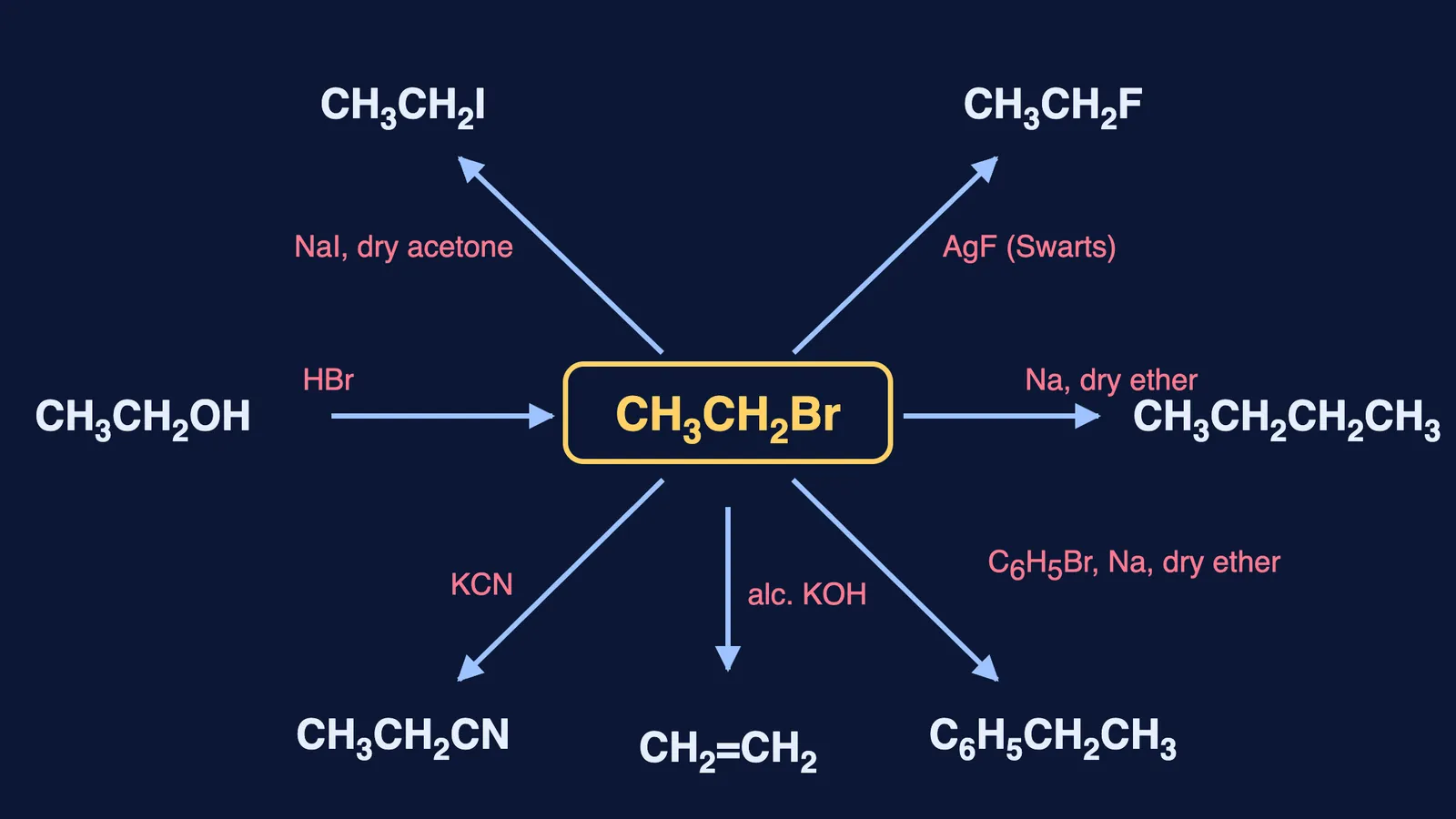
Finkelstein: R–Cl or R–Br with NaI in dry acetone gives R–I; precipitating NaCl or NaBr drives it forward.
Swarts: R–Cl or R–Br heated with a metallic fluoride such as AgF, Hg2F2, CoF2 or SbF3 gives R–F.
Wurtz: an alkyl halide with sodium in dry ether gives a hydrocarbon with double the carbons.
Wurtz-Fittig: alkyl halide plus aryl halide with sodium in dry ether gives an alkylarene.
Two-step chains: benzene to toluene (Cl2 with FeCl3, then CH3Cl and Na in dry ether), ethanol to butane (HBr, then Na in dry ether), ethanol to propanenitrile (SOCl2, then KCN, which adds the third carbon).
Worked example, forward: ethanol to 1,2-dibromoethane in three steps.
CH3CH2OH + SOCl2 gives CH3CH2Cl + SO2 + HCl.
CH3CH2Cl heated with alcoholic KOH gives CH2=CH2 (β-elimination).
CH2=CH2 with Br2 in CCl4 gives BrCH2CH2Br.
The same example, checked backwards: BrCH2CH2Br has bromines on neighbouring carbons, so it is a vic-dibromide from Br2 and ethene. Ethene comes from removing HX from an ethyl halide, which comes from ethanol. It lands on the start at two carbons throughout, so no Wurtz or KCN step belongs. If your backward chain misses the start, a step is wrong.
If you keep choosing the wrong reagent, the Fermi Problem Library has worked problems with a step-by-step solver that explains the reasoning rather than printing an answer.
How do you set out 2-, 3- and 5-mark answers?
The 2026-27 marking scheme shows where marks sit. In Q27(A), each product and each reason earns ½: CH3CH2CH2NC with AgCN (covalent; bonds through nitrogen) and CH3CH2CH2CN with KCN (ionic; free cyanide attacks through carbon). In Q20, naming nitro earns 1 mark and the explanation ½ + ½.
2 marks: the answer in one line, then a reason using the NCERT term (resonance, sp2, carbocation stability).
3 marks: one equation per mark, with conditions.
5 marks: none in the sample paper is from this unit, but Section E questions come in parts (Q31(A), on carbonyl compounds, opens with three 1-mark "account for" items). Label and finish each part in turn.
Where do assertion-reason and case-study questions trap you?
The 2026-27 sample paper has no assertion-reason or case-based question from this unit, so treat these as practice. Options run from "both true, R explains A" to "A false, R true". Traps here:
A true reason that does not explain: "chlorobenzene resists nucleophilic substitution" with "chlorine is more electronegative than carbon". NCERT's reasons are resonance, the sp2 carbon, the unstable phenyl cation and repulsion.
Swapped stereochemistry: racemisation goes with SN1, inversion with SN2.
Our three-check method for assertion-reason questions works here too.
What is a good revision plan for this chapter?
Five days, 45 minutes each:
Preparations, with conditions, from memory.
SN1, SN2, stereochemistry and the four orders.
Haloarenes: the four reasons and the nitro rule.
Named reactions and ten conversions, checked backwards.
Sample paper Q10, Q20 and Q27, timed and marked with the scheme; then polyhalogen uses.
For exam-day timing, see our 20-minute triage plan for a board paper.