On this page
Electromagnetic Waves is a short unit where most questions test one relation, one direction rule or one spectrum fact. Here is the syllabus, the NCERT chapter, three worked examples and a one-week plan.
What does the NEET syllabus include in Electromagnetic Waves?
The NMC NEET (UG)-2026 syllabus lists Electromagnetic Waves as Physics Unit 15: displacement current; electromagnetic waves and their characteristics; the transverse nature of electromagnetic waves; the electromagnetic spectrum (radio waves, microwaves, infrared, visible, ultraviolet, X-rays and gamma rays); and applications of e.m. waves.
The textbook match is Chapter 8 of NCERT Class 12 Physics Part I, marked Reprint 2026-27. Its contents page lists four sections, ending with the spectrum. Nothing in the syllabus is missing from NCERT, and neither has a section on wave intensity or radiation pressure, so older guidebook pages on those go beyond both.
As in NEET-UG 2026, the NTA information bulletin set 45 physics questions out of 180, all multiple choice with four options and a single correct answer, in 180 minutes, marked +4 for a correct answer, −1 for a wrong one and 0 for a blank. That is about a minute a question.
Which formulas do you need for NEET Electromagnetic Waves?
Displacement current: id = ε0 dΦE/dt. Between capacitor plates it equals the conduction current in the wires.
Field amplitudes: E0 = cB0, with E, B and the direction of travel mutually perpendicular and E × B along the direction of travel.
Speed: c = 1/√(μ0ε0) in vacuum, and v = 1/√(με) in a medium. Take c = 3 × 10⁸ m/s (NIST: exactly 299 792 458 m/s).
Wave relations: c = νλ, k = 2π/λ, ω = 2πν.
Worked examples
Example 1, displacement current. Circular plates of radius 3.0 cm sit 0.80 mm apart in air, and the voltage across them rises at 4.0 × 10⁸ V/s. C = ε0πR²/d ≈ 31.3 pF. Then id = C dV/dt ≈ 12.5 mA, the same as the current in the leads. At the plate edge, B = μ0id/(2πR) ≈ 8.3 × 10⁻⁸ T. Inside, B grows as r; outside, it falls as 1/r, so B at r = 1.5 cm and at 6.0 cm is the same, about 4.2 × 10⁻⁸ T.
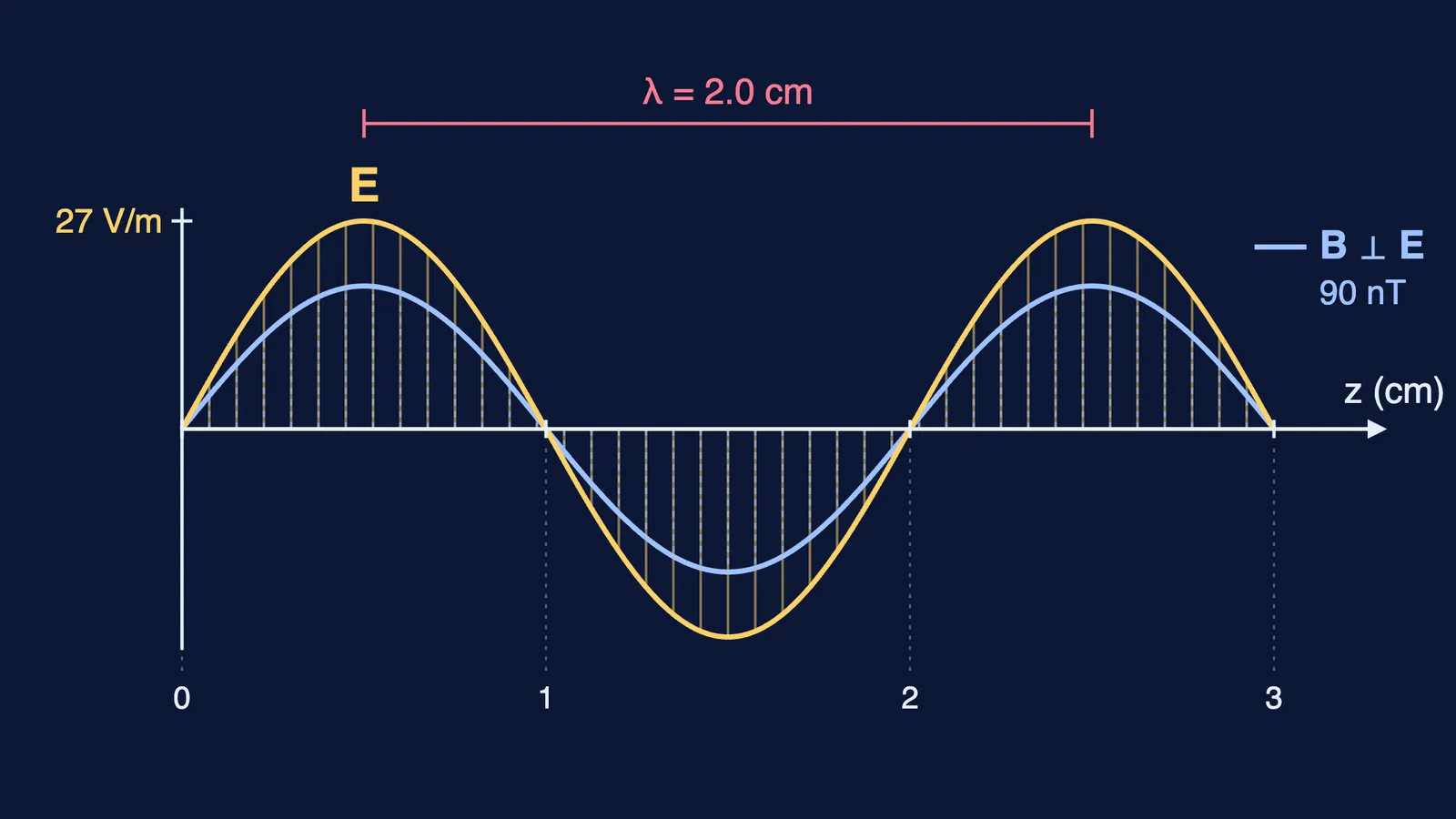
Example 2, fields and direction. A 15 GHz wave travels along +z in vacuum, with E0 = 27 V/m. B0 = E0/c = 9.0 × 10⁻⁸ T, or 90 nT; λ = c/ν = 2.0 cm. At an instant when E points along +y, B must point along −x, because ŷ × (−x̂) = +ẑ. In glass with εr = 2.25 and μr = 1, v = c/1.5 = 2.0 × 10⁸ m/s; the frequency stays 15 GHz and λ shrinks to about 1.33 cm. The diagram above plots it.
Example 3, naming the band, with λ = c/ν and NCERT's Table 8.1. At 2.5 × 10¹³ Hz, λ = 12 μm, infrared (physical therapy lamps, TV remotes). At 1.0 × 10¹⁵ Hz, λ = 300 nm, ultraviolet (germ-killing lamps in water purifiers). At 6.0 × 10¹⁸ Hz, λ = 0.05 nm, X-rays (medical diagnosis).
Stuck on a step? The Fermi Problem Library has worked problems with a step-by-step solver that explains the reasoning rather than printing an answer.
What are the common traps in NEET Electromagnetic Waves?
Thinking no current flows between capacitor plates: the displacement current there equals the conduction current.
Writing B0 = cE0 instead of E0 = cB0.
Changing frequency in a medium: only speed and wavelength drop.
Mixing up the order. By decreasing wavelength: radio, microwave, infrared, visible, ultraviolet, X-rays, gamma rays.
Treating band edges as sharp. NCERT's text and table give slightly different edges for ultraviolet and X-rays, so learn Table 8.1.
Matching uses wrongly: radar and ovens use microwaves; LASIK and water purifiers use ultraviolet; the greenhouse effect involves infrared.
If perpendicular E and B fields are hard to picture, the Fermi Simulation Lab has interactive simulations for the ideas that are easier to see than to read.
A seven-day plan for Electromagnetic Waves
Day 1: NCERT 8.1-8.2; derive id from the charging capacitor.
Day 2: section 8.3; drill the E × B rule with five orientations.
Day 3: v = 1/√(με) and c = νλ; ten quick numericals.
Day 4: write Table 8.1 from memory, one use per band.
Day 5: 15 mixed MCQs in 15 minutes; log every error.
Day 6: redo the errors, then the quick check below.
Day 7: move to Optics, where v = c/n carries over.
Quick check:
A wave in vacuum has B0 = 35 nT. What is E0?
What is the speed of light in a non-magnetic medium with εr = 6.25?
Which band contains a wavelength of 0.40 mm?
Answers: 1. 10.5 V/m. 2. 1.2 × 10⁸ m/s. 3. Infrared (1 mm to 700 nm).
Next, read our Optics for NEET guide. For harder numericals, see Electromagnetic Waves for JEE Main, or NEET physics for students who are strong in biology.