On this page
In Optics, one sign slip turns a right method into a wrong option, but the formulas are few. Here is what the syllabus lists, where it sits in NCERT, and how to practise for a paper that rewards speed.
What does the NEET syllabus include in Optics?
The NMC syllabus for NEET-UG 2026 lists Optics as Unit 16. Its ray-optics part covers reflection, spherical mirrors and the mirror formula; refraction at plane and spherical surfaces, the thin lens formula and the lens maker formula; total internal reflection and its applications; magnification, power of a lens and thin lenses in contact; refraction through a prism; and the microscope and astronomical telescope (reflecting and refracting) with their magnifying powers.
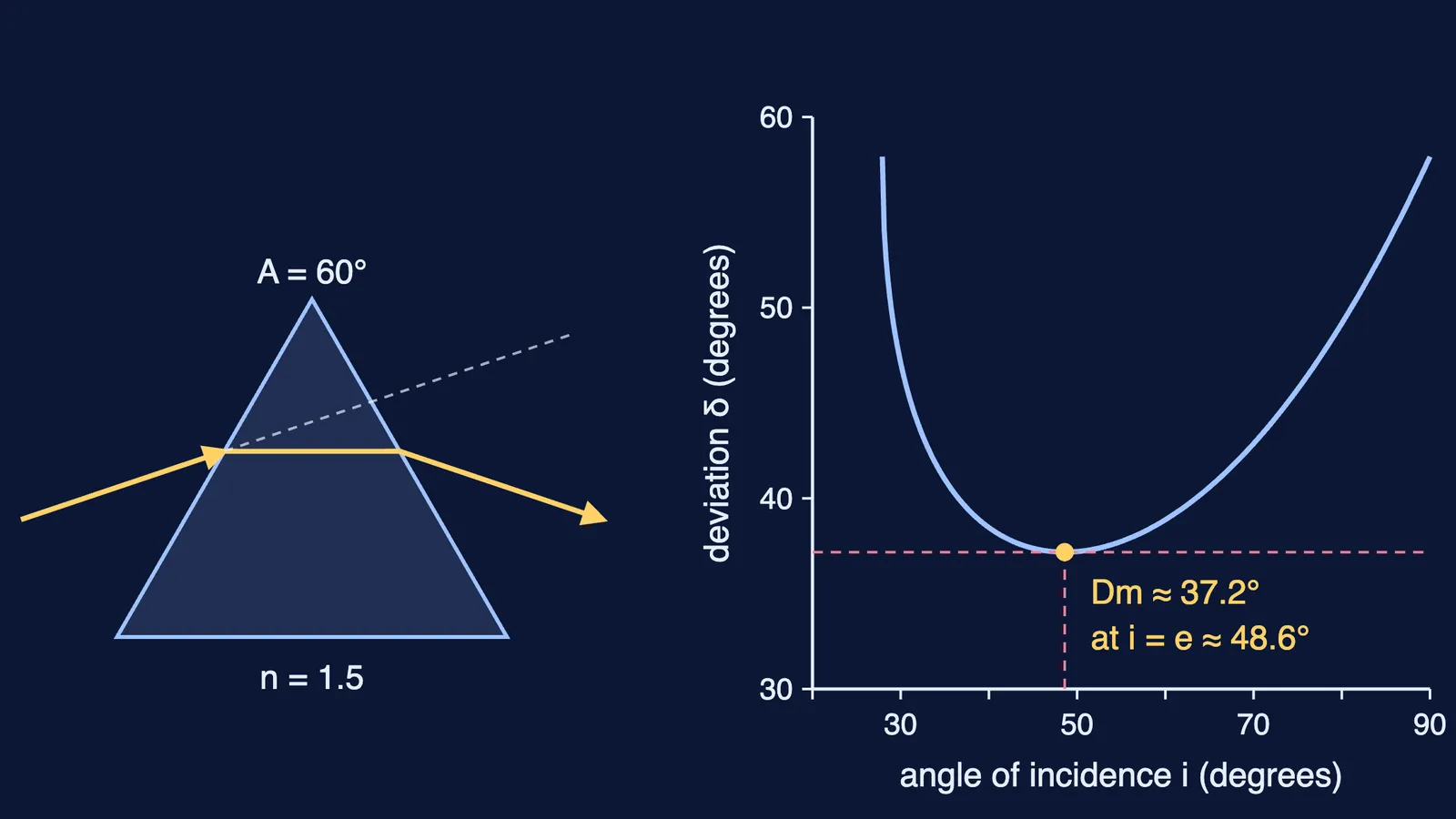
Its wave-optics part covers wavefronts and Huygens' principle, reflection and refraction using Huygens' principle, interference and Young's double-slit experiment with the fringe-width expression, coherent sources and sustained interference, single-slit diffraction and the width of the central maximum, and polarisation, including Brewster's law and Polaroids. Experimental Skills adds focal lengths by parallax and the prism's deviation-incidence plot.
Which NCERT chapters cover NEET Optics?
In the 2026-27 NCERT Class 12 Physics Part II, the unit maps to Chapter 9, Ray Optics and Optical Instruments, and Chapter 10, Wave Optics.
How are Optics questions asked in NEET?
As in NEET-UG 2026, expect 45 physics questions out of 180, all multiple choice with four options and a single correct answer, in a 180-minute paper. The NTA information bulletin gives +4 for a correct answer, −1 for a wrong one and 0 for one left blank. At about a minute per question, practise three forms: a formula with a sign trap, a ratio, or a statement to judge.
Worked examples
1. Lens, then lenses in contact
A convex lens has f = +20 cm and an object sits 30 cm in front (u = −30 cm). From 1/v − 1/u = 1/f, 1/v = 1/20 − 1/30 = 1/60, so v = +60 cm and m = v/u = −2: real, inverted, twice the size. Add a concave lens of f = −60 cm in contact. Powers add: P = 100/20 − 100/60 = 5 − 1.67 = +3.33 D, so f = +30 cm. The object is now at the focus and the image goes to infinity.
2. Critical angle depends on the outside medium
Glass of n = 1.6 sits in water (n = 4/3). sin c = (4/3)/1.6 = 0.833, so c ≈ 56.4°. In air the same glass gives sin c = 1/1.6, so c ≈ 38.7°. A ray meeting the face at 45° is totally reflected in air but escapes in water.
3. Fringe width and central maximum
Light of 600 nm, slits d = 0.3 mm apart, screen D = 1.5 m away: fringe width β = λD/d = (600 × 10⁻⁹ × 1.5)/(0.3 × 10⁻³) = 3.0 mm. Fill the apparatus with water (n = 4/3) and the wavelength drops by n, so β = 2.25 mm. With one slit 0.12 mm wide instead, the central maximum is 2λD/a = 15 mm wide.
Stuck on a step? The Fermi Problem Library has worked problems with a step-by-step solver that explains the reasoning rather than printing an answer.
What are the common traps in NEET Optics?
Mixing sign conventions: use the Cartesian convention throughout, and remember mirror magnification is −v/u while lens magnification is v/u.
Forgetting that power needs focal length in metres.
Taking the critical angle against air when the block sits in a liquid.
Forgetting that fringe width shrinks by n when the set-up is immersed.
Forgetting the single-slit central maximum is twice as wide as the others.
If ray paths are hard to picture, the Fermi Simulation Lab has interactive simulations for the ideas that are easier to see than to read.
A two-week practice plan
Days 1-3: mirrors, refraction and TIR; derive the mirror and lens formulas once.
Days 4-5: lens maker formula, power, lenses in contact; ten sign-convention MCQs daily.
Days 6-7: prism and instruments; sketch the deviation curve from memory.
Days 8-10: Chapter 10 line by line, plus Brewster's law; write ten true/false statements.
Days 11-12: 20 mixed MCQs in 20 minutes; log every sign or unit error.
Days 13-14: redo the logged errors, then one more timed set.
Quick check (answers below):
A concave mirror has a focal length of 15 cm, and an object stands 10 cm from it. Where is the image?
Lenses of +10 D and −4 D are in contact. What is the focal length?
In a double-slit set-up, 600 nm light is replaced by 450 nm. By what factor does the fringe width change?
Answers: 1. v = +30 cm, behind the mirror, virtual and three times larger. 2. f ≈ 16.7 cm. 3. 0.75 times.
For the JEE angle, see how to prepare Ray Optics for JEE Main; for boards, the Class 12 Ray Optics board-exam guide and the Class 12 Wave Optics board-exam guide.