On this page
This unit rewards two habits: matching each mixture to a technique, and running the estimation formulas without slips.
What does the NEET-UG syllabus include in this unit?
In the NMC NEET (UG)-2026 syllabus (notified 22 December 2025), Purification and Characterisation of Organic Compounds is Unit 13, the first unit of Organic Chemistry. It lists:
Purification: crystallisation, sublimation, distillation, differential extraction and chromatography, with their principles and applications.
Qualitative analysis: detection of nitrogen, sulphur, phosphorus and halogens.
Quantitative analysis (basic principles only): estimation of carbon, hydrogen, nitrogen, halogens, sulphur and phosphorus.
Calculations: empirical and molecular formulae, and numerical problems in organic quantitative analysis.
All of it sits in NCERT Class 11 Chemistry, Unit 8 Organic Chemistry: Some Basic Principles and Techniques (Reprint 2026-27), sections 8.8 to 8.10. Nothing has been cut: the 2026-27 reprint keeps the Dumas, Kjeldahl and Carius methods. It also covers oxygen (8.10.6), which the NMC list does not name.
How should you practise it for NEET?
As in NEET-UG 2026, the NTA information bulletin sets 180 compulsory multiple-choice questions in 180 minutes, 45 of them in Chemistry, each with four options and a single correct or best answer, marked +4, −1 for a wrong answer and 0 if left blank. That is about a minute a question, so:
Make a one-page table: technique, what it separates, one NCERT example (glycerol from spent-lye by reduced-pressure distillation; aniline from water by steam distillation).
Write each estimation formula from the atom it tracks: 28 g N2 in 22400 mL at STP, 80 g Br in 188 g AgBr, 32 g S in 233 g BaSO4.
Three worked examples, solved the NEET way
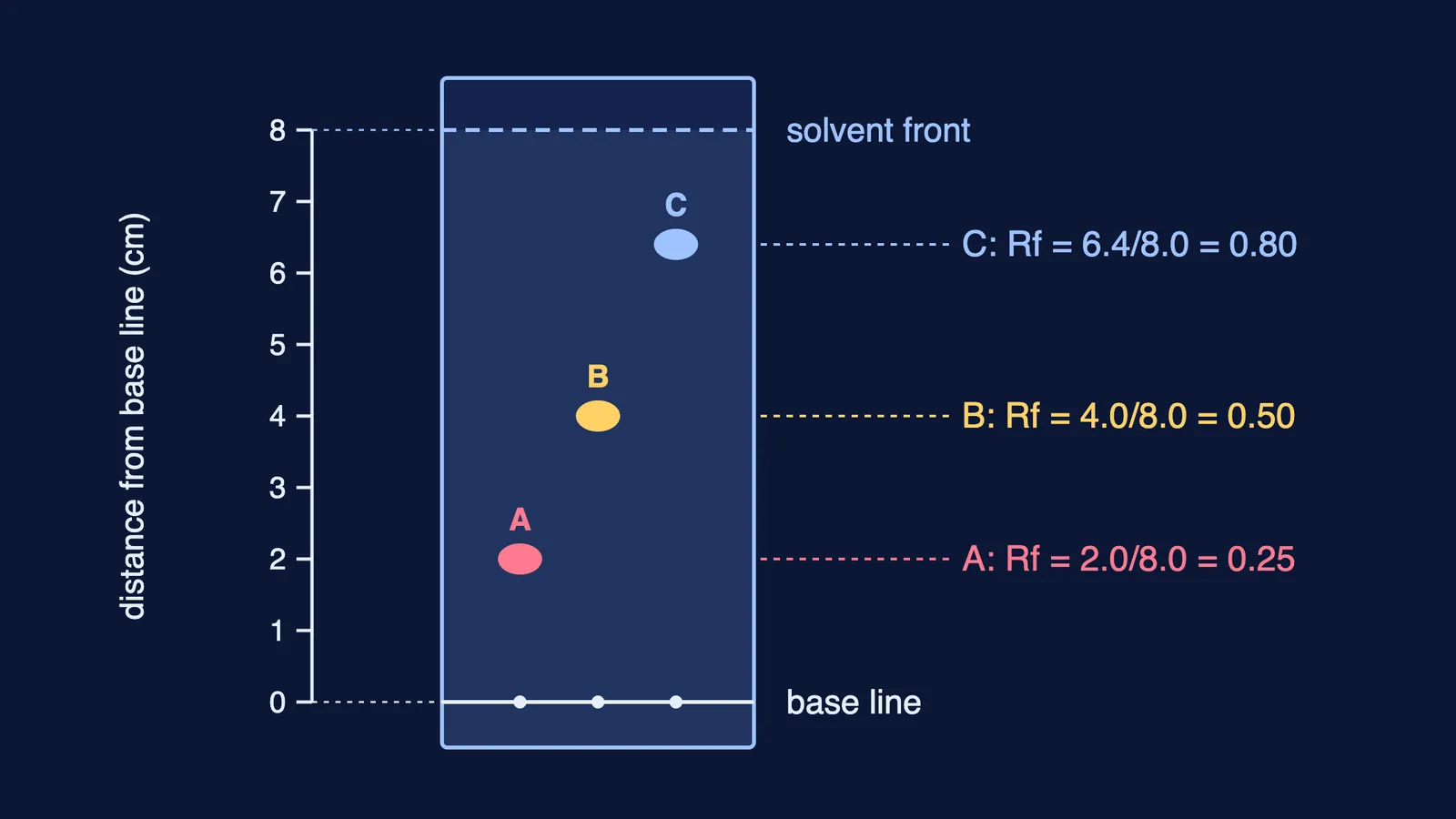
Example 1 (reading a TLC plate). On a silica plate the solvent front is 8.0 cm above the base line. Spots A, B and C sit at 2.0, 4.0 and 6.4 cm. Find each Rf value and the most strongly adsorbed compound.
Rf = distance moved by the substance ÷ distance moved by the solvent, both from the base line. A: 2.0/8.0 = 0.25. B: 4.0/8.0 = 0.50. C: 6.4/8.0 = 0.80. A has the lowest Rf, so it is held most strongly by the adsorbent. If the front travels only 6.0 cm under the same conditions, B appears about 3.0 cm up.
Example 2 (Dumas method). 0.250 g of a compound gives 40.0 mL of nitrogen, collected over aqueous KOH at 290 K and 750 mm Hg. Aqueous tension at 290 K is 14 mm Hg. Find the percentage of nitrogen.
Dry-gas pressure: 750 − 14 = 736 mm. Volume at STP: (736 × 40.0 × 273)/(760 × 290) = 36.47 mL. Percentage of nitrogen: (28 × 36.47 × 100)/(22400 × 0.250) ≈ 18.2%.
Example 3 (Kjeldahl's method). Ammonia from 0.400 g of a compound is passed into 40 mL of 0.50 M H2SO4. The leftover acid needs 30 mL of 1.0 M NaOH. Find the percentage of nitrogen.
Acid taken: 0.040 × 0.50 = 0.020 mol. NaOH: 0.030 mol, neutralising 0.015 mol H2SO4. Acid used by ammonia: 0.005 mol, so ammonia = 0.010 mol (two NH3 per H2SO4). Nitrogen: 0.010 × 14 = 0.14 g, or 35.0%.
What are the common traps?
Kjeldahl's limits. NCERT says it does not work for nitrogen in nitro or azo groups or in a ring, as in pyridine. Use Dumas there.
Forgetting aqueous tension. Nitrogen collected over aqueous KOH is moist; subtract the aqueous tension first.
Two-to-one. One H2SO4 takes two NH3.
Blood red, not Prussian blue. When nitrogen and sulphur are both present, sodium fusion can give sodium thiocyanate, which turns blood red with iron(III) instead of giving Prussian blue.
Halogen test order. If nitrogen or sulphur is also present, boil the extract with concentrated nitric acid first; otherwise cyanide or sulphide interferes with the silver nitrate test.
Stuck on a step? The Fermi Problem Library has worked problems with a step-by-step solver that explains the reasoning rather than printing an answer.
A seven-day practice plan
Day 1: sublimation, crystallisation, the four kinds of distillation.
Day 2: extraction and chromatography; Rf sums.
Day 3: Lassaigne's test, element by element, with colours.
Day 4: carbon, hydrogen and Dumas nitrogen.
Day 5: Kjeldahl, Carius halogen and sulphur, phosphorus.
Day 6: empirical and molecular formulae from percentages.
Day 7: 20 mixed questions, a minute each; name the trap behind every miss.
Try these in five minutes:
In a Carius estimation, 0.240 g of a compound gives 0.376 g of AgBr. What is the percentage of bromine?
0.300 g of a compound gives 0.466 g of BaSO4. What is the percentage of sulphur?
Two miscible liquids boil at 353 K and 363 K. Simple or fractional distillation?
Can Kjeldahl's method estimate the nitrogen in nitrobenzene?
Answers: 1. 66.67%. 2. 21.33%. 3. Fractional; the boiling points are close. 4. No; use Dumas.
Rusty on empirical formulae? Start with Some Basic Concepts of Chemistry for NEET. Sitting JEE Main too? See our purification and characterisation guide for JEE Main. For boards, read the Class 11 organic chemistry basic principles guide.