On this page
Some Basic Concepts in Chemistry is the first chemistry unit in the NEET-UG syllabus, and most physical chemistry numericals lean on it. Fast gram-to-mole conversion speeds up later units.
What does the NEET syllabus include in Some Basic Concepts in Chemistry?
The NMC syllabus for NEET-UG 2026 lists Unit I as: matter and its nature; Dalton's atomic theory and the concepts of atom, molecule, element and compound; laws of chemical combination; atomic and molecular masses, mole concept, molar mass, percentage composition, empirical and molecular formulae; chemical equations and stoichiometry. Before NEET 2027, check the NMC website for any later version.
In the current 2026-27 reprint, all of this sits in Unit 1 of NCERT Class 11 Chemistry Part I. NCERT has not dropped any topic the NMC list names. Three mapping notes:
Limiting reagent is not named in the NMC list, but NCERT teaches it as section 1.10.1 inside stoichiometry, so treat it as in scope.
NCERT's Unit 1 also teaches concentration terms (mole fraction, molarity, molality), which the NMC list places under Unit 5, Solutions. Learn them here, revise them there.
NCERT opens with measurement, SI units and significant figures, which the NMC list for this unit does not name. Skim them; spend your time on moles.
One mole contains exactly 6.02214076 × 10²³ elementary entities (NCERT Unit 1); 6.022 × 10²³ is enough for NEET.
How is this unit tested in NEET-UG?
As in NEET-UG 2026, every question is a single-correct MCQ with four options: 180 questions in 180 minutes, +4 for a correct answer and −1 for a wrong one (NTA information bulletin). That is about a minute per question, with no numerical-value section, so use the options. More in our guide to the NEET-UG paper pattern.
Expect short calculations, NCERT-statement questions on laws and definitions, and assertion-reason pairs.
Three worked examples in NEET style
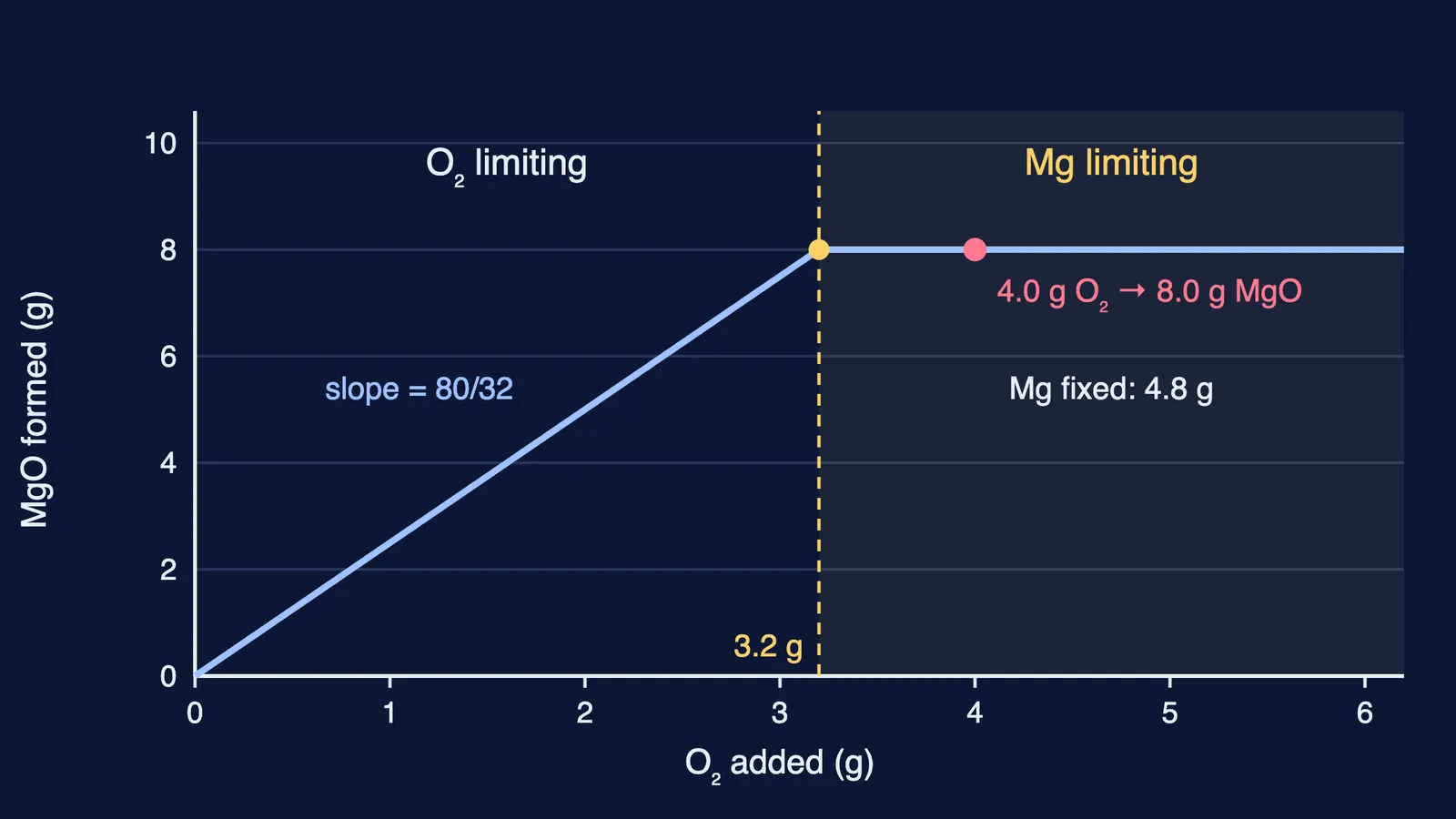
Example 1: limiting reagent. 4.8 g of Mg is burnt in 4.0 g of O₂ (Mg = 24, O = 16). How much MgO forms?
Write the balanced equation: 2Mg + O₂ → 2MgO.
Moles: Mg = 4.8/24 = 0.20 mol; O₂ = 4.0/32 = 0.125 mol.
0.20 mol Mg needs only 0.10 mol O₂, so Mg is the limiting reagent.
MgO = 0.20 mol × 40 g mol⁻¹ = 8.0 g. Left over: 0.025 mol O₂, which is 0.8 g.
The diagram above shows it: MgO rises with O₂ until 3.2 g, then stays flat at 8.0 g.
Example 2: empirical and molecular formula. A compound is 50.0% C, 5.6% H and 44.4% O by mass, and its molar mass is 144 g mol⁻¹.
Take 100 g: C = 50.0/12 = 4.17 mol; H = 5.6/1 = 5.6 mol; O = 44.4/16 = 2.775 mol.
Divide by the smallest (2.775): C : H : O = 1.5 : 2 : 1. Double it to get whole numbers: 3 : 4 : 2, so the empirical formula is C₃H₄O₂ (72 g mol⁻¹).
n = 144/72 = 2, so the molecular formula is C₆H₈O₄.
Speed check: eliminate any option whose formula mass is not a multiple of 72.
Example 3: counting atoms. How many oxygen atoms are in 5.4 g of N₂O₅ (N = 14, O = 16)? Moles of N₂O₅ = 5.4/108 = 0.05 mol, and each molecule has five O atoms, so O atoms = 0.25 × 6.022 × 10²³ = 1.51 × 10²³. The option 3.01 × 10²² is the trap: it counts molecules, not atoms.
What are the common traps in mole concept questions?
Using an unbalanced equation, so every mole ratio after it is wrong.
Picking the limiting reagent by smaller mass instead of moles divided by the coefficient.
Counting molecules when the question asks for atoms or ions.
Rounding mole ratios too early in formula questions: 1.5 means double everything, not round to 2.
Stuck on a step? The Fermi Problem Library has worked problems with a step-by-step solver that explains the reasoning rather than printing an answer.
How should you practise this unit for NEET?
A two-week plan:
Days 1-2: read NCERT Unit 1 closely, including the box on balancing equations. Write each law in one line.
Days 3-5: solve the in-text problems on molar mass, mass per cent and formulae before reading the solutions.
Days 6-8: limiting reagent and stoichiometry, always balancing first and dividing moles by coefficients.
Days 9-11: timed MCQ sets at the one-minute pace worked out above.
Days 12-14: redo every wrong question from scratch.
Try these three (answers at the end):
4.0 g of H₂ reacts with 24 g of O₂ to form water. What mass of water forms?
What is the mass per cent of nitrogen in glycine, C₂H₅NO₂?
A hydrocarbon has the empirical formula C₂H₅ and a molar mass of 58 g mol⁻¹. What is its molecular formula?
Preparing for JEE Main too? Our mole concept guide for JEE Main covers its numerical-value questions, and the Class 11 board guide to this chapter helps with written answers.
Answers: 1. 27 g (O₂ is limiting). 2. 18.7%. 3. C₄H₁₀.