On this page
Some Basic Concepts of Chemistry is Unit 1 of NCERT's Class 11 Chemistry Part I. This guide covers the CBSE school exam: what the 2026-27 curriculum asks, two board-layout numericals and practice questions. For the entrance exam, our mole concept guide for JEE Main covers that syllabus separately.
How many marks is Some Basic Concepts of Chemistry in Class 11?
The CBSE Chemistry curriculum for 2026-27 gives Unit 1 7 marks out of 70 in the Class XI theory paper.
Its topic list runs from the nature and measurement of matter, uncertainty in measurement and the laws of chemical combination to Dalton's atomic theory, atomic and molecular masses, the mole, percentage composition and stoichiometric calculations.
A note in the curriculum lists two topics, s- and p-block elements and the gaseous state, that stay in the syllabus but are assessed only formatively, without adding to summative assessments. Unit 1 is not one of them.
What does the rationalised NCERT chapter cover?
The current NCERT chapter (Reprint 2026-27) is the text to study. Its main ideas:
SI units, density, significant figures and dimensional analysis.
The laws of chemical combination and Dalton's atomic theory.
Atomic mass on the carbon-12 scale, where one atomic mass unit is one-twelfth of the mass of a carbon-12 atom.
The mole: one mole contains exactly 6.02214076 × 10²³ elementary entities, per the NCERT chapter.
Percentage composition, and empirical and molecular formulae.
Stoichiometry, the limiting reagent, and concentration: molarity, molality, mass per cent and mole fraction.
NCERT treats concentration under reactions in solutions; you will use it again in the Class 12 Solutions chapter.
How do you solve a limiting reagent numerical in board style?
Write Given, Equation, Working and Answer, with units on every line. The limiting reagent is the reactant used up first, as the NCERT chapter defines it.
Example 1. 6.00 g of H₂ reacts with 32.0 g of O₂. Find the limiting reagent, the water formed and the reactant left. (H = 1.008, O = 16.00)
Equation: 2H₂ + O₂ → 2H₂O.
Moles: H₂ = 6.00 ÷ 2.016 = 2.976 mol; O₂ = 32.0 ÷ 32.00 = 1.000 mol.
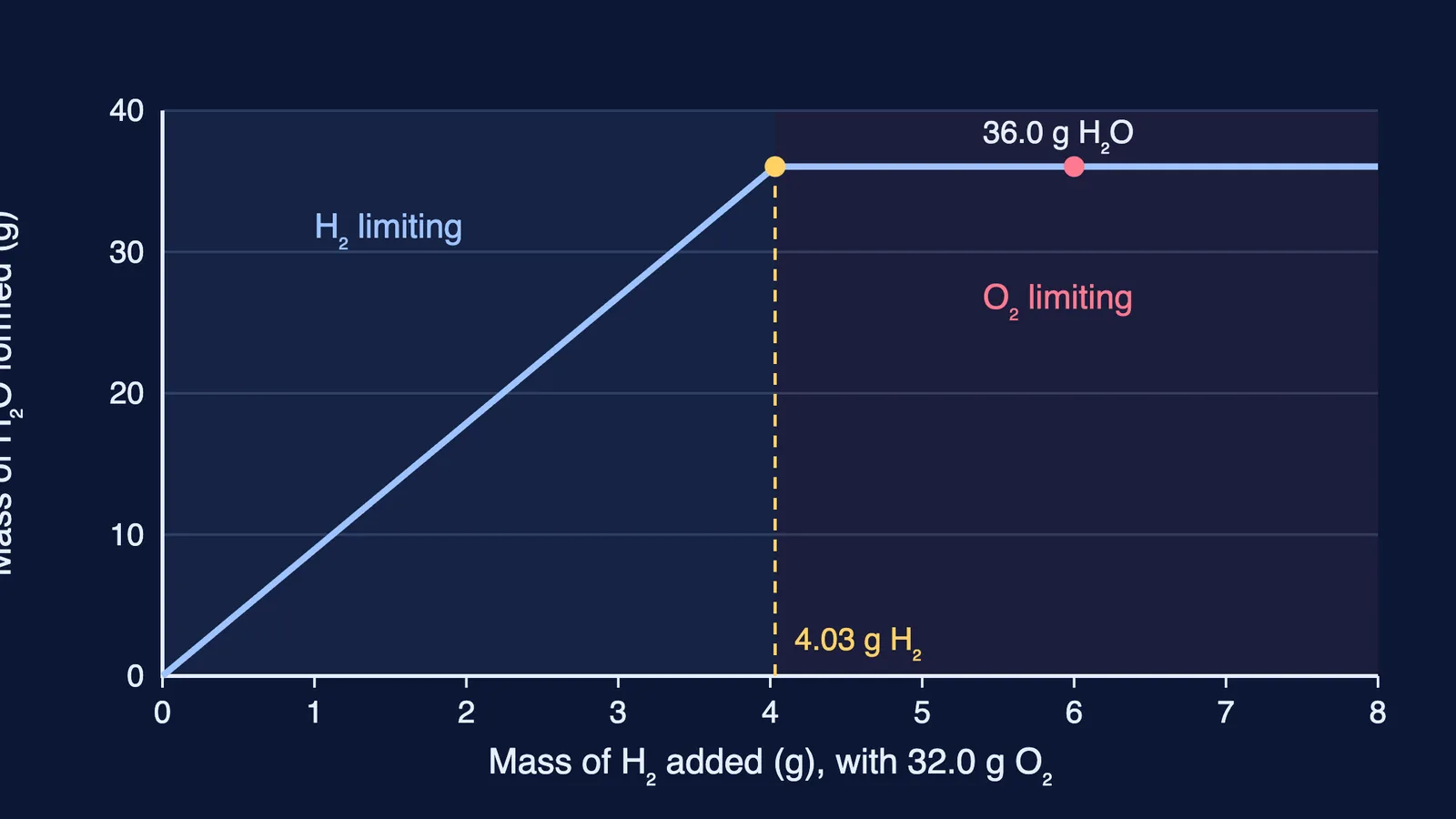
Divide by coefficients: H₂ 2.976 ÷ 2 = 1.488; O₂ 1.000 ÷ 1 = 1.000. O₂ is smaller, so O₂ is the limiting reagent.
Water: 1.000 mol O₂ gives 2.000 mol H₂O = 2.000 × 18.016 = 36.0 g.
H₂ used = 2.000 mol, so H₂ left = 0.976 mol × 2.016 = 1.97 g.
Check: 6.00 + 32.0 = 38.0 g in; 36.0 + 1.97 = 38.0 g out.
The graph above shows this: with 32.0 g of O₂, water stops rising at 4.03 g of H₂, holding at 36.0 g.
How do you express concentration: molarity, molality, mole fraction?
The NCERT chapter defines molarity per litre of solution and molality per kilogram of solvent.
Example 2. An aqueous solution of urea, CO(NH₂)₂, is 0.500 m. Its density is 1.006 g mL⁻¹ (given). Find the molarity, mole fraction of urea and mass per cent. Take urea = 60.0 g mol⁻¹ and H₂O = 18.0 g mol⁻¹.
Take 1.000 kg of water: it holds 0.500 mol urea = 30.0 g.
Mass of solution = 1000.0 + 30.0 = 1030.0 g.
Volume = 1030.0 g ÷ 1.006 g mL⁻¹ = 1023.9 mL, so molarity = 0.500 mol ÷ 1.0239 L = 0.488 M.
Moles of water = 1000.0 ÷ 18.0 = 55.56 mol, so mole fraction of urea = 0.500 ÷ 56.06 = 0.00892.
Mass per cent = 30.0 ÷ 1030.0 × 100 = 2.91 per cent.
What board-style questions should you practise?
These are our own questions; the mark labels are our suggestion, not CBSE's.
(1 mark) Why does molality not change with temperature? Answer: it uses solvent mass, which temperature does not change.
(2 marks) State the number of significant figures in 0.04060 and in 3.00 × 10⁴. Answer: four and three.
(3 marks) A hydrocarbon has 85.6 per cent carbon and 14.4 per cent hydrogen by mass, and molar mass 56.1 g mol⁻¹. Find its empirical and molecular formulae. (C = 12.01, H = 1.008) Answer: CH₂ and C₄H₈.
(5 marks) 3.00 g of Mg is heated in 1.00 g of N₂: 3Mg + N₂ → Mg₃N₂. Find the limiting reagent, the mass of Mg₃N₂ formed and the mass of excess reactant left. (Mg = 24.31, N = 14.01) Answer: N₂ is limiting; 3.60 g Mg₃N₂; 0.397 g Mg left.
Which mistakes cost marks in this chapter?
Calling the reactant with the smaller mass limiting, instead of comparing moles divided by coefficients.
Swapping the bases: molality is per kilogram of solvent, molarity per litre of solution.
Dropping significant figures: 32.0 g has three, so the answer should carry three.
Skipping the mass check: products plus leftover reactant must equal the mass you started with.
If you are unsure where to start revising, Fermi's AI tutor can work out what you already know and build a plan for the session, so you sit down to a clear next step. Tonight, cover Example 1's working and solve it again.