On this page
Solutions, the first unit of Class 12 Chemistry, rewards neat, complete working more than tricks. This guide covers the CBSE board paper: how marks are awarded, one numerical you can check yourself, and the reasons that keep coming back. For JEE, our guide on how to prepare Solutions for JEE Main covers the speed side.
How many marks is Solutions in the CBSE Class 12 board exam?
In the CBSE Chemistry curriculum for 2026-27, Solutions carries 7 of the 70 theory marks, printed in its own row of the Class XII table. The same document says there is no chapter-wise weightage in the paper, so treat 7 as a guide to effort.
The 2026-27 sample question paper has 33 questions in five sections, from 1-mark MCQs to 5-mark long answers. Log tables and calculators are not allowed, so practise every number by hand.
The syllabus follows NCERT Chemistry Part I, Unit 1 (Reprint 2026-27): concentration terms, Henry's law, Raoult's law, ideal and non-ideal solutions, colligative properties and van't Hoff factor.
How should you set out 2-, 3- and 5-mark answers?
The 2026-27 marking scheme splits numericals into half marks: formula, substitution, working, and answer with unit. A bare answer risks most of the credit.
2 marks: formula, substitution, answer with unit. For a reason, write the observation, then the interaction behind it.
3 marks: often a 2-mark calculation plus a 1-mark reason, as labelled parts.
5 marks: several short parts stacked (two to five in the sample paper). Write each formula before any numbers; box each answer.
See setting out CBSE chemistry numericals step by step for other units.
Worked example: freezing point of a glycol solution, done twice
Question: 6.2 g of ethylene glycol (C2H6O2, molar mass 62 g/mol) is dissolved in 250 g of water. Find the depression in freezing point. Kf for water is 1.86 K kg/mol, the value in NCERT Table 1.3.
Pass 1, forward.
Moles of solute = 6.2 / 62 = 0.1 mol.
Molality, m = 0.1 / 0.250 kg = 0.4 mol/kg. Use kilograms of solvent, not of solution.
ΔTf = Kf × m = 1.86 × 0.4 = 0.744 K.
Pass 2, an independent check. Work backwards to the molar mass with the NCERT form M2 = (Kf × w2 × 1000) / (ΔTf × w1).
Denominator: 0.744 × 250 = 186.
Notice 186 = 100 × 1.86, so the Kf cancels.
M2 = (6.2 × 1000) / 100 = 62 g/mol, which matches the formula C2H6O2.
If the passes disagree, check grams versus kilograms first.
Raoult's law and the reasons for deviations
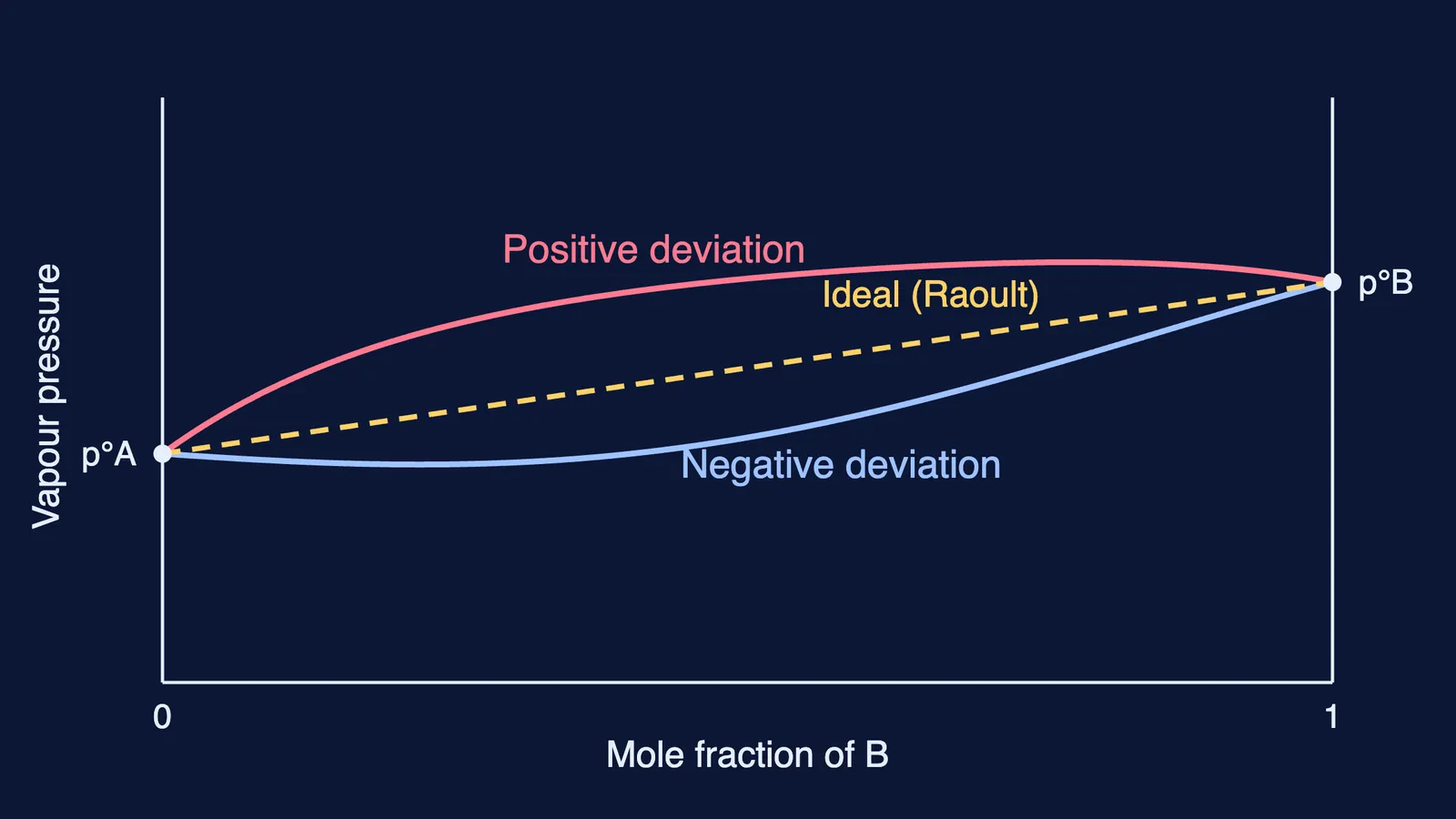
NCERT gives Raoult's law for a mixture of volatile liquids: each liquid's vapour pressure over the mixture equals its pure vapour pressure times its mole fraction, p1 = p1° x1. An ideal solution obeys it at every composition, with zero enthalpy and volume change on mixing.
Positive deviation: A-B attractions are weaker than A-A or B-B, so molecules escape more easily and vapour pressure is higher. Examples: ethanol + acetone (acetone breaks hydrogen bonds in ethanol), acetone + carbon disulphide.
Negative deviation: A-B attractions are stronger, so vapour pressure falls. Examples: phenol + aniline, chloroform + acetone (hydrogen bonded to each other).
Azeotropes: large positive deviation gives a minimum boiling azeotrope (ethanol-water near 95% ethanol by volume); large negative deviation gives a maximum boiling one (nitric acid about 68% by mass). Neither can be separated by fractional distillation.
The marking scheme links this to volume: acetone + carbon disulphide comes out slightly more than the sum, acetone + chloroform slightly less.
Assertion-reason and case-study traps
Section A of the sample paper ends with four assertion-reason questions. Judge each statement alone, then ask whether R explains A; see our three-check method for assertion-reason questions.
"Chloroform and acetone show positive deviation." False: they show negative deviation.
"An azeotrope can be separated by fractional distillation." False: liquid and vapour have the same composition.
A true R about a different property does not explain A.
Case data on salts: find i before comparing.
Osmotic pressure, Π = CRT, uses molarity; boiling and freezing formulas use molality.
A seven-day revision plan for Solutions
Day 1: concentration terms. Convert a mass percentage into molality and mole fraction.
Day 2: Henry's law and NCERT intext questions 1.6 and 1.7.
Day 3: Raoult's law and deviations. Draw the three curves from memory with a reason each.
Day 4: relative lowering of vapour pressure and boiling point elevation, by hand.
Day 5: freezing point depression and osmotic pressure. Redo the example with 12.4 g glycol.
Day 6: van't Hoff factor; association gives i below 1, dissociation above 1.
Day 7: the sample paper's Solutions questions, timed, marked against the scheme.
When a step goes wrong and you cannot see why, the Fermi Problem Library has worked problems with a step-by-step solver that explains the reasoning rather than printing an answer. Tonight, do one numerical twice and see if both passes agree.