On this page
Electromagnetic Waves is a short unit where most questions reward one clean idea or one careful calculation. Here is the syllabus, four relations, worked numbers and a seven-day plan.
What does the JEE Main 2027 syllabus include in Electromagnetic Waves?
The NTA's Syllabus for JEE (Main) - 2027 lists Physics Unit 15, "Electromagnetic Waves": displacement current, electromagnetic waves and their characteristics, their transverse nature, the spectrum from radio waves to gamma rays, and applications.
The textbook match is Chapter 8 of NCERT Class 12 Physics Part 1 (Reprint 2026-27): four sections ending with the spectrum, per the book's contents. It is 14 pages, so read every line, examples and exercises included.
If Faraday's law feels shaky, revise our Electromagnetic Induction for JEE Main guide first.
What is displacement current, and how do you calculate it?
While a capacitor charges, no charge crosses the gap. Maxwell's fix, in NCERT section 8.2, is the displacement current id = ε0 dΦE/dt, which produces a magnetic field just as a conduction current does. The Ampere-Maxwell law becomes ∮B·dl = μ0ic + μ0ε0 dΦE/dt.
Worked example. Circular plates of radius 8.0 cm sit 2.0 mm apart in air, and the voltage rises at 5.0 × 10⁶ V/s.
Plate area A = π(0.080)² ≈ 0.0201 m².
Capacitance C = ε0A/d ≈ (8.85 × 10⁻¹² × 0.0201)/0.0020 ≈ 89 pF.
Conduction current in the wires: i = C dV/dt ≈ 89 × 10⁻¹² × 5.0 × 10⁶ ≈ 0.45 mA.
Between the plates, ε0 dΦE/dt = (ε0A/d) dV/dt: the same 0.45 mA.
Inside the gap at r = 4.0 cm, only the fraction r²/R² of id is enclosed, so B = μ0 id r/(2πR²) ≈ 5.6 × 10⁻¹⁰ T.
On an AC supply, id oscillates too; our Alternating Current guide covers capacitors there.
How are E, B and c related in an electromagnetic wave?
E and B are perpendicular to each other and to the direction of travel, oscillate in phase, and satisfy E0 = cB0, per NCERT section 8.3. The speed in vacuum is c = 1/√(μ0ε0); with NIST's values ε0 = 8.8541878188 × 10⁻¹² F/m and μ0 = 1.25663706127 × 10⁻⁶ N/A², it gives about 299,792,458 m/s, the exact defined value of c. In a medium, v = 1/√(με).
Worked example. A wave in vacuum has B0 = 40 nT and frequency 5.0 GHz, travelling along +z.
E0 = cB0 = 3.0 × 10⁸ × 40 × 10⁻⁹ = 12 V/m.
λ = c/ν = 0.060 m, so k = 2π/λ ≈ 105 rad/m and ω = 2πν ≈ 3.14 × 10¹⁰ rad/s.
If E is along x, B is along y, because E × B must point along +z.
How much energy does an electromagnetic wave carry?
NCERT's exercise 8.10 asks you to show that the average electric and magnetic energy densities are equal. The formulas are in OpenStax University Physics, section 16.3: u = ½ε0E² + ½μ0B², where the two halves are equal, and the average intensity is I = ½cε0E0².
For the 12 V/m wave above, the average energy density is ½ε0E0² ≈ 6.4 × 10⁻¹⁰ J/m³, split equally between E and B, and I = c × that ≈ 0.19 W/m².
Trap: the average of sin² is ½; forgetting it doubles your answer.
How should you learn the electromagnetic spectrum?
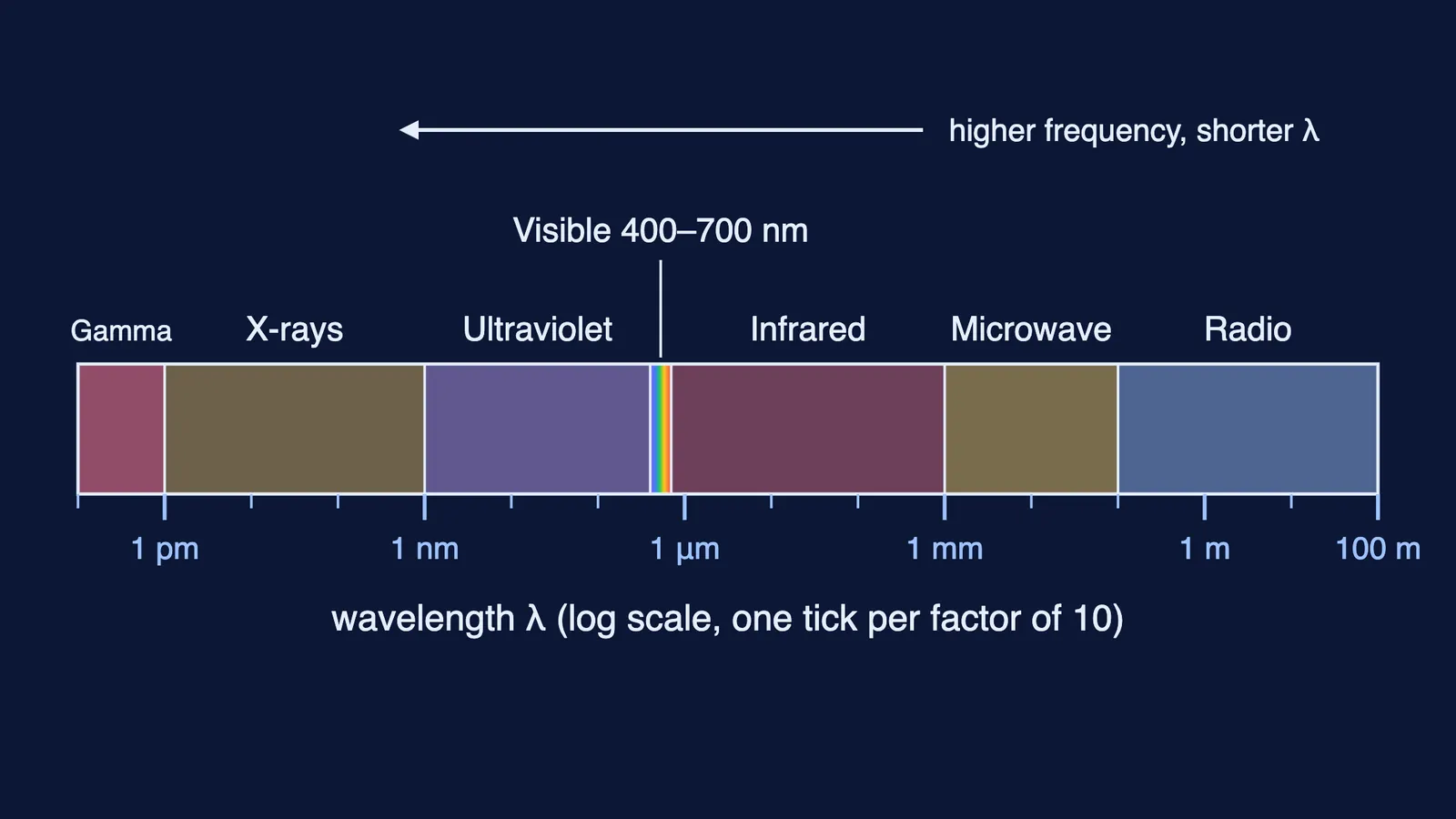
Learn NCERT's Table 8.1, plotted in the diagram above, by decreasing wavelength:
Radio, above 0.1 m: radio and TV communication; FM runs 88 to 108 MHz.
Microwave, 0.1 m to 1 mm: radar, speed guns, microwave ovens.
Infrared, 1 mm to 700 nm: physiotherapy lamps, TV remotes, the greenhouse effect.
Visible, 700 to 400 nm: what the eye detects.
Ultraviolet, 400 nm to 1 nm: LASIK surgery, germ-killing lamps in water purifiers; ordinary glass absorbs it.
X-rays, 1 nm to 10⁻³ nm: medical diagnosis and some cancer treatment.
Gamma rays, below 10⁻³ nm: from nuclear decay; used in medicine to kill cancer cells.
NCERT notes the boundaries overlap. Our 5.0 GHz wave (6 cm) is a microwave; at 2.0 GHz (15 cm) it would fall in the table's radio band.
What is a seven-day plan for Electromagnetic Waves?
Day 1: NCERT 8.1-8.2; redo the capacitor example with new numbers.
Day 2: exercises 8.1 and 8.2.
Day 3: section 8.3, Examples 8.1-8.2 and exercises 8.4-8.8.
Day 4: energy density and intensity; exercise 8.10.
Day 5: write Table 8.1 from memory, one use per band; exercises 8.3 and 8.9.
Day 6: a timed mixed set; tag each mistake as concept, formula or arithmetic.
Day 7: redo the mistakes, then start our Wave Optics for JEE Main guide.
Some ideas in physics are easier to see than to read; the Fermi Simulation Lab has interactive simulations for them. If a numerical keeps going wrong, the Fermi Problem Library has worked problems with a step-by-step solver that explains the reasoning rather than printing an answer.