On this page
Hydrocarbons is where organic chemistry turns into prediction: given an alkene and a reagent, name the product. Learn a small reaction map, why each arrow goes where it does, and the traps.
What does the NEET-UG syllabus include in Hydrocarbons?
NEET-UG 2027 has not been notified, so this guide follows the National Medical Commission's updated syllabus for NEET (UG)-2026, dated 22 December 2025. There, Hydrocarbons is Unit 15 under Organic Chemistry. It lists:
General: classification, isomerism, IUPAC nomenclature, preparation, properties and reactions.
Alkanes: conformations (Sawhorse and Newman projections of ethane) and the mechanism of halogenation.
Alkenes: geometrical isomerism; the mechanism of electrophilic addition of hydrogen, halogens, water and hydrogen halides (Markovnikov's rule and the peroxide effect); ozonolysis and polymerisation.
Alkynes: acidic character; addition of hydrogen, halogens, water and hydrogen halides; polymerisation.
Aromatic hydrocarbons: nomenclature; benzene's structure and aromaticity; electrophilic substitution (halogenation, nitration, Friedel-Crafts alkylation and acylation); directive influence of groups.
All of it sits in NCERT Class 11 Chemistry, Unit 9 Hydrocarbons (Reprint 2026-27), sections 9.1 to 9.5. Nothing listed is missing. Section 9.6, on carcinogenicity and toxicity, is not named in the NMC list; read it once anyway.
How should you practise Hydrocarbons for NEET?
As in NEET-UG 2026, the NTA information bulletin sets 180 compulsory multiple-choice questions in 180 minutes, 45 of them in Chemistry, each with four options and a single correct or best answer, marked +4, −1 for a wrong answer and 0 if left blank. That is about a minute a question, with no numerical-answer section. So:
Build one page of reactions from propene, propyne and benzene, and redraw it from memory.
For every addition, write the intermediate (carbocation or radical) first; its stability decides the product.
Eliminate options fast: count carbons, check the formula, and ask whether peroxide and HBr are both present.
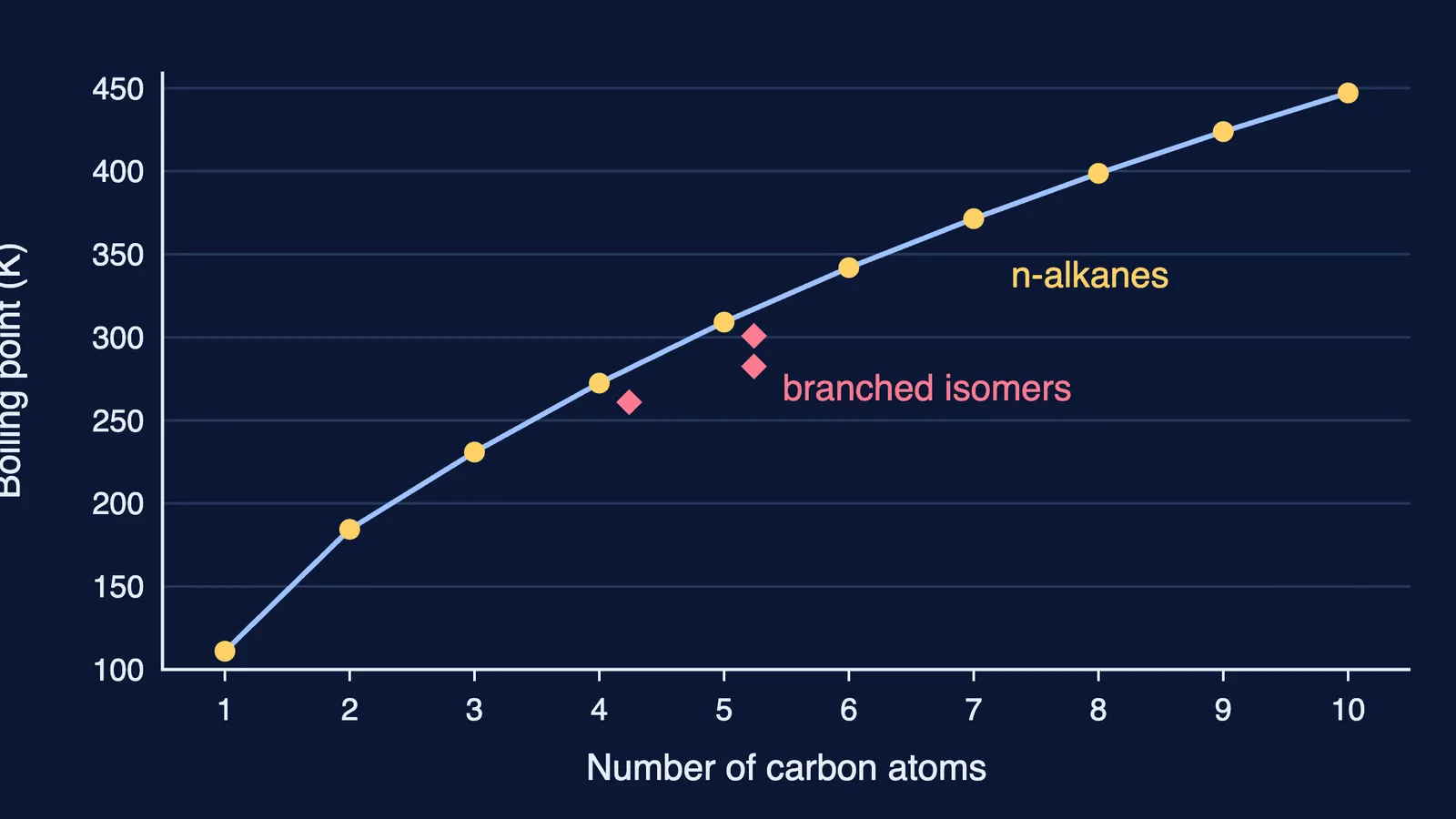
Read the trend, not the table: in NCERT Table 9.2, boiling points of straight-chain alkanes climb from 111.0 K for methane to 447.1 K for decane, and branching lowers them: pentane boils at 309.1 K but 2,2-dimethylpropane at 282.5 K.
Three worked examples, solved the NEET way
Example 1 (Markovnikov vs peroxide). Give the major product when 2-methylpent-1-ene, CH2=C(CH3)CH2CH2CH3, reacts with HBr (a) alone and (b) with benzoyl peroxide.
(a) H⁺ adds to the CH2 end, leaving a tertiary carbocation on C2, where bromide joins: 2-bromo-2-methylpentane. (b) A bromine radical adds first, to the CH2 end, giving the more stable tertiary radical; hydrogen then joins C2: 1-bromo-2-methylpentane.
Example 2 (ozonolysis in reverse). An alkene C7H14 gives propanone and butanal on ozonolysis. Identify it and say whether it shows geometrical isomerism.
Face the two C=O carbons towards each other, delete both oxygens and join them with a double bond: (CH3)2C=CHCH2CH2CH3 (3 + 4 = 7 carbons, 14 hydrogens). Numbering from the end nearer the double bond gives 2-methylhex-2-ene. C2 carries two identical methyl groups, so no cis and trans forms exist.
Example 3 (counting π bonds). 2.70 g of an open-chain hydrocarbon C4H6 takes up 0.20 g of H2 for complete hydrogenation over nickel. How many π bonds does it have?
C4H6: 2.70/54.0 = 0.0500 mol. H2: 0.20/2.0 = 0.10 mol. Ratio 2:1, so two π bonds: an alkyne (but-1-yne or but-2-yne) or a diene (buta-1,3-diene or buta-1,2-diene). Check: C4H6 has (2 × 4 + 2 − 6)/2 = 2 degrees of unsaturation. If it also reacts with sodamide, only but-1-yne fits: it alone has a hydrogen on a triply bonded carbon.
What are the common traps?
Peroxide with HCl or HI. NCERT states the peroxide effect is seen only with HBr; with HCl or HI, Markovnikov's rule still holds.
Halogens on benzene. Chlorine deactivates the ring yet directs the next group to ortho and para positions. Do not file it with –NO2 as meta.
Benzene and Cl2. A Lewis acid gives substitution; UV light gives addition (benzene hexachloride).
Staggered vs eclipsed. The staggered form of ethane has the least torsional strain; the eclipsed form has the most.
Stuck on a step? The Fermi Problem Library has worked problems with a step-by-step solver that explains the reasoning rather than printing an answer.
A seven-day practice plan
Day 1: IUPAC names and isomers.
Day 2: conformations, halogenation mechanism.
Day 3: alkene additions; ten Markovnikov vs peroxide pairs.
Day 4: ozonolysis both ways; cis and trans.
Day 5: alkyne acidity, additions, polymerisation.
Day 6: benzene, aromaticity, directing groups.
Day 7: 20 mixed questions, a minute each; name every miss's trap.
Try these original questions in four minutes:
Which gives the same major product with HBr, with or without peroxide: but-1-ene, 2-methylbut-1-ene, hex-3-ene or 3-methylbut-1-ene?
How many σ and π bonds are there in pent-1-en-4-yne, CH2=CH–CH2–C≡CH?
Assertion: hex-1-yne reacts with sodamide but hex-3-yne does not. Reason: a hydrogen on a triply bonded carbon is acidic.
Chlorobenzene is nitrated. Does the nitro group go mainly meta, or ortho and para?
Answers: 1. Hex-3-ene. 2. 10 σ and 3 π. 3. Both true; the reason explains the assertion. 4. Ortho and para.
Sitting JEE Main too? See our Hydrocarbons guide for JEE Main. For boards, read Hydrocarbons Class 11 chemistry: the CBSE 2026-27 guide.