On this page
It is 11 pm, the physics paper is in two days, and your brain is running the same loop: what if electrostatics comes, what if I blank, what will everyone say. You have not solved a problem in an hour.
Research offers a simple way to interrupt that loop: not forcing the thoughts away, but giving them an appointment.
Is overthinking the same as planning?
No, and the difference matters. Psychologist Edward Watkins reviewed the research on repetitive thought and found it can go either way: it can help with preparation and planning, or feed anxiety and low mood (Watkins, Psychological Bulletin, 2008). One factor he identified is how abstract the thinking is.
Abstract thinking sounds like "Why am I always like this?" or "What if I fail?" It has no answer, so it repeats. Concrete thinking sounds like "Which three electrostatics topics am I weakest at, and when will I practise them?" It ends in an action.
A rough self-check: after ten minutes of thinking, do you have a next step? Then it was probably problem-solving. If you only feel worse, it was probably rumination.
What is worry postponement, and does it work?
Worry postponement (also called stimulus control) means you notice a worry, write it down, and save it for one fixed worry period instead of chewing on it now. The idea goes back to a 1983 paper by Borkovec and colleagues, Stimulus control applications to the treatment of worry90206-1).
The best summary of the evidence is a 2023 meta-analysis by Dippel, Brosschot and Verkuil (International Journal of Cognitive Therapy). It pooled 7 randomised trials with 999 participants, mostly women; only 250 of them found worry a burden, and none of the trials was about exams.
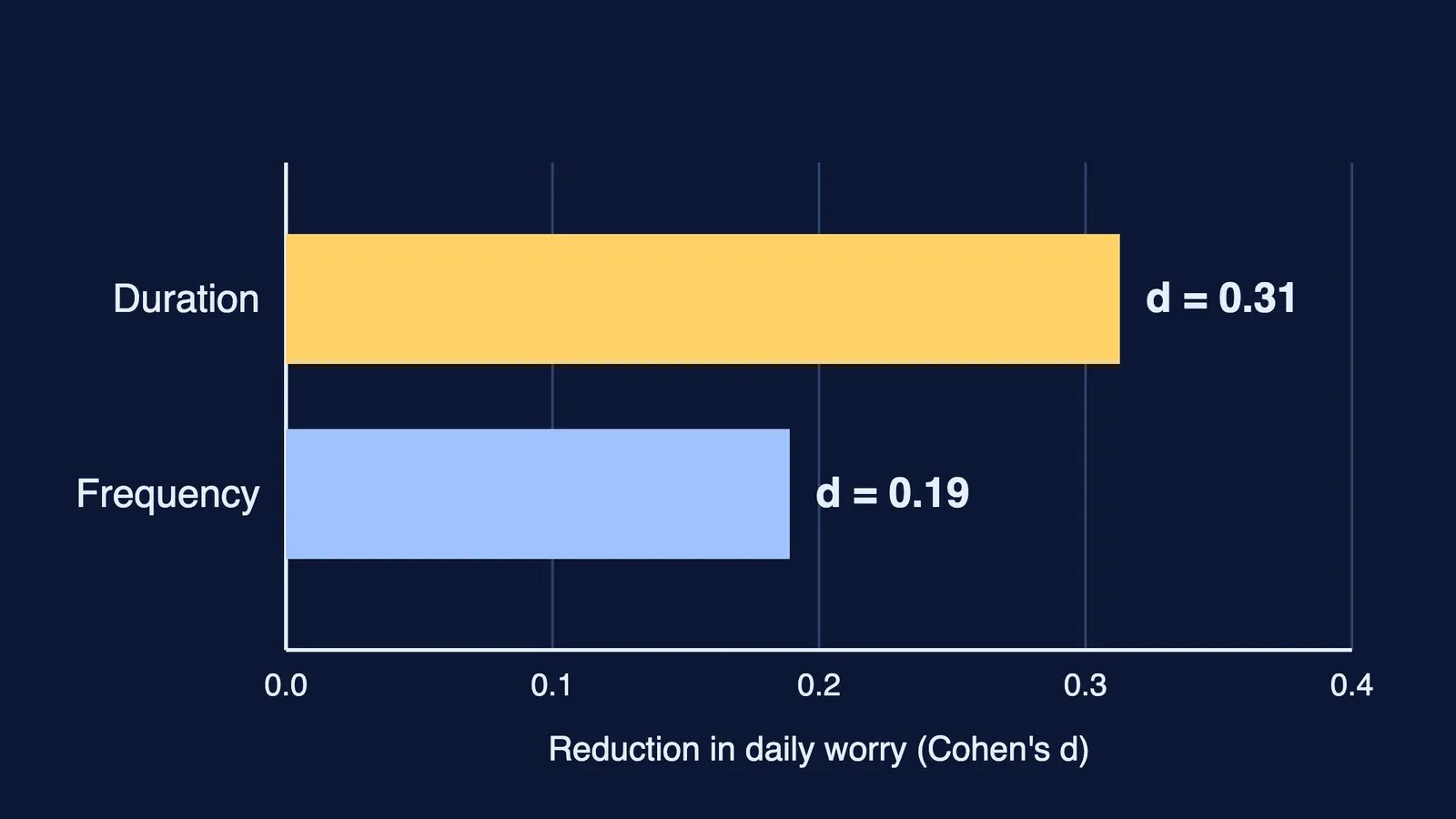
Compared with simply recording worries, postponement produced small reductions in how long people worried (d = 0.31) and how often (d = 0.19), according to the same meta-analysis. The authors note that long-term follow-up studies are still missing, and practice in the trials lasted between a week and a month.
Three trials show what makes the difference:
In a trial of 53 people with high worry, a daily 30-minute worry period at a fixed time and place reduced worry, anxiety and insomnia more than a comparison condition, though not depression (McGowan and Behar, Behavior Modification, 2013).
An online version did not work: 996 people were enrolled, only 361 finished, there was no difference in worry, and participants reported that postponing was hard (Versluis, Verkuil and Brosschot, British Journal of Health Psychology, 2016).
In a 2025 trial of 186 adults over 14 days, people who added specific if-then plans for when and how to postpone reported about 15 minutes less worry than people using postponement alone; neither version improved sleep compared with the control groups (McCarrick and colleagues, Psychology and Health, 2025).
How do you set up a worry slot before exams?
A routine built from those studies. Try it for a week before judging it.
Pick the slot. About 30 minutes, as in the trials, same time and place every day, early evening, not in bed. For example, 6:30 pm at the dining table.
Write your if-then plan. "If an exam worry comes while I'm studying, then I write three words in my worry note and go back to the question."
Catch, don't chase. During the day, a worry gets one line in your notebook. That's all.
In the slot, sort each worry. Can I do something about this? If yes, turn it into a concrete step with a time. If no, write "can't control" next to it.
Stop when the timer ends. Leftovers go to tomorrow's slot.
A worked example from one evening slot:
"What if I forget the capacitor formulas?" Step: a one-page formula sheet tomorrow at 4 pm.
"What if I blank in the exam?" Step: one timed section on Sunday, and read the routine for blanking out mid-exam.
"I'm not good enough for JEE." Too abstract. Rewrite it: "My last mock was weak in rotation." Step: ten rotation problems on Thursday.
If the step is a chapter you can't get into, Fermi's AI tutor can work out what you already know and build a plan for the session, so the worry turns into a clear next step.
What else helps the night before?
Writing about your worries just before a test has its own research, covered in our post on expressive writing before exams. And protect your sleep before the exam.
Tele MANAS is India's national tele-mental health service, offering 24x7 counselling on the toll-free number 14416 (Press Information Bureau).
Tonight, pick your slot and write your first if-then plan. The worries can wait until 6:30 pm tomorrow.