On this page
The NEET-UG 2026 syllabus lists p-Block Elements, but the 2026-27 NCERT Chemistry books have no p-block chapter. Here is how to prepare for both facts.
What does the NEET syllabus include in p-Block Elements?
The NMC's updated syllabus for NEET (UG)-2026, the same text as the syllabus PDF on the NTA site, lists Unit 10, p-Block Elements, Group 13 to Group 18. Its scope: electronic configuration, general trends in physical and chemical properties across periods and down groups, and the unique behaviour of the first element in each group.
Unit 10 itself names no compounds. The practical chemistry unit adds the salt-analysis anions: carbonate, sulphide, sulphate, nitrate, nitrite, chloride, bromide and iodide.
Which NCERT chapters still cover p-block elements?
None of the 2026-27 NCERT Chemistry books has a p-block unit. The contents of Class 11 Part I, Class 11 Part II, Class 12 Part I and Class 12 Part II leave the d- and f-block as the only block unit.
What still maps to the syllabus is in Class 11 Unit 3, Classification of Elements:
Section 3.6.2: the p-block is groups 13 to 18, with outer configurations from ns2np1 to ns2np6.
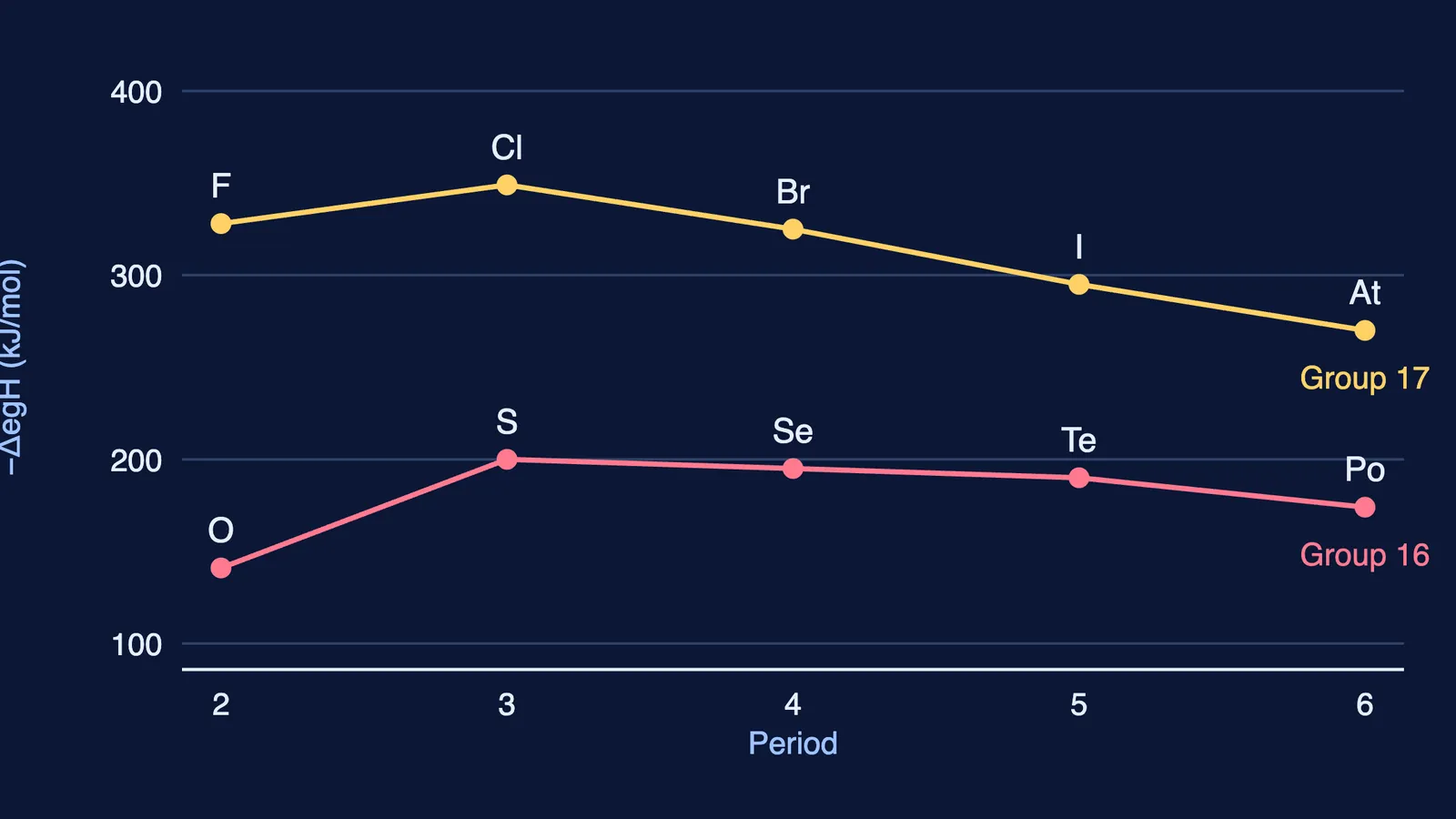
Table 3.7: electron gain enthalpies for groups 16 and 17, where oxygen and fluorine are less negative than sulphur and chlorine.
Section 3.7.2: the first element differs because of small size, large charge/radius ratio, high electronegativity and only four valence orbitals, so its maximum covalency is 4 (boron forms BF4−, aluminium AlF6 3−). It also forms pπ–pπ multiple bonds more readily.
Section 3.7.3: Cl2O7 is acidic, Al2O3 and As2O3 are amphoteric, and CO, NO and N2O are neutral.
Our Class 11 guide to classification of elements covers Unit 3 in full.
What is no longer in NCERT: group-by-group chemistry. Unit 3 mentions the diagonal relationship briefly but defers the inert pair effect and other group trends to later group-wise units, and those units are gone. Learn them from a reference book or your teacher's notes. Our guide on how to check the deleted NCERT syllabus helps you spot old material.
How is p-block tested in NEET?
In NEET-UG 2026, the paper had 180 compulsory questions in 180 minutes, 45 of them in Chemistry, all multiple-choice with four options and a single correct or best answer, according to the NTA information bulletin. Marking was +4 and −1. That is about a minute a question, so learn each fact as a sentence you can mark true or false, and every ranking with its cause. NEET 2027 is not yet notified; check neet.nta.nic.in.
How do you solve p-block questions? Three worked examples
Example 1: which species cannot exist? NCl5, PCl5, [BF6]3−, [AlF6]3−, [CF6]2−. Nitrogen, boron and carbon are period-2 atoms with only four valence orbitals (NCERT Unit 3), so none can form more than four bonds. NCl5 needs five, [BF6]3− and [CF6]2− need six: all three are impossible.
Example 2: rank O, S, F and Br by electron gain enthalpy, most negative first. From NCERT Table 3.7: F −328, Br −325, S −200, O −141 kJ/mol. Order: F > Br > S > O. Then: how much more energy is released when 2.0 mol of gaseous chlorine atoms gain an electron than 2.0 mol of fluorine atoms? 2.0 × (349 − 328) = 42 kJ.
Example 3: oxidation state versus covalency. In O2F2, fluorine is −1, so 2x − 2 = 0 and oxygen is +1. Boron in BF4− and aluminium in AlF6 3− are both +3, but their covalencies are 4 and 6.
Stuck on a step? The Fermi Problem Library has worked problems with a step-by-step solver that explains the reasoning rather than printing an answer.
What are the common p-block traps?
The most negative electron gain enthalpy belongs to chlorine, not fluorine; in group 16, to sulphur, not oxygen. The chart above plots Table 3.7.
Oxygen is not always −2: it is +2 in OF2, as NCERT shows, and +1 in O2F2.
CO, NO and N2O are neutral, not acidic, although they are non-metal oxides.
A 10-day plan for p-block
Days 1-2: Unit 3 sections 3.6.2, 3.7.1 to 3.7.3; one cause per trend.
Days 3-4: VSEPR shapes (Unit 4) and oxidation states (Unit 7) of p-block compounds.
Days 5-7: one page per group from a reference: configuration, common oxidation states, first-element anomaly.
Day 8: the eight salt-analysis anions.
Days 9-10: timed mixed sets at about a minute each, logging errors by cause. Our JEE Main p-block guide has more examples.
If a trend feels arbitrary, the Fermi Concept Library covers every concept in physics, chemistry, biology, mathematics and computing, each with its own lesson and its place in the map.
Practice: (1) By how many kJ/mol is selenium's electron gain enthalpy more negative than oxygen's? (2) Give the oxidation states of S in SF6 and N in NF3; which central atom goes beyond covalency 4? (3) In which period is electron gain enthalpy most negative for groups 16 and 17?
Answers: (1) 54 kJ/mol; (2) +6 and +3, sulphur; (3) period 3 (S and Cl).