On this page
Thermodynamics in NEET physics is energy bookkeeping for a gas: heat in, work out, internal energy in between. Sign conventions and process names cause most lost marks. Here is the syllabus, the NCERT map, worked examples and a one-week plan. For enthalpy, entropy and Gibbs energy, see our separate Chemical Thermodynamics for NEET guide.
What does the NEET syllabus include in Thermodynamics?
The latest official syllabus is the NMC's updated syllabus for NEET (UG) 2026, dated 22-12-2025. Physics Unit 8, Thermodynamics, lists thermal equilibrium, the zeroth law and the concept of temperature; heat, work and internal energy; the first law; isothermal and adiabatic processes; and the second law with reversible and irreversible processes. No 2027 syllabus is on the NTA NEET site yet; check there before you finalise your plan.
It maps to Chapter 11 of NCERT Class 11 Physics Part II (Reprint 2026-27). Two notes:
The chapter also covers specific heat capacity, isobaric, isochoric and cyclic processes, and the Carnot engine (Section 11.11). The NMC unit does not name them (specific heats of gases are in Unit 9), but they are where the first law gets used.
Physics writes the first law as ΔQ = ΔU + ΔW, where W is work done by the system. NCERT Class 11 Chemistry writes ΔU = q + w, where w is work done on the system. Same law, opposite sign for work.
How is Thermodynamics tested in NEET?
As in NEET-UG 2026, the NTA information bulletin set 180 compulsory questions in 180 minutes, with 45 Physics questions worth 180 marks. Each is a multiple-choice question with four options and a single correct or best answer: +4 if right, -1 if wrong, 0 if unanswered.
That is about a minute per question, so you need process formulas on recall, a sign check on every Q and W, and the habit of striking out options that break the first or second law.
How do you solve Thermodynamics questions fast?
Example 1: the sign trap. A gas absorbs 800 J of heat and expands, doing 300 J of work on its surroundings. Find ΔU. Options: 300 J, 500 J, 800 J, 1100 J.
Physics form: ΔU = ΔQ − ΔW = 800 − 300 = 500 J. In chemistry form, w = −300 J (work done on the gas), so ΔU = 800 + (−300) = 500 J again. 1100 J is the trap for anyone who adds the two numbers.
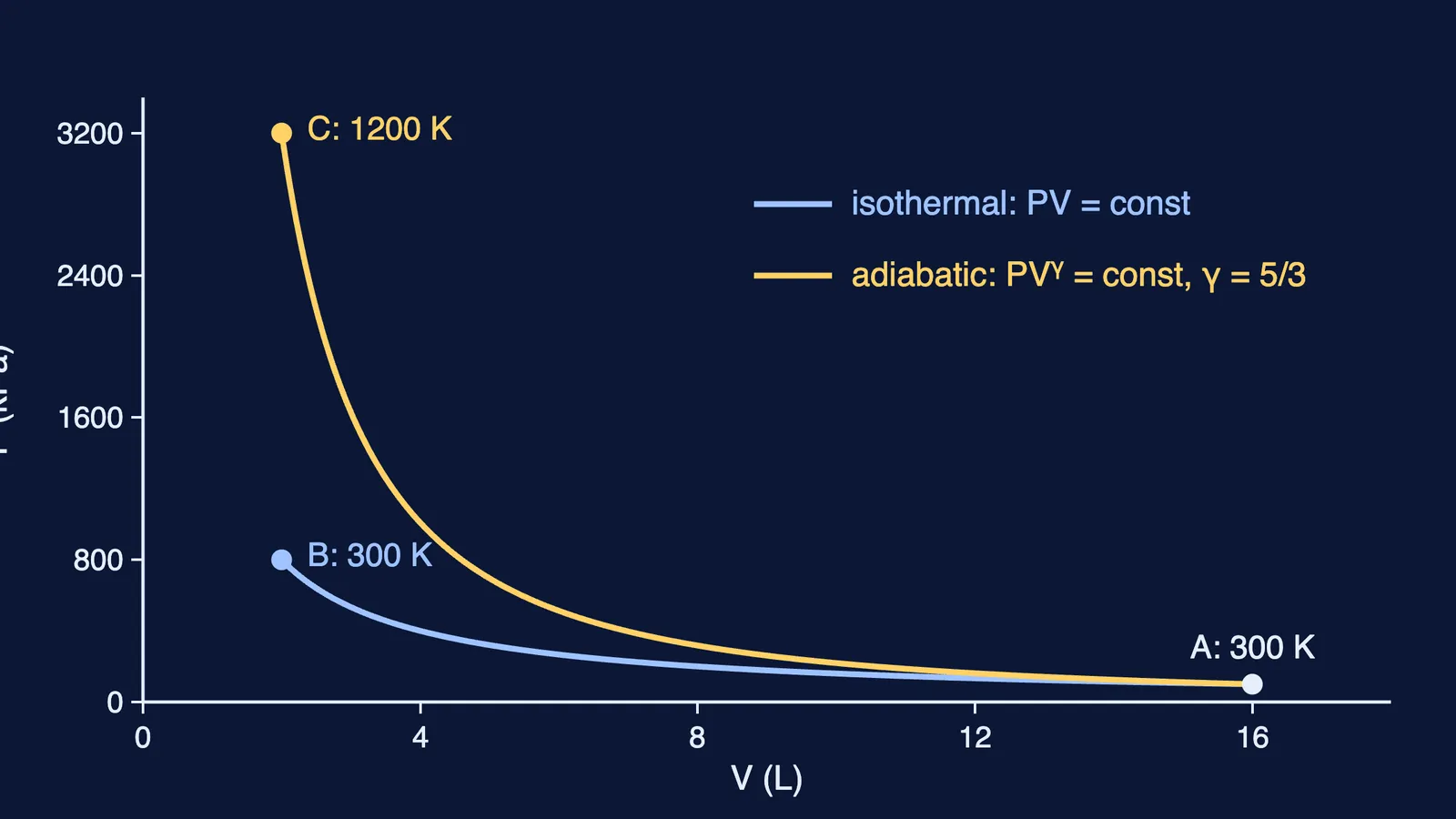
Example 2: isothermal versus adiabatic compression. A monatomic ideal gas (γ = 5/3) at 300 K and 100 kPa is compressed from 16 L to 2 L, a factor of 8.
Isothermal: PV is constant, so the final pressure is 800 kPa. Work done on it is P₁V₁ ln 8 ≈ 3330 J, all released as heat since ΔU = 0.
Adiabatic: TV^(γ−1) is constant, so T₂ = 300 × 8^(2/3) = 1200 K, and PV^γ constant gives 100 × 8^(5/3) = 3200 kPa. Work done on it is (P₂V₂ − P₁V₁)/(γ − 1) = 7200 J, all stored as internal energy.
The adiabat is steeper and needs more work, as the graph above shows.
Example 3: a cycle on a P-V graph. A gas goes clockwise round a rectangle between 100 and 300 kPa and between 2 and 5 L. Net work by the gas is the enclosed area: 200 kPa × 3 L = 600 J. For any cycle ΔU = 0, so net heat absorbed is also 600 J.
Stuck on a step? The Fermi Problem Library has worked problems with a step-by-step solver that explains the reasoning rather than printing an answer.
What are the common traps?
Using ΔU = 0 for every process. It holds for an isothermal change of an ideal gas and for a full cycle, not for an adiabatic one.
Treating free expansion as a reversible adiabatic (PV^γ constant). NCERT lists it as irreversible: the gas passes through non-equilibrium states.
Mixing up the second-law statements: Kelvin-Planck forbids turning reservoir heat wholly into work as the sole result; Clausius forbids moving heat from colder to hotter as the sole result.
What should a one-week Thermodynamics plan look like?
Day 1: NCERT Sections 11.1-11.5 line by line.
Day 2: the four processes; one table of W, Q and ΔU.
Day 3: P-V graphs and cycles.
Day 4: second law, reversible and irreversible processes, Carnot engine.
Days 5-7: timed sets of 20 questions in 20 minutes; tag each mistake as sign, unit, formula or reading.
Practice questions
250 J of work is done on a gas and it gives out 90 J of heat. What is ΔU?
An ideal gas expands isothermally, absorbing 1.2 kJ of heat. How much work does it do?
A gas at a constant 150 kPa expands from 3 L to 8 L while absorbing 2625 J. Find the work done by the gas and ΔU.
Answers: 1. +160 J. 2. 1.2 kJ (ΔU = 0). 3. 750 J and 1875 J.
For board-level theory, read our Thermodynamics guide for Class 11 Physics. Taking JEE too? See the Thermodynamics for JEE Main guide.