On this page
Most Gravitation questions reduce to a handful of results and how they scale. Learn them as ratios, not just formulas, and a one-minute question gets much shorter. Here is the syllabus, the NCERT map, three worked examples and a one-week plan.
What does the NEET syllabus include in Gravitation?
The latest official syllabus is the NMC's updated syllabus for NEET (UG) 2026, dated 22-12-2025. Physics Unit 6, Gravitation, lists the universal law of gravitation, acceleration due to gravity and its variation with altitude and depth, Kepler's laws of planetary motion, gravitational potential energy, gravitational potential, escape velocity, and the motion of a satellite: orbital velocity, time period and energy. No 2027 syllabus is on the NTA NEET site yet; check there before finalising your plan.
It maps to Chapter 7, Gravitation, in the 2026-27 NCERT Class 11 Physics Part I, sections 7.2 Kepler's laws to 7.10 energy of an orbiting satellite. Two notes:
Neither the NMC unit nor the NCERT chapter has a section on geostationary or polar satellites.
Weightlessness has no section of its own; a Points to Ponder note explains it: astronaut and satellite are both in free fall.
How is Gravitation tested in NEET?
As in NEET-UG 2026, the NTA information bulletin set 180 compulsory questions in 180 minutes, with 45 Physics questions worth 180 marks. Each is a multiple-choice question with four options and a single correct or best answer: +4 if right, -1 if wrong, 0 if unanswered.
That is about a minute per question, so three habits pay: write every quantity as a ratio to Earth's value, check units before calculating, and strike out options that scale the wrong way.
How do you solve NEET Gravitation questions fast?
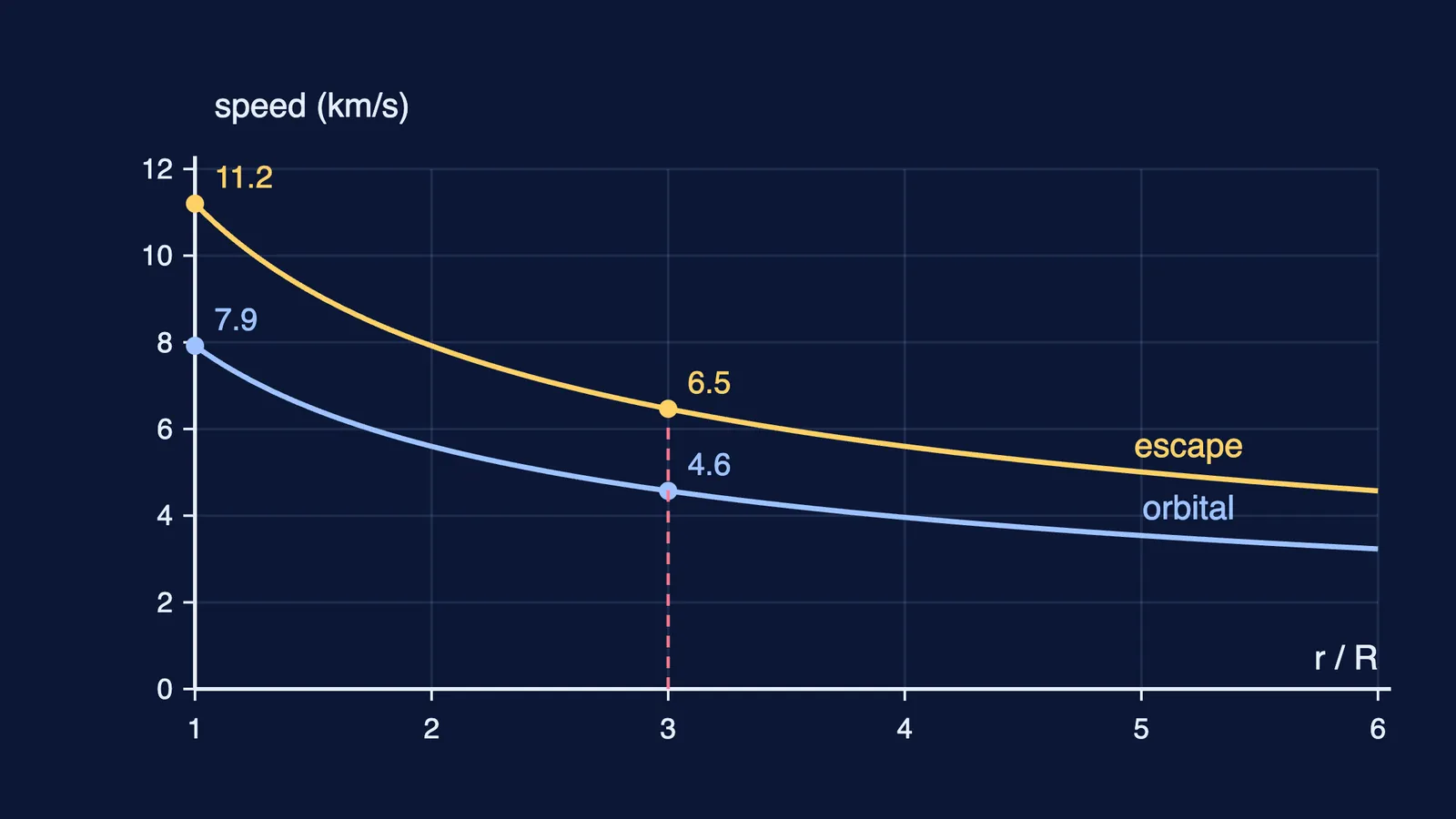
Use g = 9.8 m/s² and Earth's radius R = 6400 km, so Earth's escape speed is √(2gR) ≈ 11.2 km/s, as in the NCERT chapter.
Example 1: a bigger planet. A planet has 4 times Earth's mass and 2.5 times its radius. Find g and the escape speed there.
g = GM/R², so g scales as 4/2.5² = 0.64: g ≈ 6.27 m/s². Escape speed √(2GM/R) scales as √(4/2.5) = √1.6 ≈ 1.26: about 14.2 km/s. The trap: g falls while escape speed rises.
Example 2: two satellites. Satellite B circles Earth at 9 times the orbital radius of satellite A. Compare their periods and speeds.
Kepler's third law gives T² ∝ r³, so T_B/T_A = 9^(3/2) = 27. Orbital speed √(GM/r) scales as 1/√r, so B moves at a third of A's speed. Neither ratio depends on the satellites' masses.
Example 3: launch energy versus escape energy. A 600 kg satellite is to orbit at r = 3R from Earth's centre. Ignoring Earth's rotation, what energy places it there, and what then frees it?
At the surface the energy is −GMm/R; in orbit it is −GMm/2r = −GMm/6R. Placing it costs GMm(1 − 1/6)/R = (5/6)mgR = (5/6) × 600 × 9.8 × 6.4 × 10⁶ ≈ 3.14 × 10¹⁰ J. Freeing it from orbit needs only GMm/6R = mgR/6 ≈ 6.27 × 10⁹ J, a fifth as much. Our explainer on why a satellite's energies are in the ratio 1 : −2 : −1 shows where the factor of 2 comes from.
Finding an idea hard to picture? The Fermi Simulation Lab has interactive simulations for the ideas that are easier to see than to read.
What should a one-week Gravitation plan look like?
Day 1: NCERT 7.1 to 7.4 line by line; state Kepler's laws and the universal law from memory.
Day 2: g at height and depth; use g(1 − 2h/R) only when h is much smaller than R.
Day 3: potential energy, potential and escape speed; know why potential energy is negative.
Day 4: orbital speed, period and energy; write each as a power of r.
Day 5: thirty mixed questions in thirty minutes.
Day 6: tag each error as formula, r versus h, units or reading; redo the wrong ones.
Day 7: reread the chapter summary and Points to Ponder.
Stuck on a step? The Fermi Problem Library has worked problems with a step-by-step solver that explains the reasoning rather than printing an answer.
Practice questions
A planet has Earth's mass and 0.8 times its radius. What is its escape speed?
At what depth below Earth's surface is g three-fifths of its surface value (R = 6400 km)?
Satellite A has a period of 2 hours. Satellite B orbits the same planet at 2.25 times A's orbital radius. What is B's period?
True or false: a heavier satellite needs a higher speed to stay in the same circular orbit.
Answers: 1. 11.2 × √1.25 ≈ 12.5 km/s. 2. d = 0.4R = 2560 km. 3. 2 × 2.25^(3/2) = 6.75 hours. 4. False; orbital speed √(GM/r) does not depend on the satellite's mass.
For board-level derivations, see our guide to Gravitation for Class 11. Taking JEE too? Read our Gravitation for JEE Main guide.