On this page
Class 11 Gravitation rests on Kepler's laws and five derivations, and its numericals are built on them. Below: the CBSE 2026-27 syllabus map, each result, a solved numerical and practice questions.
What does the CBSE 2026-27 syllabus include in Gravitation?
The CBSE Physics curriculum for 2026-27 lists Gravitation as Unit VI, Chapter 7. It covers Kepler's laws, the universal law, g and its variation with altitude and depth, potential energy and potential, escape speed, orbital velocity and the energy of an orbiting satellite.
Marks are printed per group of units. Units IV, V and VI (Chapters 5 to 7) share one cell of 17 out of 70 theory marks, so Gravitation has no separate figure.
Its question paper design gives 27 marks to remembering and understanding, 22 to applying and 21 to analysing, evaluating and creating, so 43 of the 70 marks ask you to use a result, not just recall it.
The current NCERT Class 11 Physics Part I chapter (Reprint 2026-27) runs from 7.1 Introduction to 7.10 Energy of an orbiting satellite. Geostationary and polar satellites are in neither the syllabus nor the chapter.
Which derivations should you know for the exam?
M and R are Earth's mass and radius (NCERT adds a subscript E).
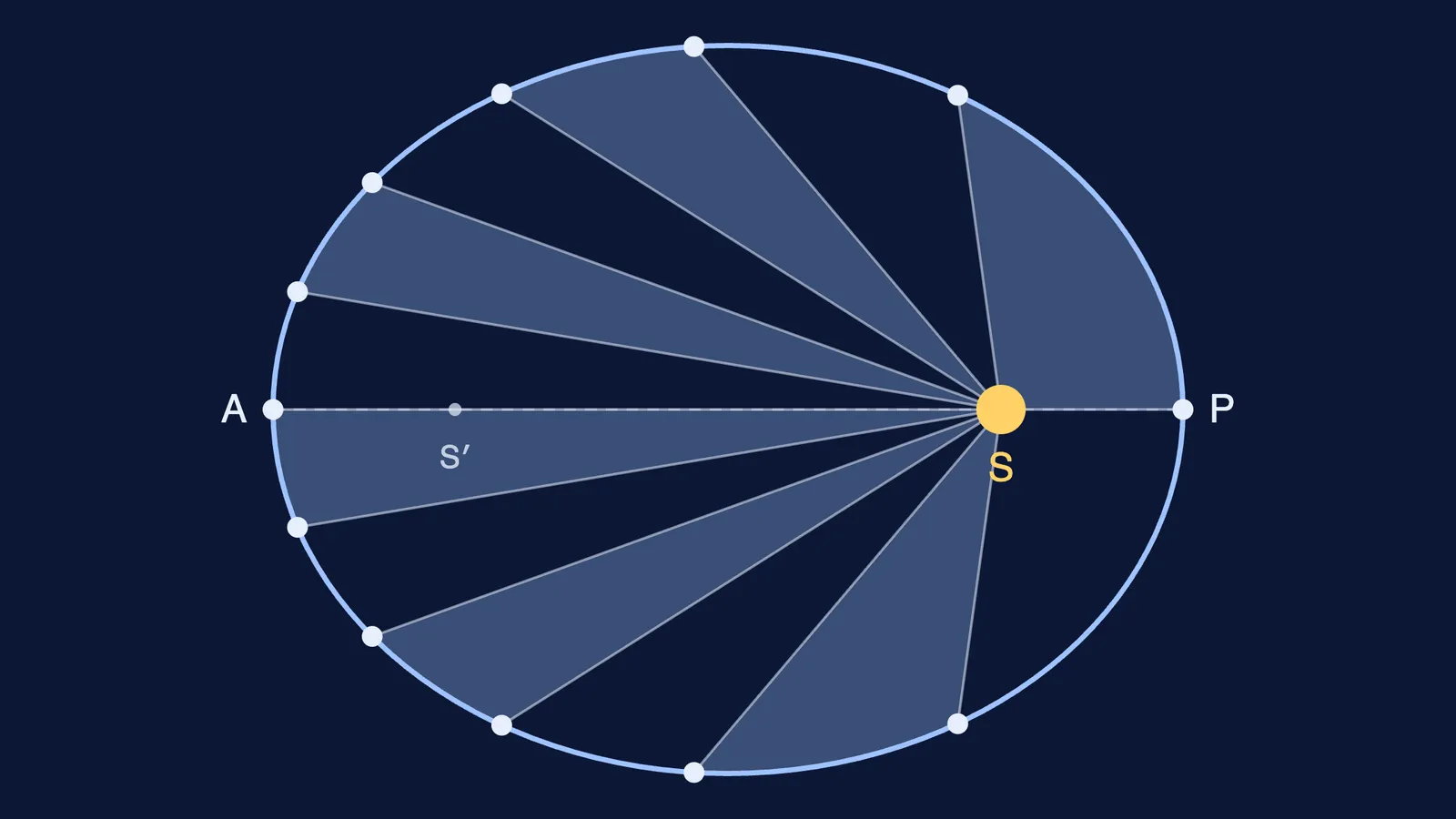
Kepler's laws. State all three. The law of areas means a planet moves faster near perihelion P than near aphelion A, as the twelve equal-time sectors in the diagram show.
g at the surface. Set mg = GMm/R², so g = GM/R². This is how g and G give Earth's mass.
g at height h. g(h) = GM/(R + h)². For h much smaller than R, the binomial expansion gives g(h) ≈ g(1 − 2h/R).
g at depth d. Only the inner sphere of radius (R − d) pulls; the outer shell exerts no net force. For uniform density, mass scales as radius cubed, so g(d) = g(1 − d/R).
Escape speed. ½mVᵢ² − GMm/R ≥ 0 gives the minimum Vᵢ = √(2GM/R) = √(2gR), about 11.2 km s⁻¹ for Earth.
Orbital speed, period and energy. From mV²/(R + h) = GMm/(R + h)², V = √(GM/(R + h)) and T² = (4π²/GM)(R + h)³, which is Kepler's third law. Then K.E. = GMm/2(R + h), P.E. = −GMm/(R + h) and E = −GMm/2(R + h).
How do you solve a CBSE gravitation numerical?
Question (3 marks). A 500 kg satellite circles Earth 1000 km up. Find its orbital speed, period and total energy, taking the NCERT chapter's g = 9.8 m s⁻² and R = 6400 km.
Distance from the centre: r = R + h = 6400 + 1000 = 7400 km = 7.4 × 10⁶ m.
Replace GM by gR²: 9.8 × (6.4 × 10⁶)² = 4.014 × 10¹⁴ m³ s⁻².
Speed: V = √(GM/r) = √(4.014 × 10¹⁴ / 7.4 × 10⁶) = √(5.424 × 10⁷) = 7.37 × 10³ m s⁻¹, about 7.4 km s⁻¹.
Period: T = 2πr/V = (2π × 7.4 × 10⁶)/(7.37 × 10³) = 6.31 × 10³ s, about 105 minutes.
Energy: E = −GMm/2r = −(4.014 × 10¹⁴ × 500)/(2 × 7.4 × 10⁶) = −1.36 × 10¹⁰ J.
Check the signs: K.E. is +1.36 × 10¹⁰ J and P.E. is −2.71 × 10¹⁰ J, twice as large. So 1.36 × 10¹⁰ J is also the energy needed to free the satellite from this orbit. Here is why gravitational potential energy is negative.
What questions can you practise for the Class 11 exam?
(1 mark, assertion-reason) Assertion: a satellite in circular orbit has negative total energy. Reason: its P.E. is negative and twice its K.E. in size. *Both are true, and the reason explains the assertion.*
(2 marks) At what height above the surface does g fall to one-quarter of its surface value? *(R + h)² = 4R², so h = R, one Earth radius.*
(2 marks) Show that, for small heights, g at height h equals g at depth 2h. *g(1 − 2h/R) = g(1 − d/R) gives d = 2h.*
(3 marks) A planet orbits a star of the Sun's mass at four times Earth's orbital radius. Find its period. *T ∝ r^(3/2), so T = 4^(3/2) = 8 years.*
(5 marks) Derive the escape speed from a planet's surface. Find it for a planet of Earth's density and twice its radius. *M grows as R³, so √(2GM/R) grows as R: 2 × 11.2 = 22.4 km s⁻¹, using NCERT's 11.2.*
How should you revise Gravitation before the exam?
Write Kepler's laws and all five derivations from a blank page in one session; spend a second on mixed numericals, marking each error as wrong formula, wrong r or arithmetic. If you also sit JEE Main, our Gravitation for JEE Main guide adds a one-week plan and harder numbers. With no physics teacher at school, try this weekly self-study plan for Class 11 physics.
If you are not sure where to start, Fermi's AI tutor can work out what you already know and build a plan for the session.