On this page
Chemical Bonding and Molecular Structure is Unit 4 of NCERT Chemistry Part I, and this guide follows the current NCERT chapter (Reprint 2026-27) for the CBSE school exam. Preparing for JEE instead? Read how to prepare chemical bonding for JEE Main; this page covers board marks and board-style answers.
What does the CBSE 2026-27 syllabus include, and how many marks?
The CBSE Chemistry curriculum for 2026-27 gives Unit 4 its own row in the Class XI marks table: 7 of the 70 theory marks. Its topic list matches the nine sections of the current NCERT chapter:
Kossel-Lewis approach, ionic bond, bond parameters
VSEPR theory
Valence bond theory and hybridisation
Molecular orbital theory and bonding in homonuclear diatomic molecules
Hydrogen bonding
The same curriculum's question-paper design splits the 70 marks into remembering and understanding (28), applying (21), and analysing, evaluating and creating (21). Revise from the 2026-27 reprint.
How do you predict a molecule's shape with VSEPR?
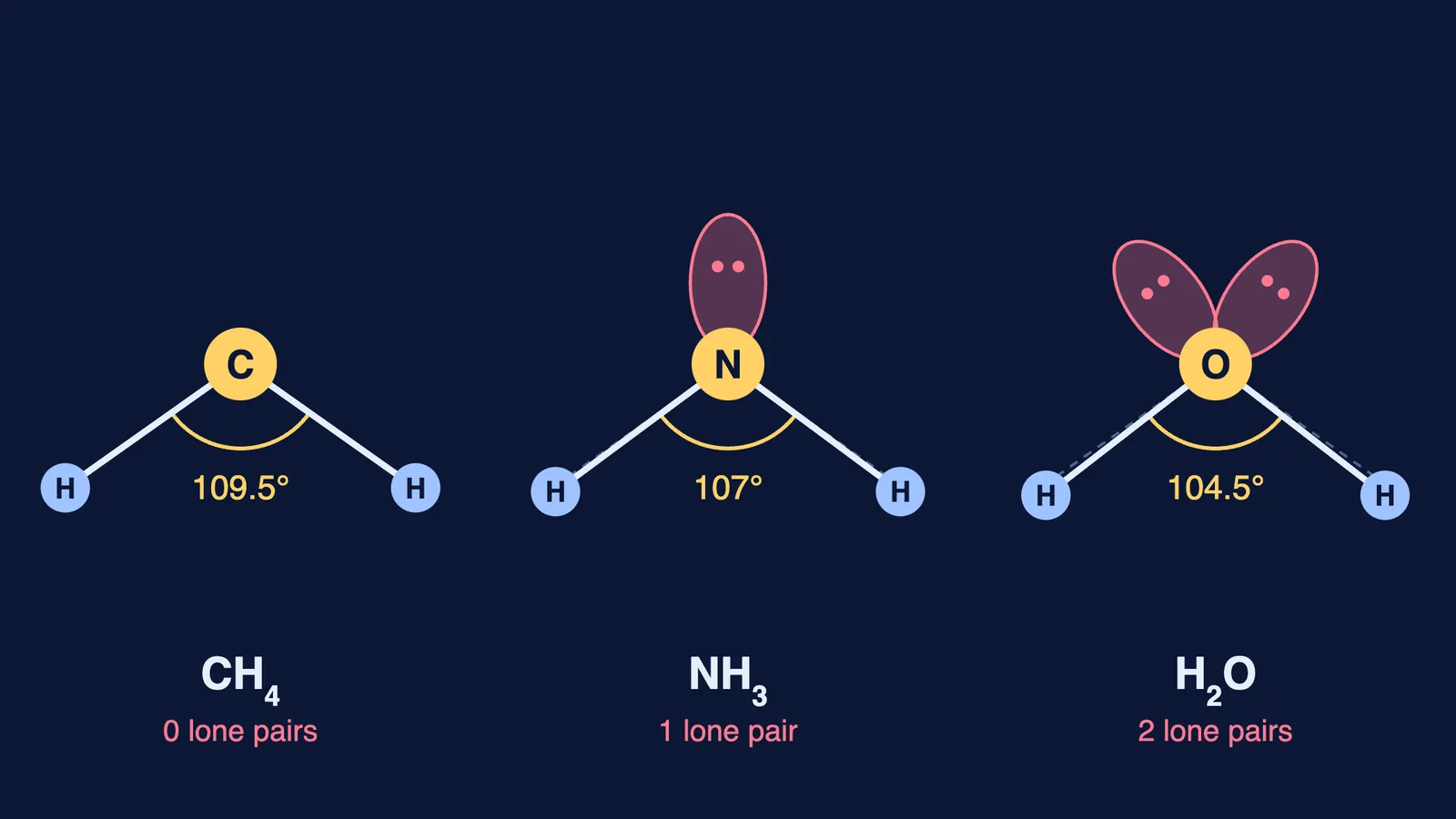
VSEPR says electron pairs around the central atom spread out to keep repulsion low, and repulsion falls in the order lone pair–lone pair > lone pair–bond pair > bond pair–bond pair. In NCERT's tables, CH₄ is 109.5°, NH₃ is squeezed to 107° by one lone pair, and H₂O to 104.5° by two, as the diagram above draws. A multiple bond counts as one pair.
Shape-prediction list (total pairs, then lone pairs):
2 pairs, 0 lone: linear (BeCl₂)
3 pairs, 0 lone: trigonal planar (BF₃); 1 lone: bent (SO₂)
4 pairs, 0 lone: tetrahedral (CH₄); 1 lone: trigonal pyramidal (NH₃); 2 lone: bent (H₂O)
5 pairs, 0 lone: trigonal bipyramidal (PCl₅); 1 lone: see-saw (SF₄); 2 lone: T-shape (ClF₃)
6 pairs, 0 lone: octahedral (SF₆); 1 lone: square pyramidal (BrF₅); 2 lone: square planar (XeF₄)
Worked example. With only H or halogen atoms on the central atom, lone pairs = (valence electrons − charge − number of bonded atoms) ÷ 2.
PCl₃: (5 − 0 − 3) ÷ 2 = 1 lone pair, 4 pairs in all, so trigonal pyramidal.
BrF₃: (7 − 0 − 3) ÷ 2 = 2 lone pairs, 5 in all, so T-shaped.
ICl₄⁻: (7 + 1 − 4) ÷ 2 = 2 lone pairs, 6 in all, so square planar.
For why lone pairs squeeze angles, see lone pair repulsion in CH₄, NH₃ and H₂O.
How do hybridisation and molecular orbital theory fit together?
Hybridisation follows the same pair count: 2 pairs sp, 3 sp², 4 sp³, 5 sp³d (PCl₅), 6 sp³d² (SF₆). Lone pairs count, so NH₃ and H₂O are sp³.
MO theory adds bond order = ½(Nb − Na) and magnetism. NCERT fills B₂, C₂ and N₂ with π2p below σ2p, and O₂ and F₂ with σ2p below π2p.
Worked example: C₂, C₂⁻ and C₂²⁻.
C₂ has 12 electrons: (σ1s)²(σ*1s)²(σ2s)²(σ*2s)²(π2pₓ² = π2pᵧ²). Nb = 8, Na = 4, bond order 2, no unpaired electrons, diamagnetic (as NCERT finds).
C₂⁻ has 13: the extra electron enters σ2pz. Nb = 9, bond order 2.5, one unpaired electron, paramagnetic.
C₂²⁻ has 14, filling σ2pz. Nb = 10, bond order 3, diamagnetic.
Bond length falls as bond order rises, so the bond shortens from C₂ to C₂²⁻. Check: Na stays 4, so each added electron adds ½. For the orbital picture behind this, read bonding vs antibonding molecular orbitals.
What is hydrogen bonding, and where does it show up?
A hydrogen bond is the attraction between H bonded to F, O or N and another electronegative atom, usually in a neighbouring molecule. NCERT names two types:
Intermolecular, between molecules, as in HF or water
Intramolecular, within one molecule, as in o-nitrophenol, where H sits between two oxygen atoms
It is weaker than a covalent bond, and strongest in the solid state.
What questions should you practise for the Class 11 exam?
The curriculum's question-paper design covers Classes XI and XII, and the 2026-27 Class XII chemistry sample paper uses 1-mark MCQs, 2-mark very short answers, 3-mark short answers, 4-mark case-based questions and 5-mark long answers. Mark labels below are our suggestion, not CBSE's; answers in brackets.
MCQ (1 mark). Which is square planar: CF₄, SeF₄, BrF₄⁻ or BF₄⁻? [BrF₄⁻]
Assertion-reason (1 mark). A: The I₃⁻ ion is linear. R: Its three lone pairs take the equatorial positions of a trigonal bipyramid. [Both true; R explains A.]
2 marks. Find the bond order and magnetic nature of N₂²⁻. [2; paramagnetic, two unpaired electrons]
3 marks. Give the hybridisation and shape of BBr₃, PF₅ and SeF₆. [sp², trigonal planar; sp³d, trigonal bipyramidal; sp³d², octahedral]
5 marks. (a) H₂O gains H⁺ to form H₃O⁺. Give the hybridisation and shape of each, and say whether the H–O–H angle widens or narrows. (b) Find the bond orders of F₂ and Ne₂ and say which can exist. [(a) Both sp³; bent becomes trigonal pyramidal; the angle widens, as one lone pair remains instead of two. (b) 1 and 0; only F₂.]
If one step keeps tripping you, Fermi's AI tutor works out what you already know and builds a plan for the session, so you sit down to a clear next step.