On this page
Kinetic Theory is Chapter 12 of NCERT Physics Part II for Class 11. It explains pressure and temperature by treating a gas as a huge number of molecules in random motion. This guide is for the CBSE school exam: what the 2026-27 curriculum asks for, the key derivation and board-style practice. For entrance-exam depth, see our guide to Kinetic Theory of Gases for JEE Main.
How many marks is Kinetic Theory in CBSE Class 11?
There is no separate figure. In the CBSE Physics curriculum for 2026-27, Unit IX (Behaviour of Perfect Gases and Kinetic Theory of Gases) shares one 20-mark block with Unit VII (Properties of Bulk Matter) and Unit VIII (Thermodynamics). That block covers Chapters 8 to 12, out of a 70-mark theory paper, with 30 more marks for practicals.
The same document sets the paper's balance: 27 marks for remembering and understanding, 22 for applying, and 21 for analysing, evaluating and creating. Learn statements exactly, but expect numericals and "explain why" questions too.
What does the 2026-27 syllabus keep?
The curriculum lists these topics for Chapter 12:
equation of state of a perfect gas, and work done in compressing a gas
assumptions of kinetic theory and the concept of pressure
kinetic interpretation of temperature and rms speed
degrees of freedom, and the law of equipartition of energy (statement only) applied to specific heat capacities of gases
concept of mean free path, and Avogadro's number
The curriculum says content NCERT marks as excluded for 2026-27 is not to be tested by schools, so study from the current NCERT chapter (Reprint 2026-27). Work done in compressing a gas is covered in the NCERT Thermodynamics chapter.
How do you derive the pressure of an ideal gas?
Write it in five steps, following NCERT's method:
State the assumptions: molecules move randomly, all collisions are elastic, and forces between molecules are negligible except during collisions.
Take a cube with a wall of area A. A molecule with velocity component vx rebounds elastically, giving the wall momentum 2mvx.
In time Δt, molecules within vxΔt of the wall can reach it, and half are moving towards it. The momentum delivered is (2mvx)(½nAvxΔt), so P = nmvx².
Average over all molecules. With no preferred direction, the mean of vx² is one-third of the mean of v².
Conclude P = (1/3)nm⟨v²⟩, with n the number density (molecules per cubic metre).
Combined with PV = kBNT, this gives the kinetic meaning of temperature: a molecule's average kinetic energy is (3/2)kBT, whatever the gas, so vrms = √(3kBT/m).
Can you solve these worked examples?
Our own numbers, with R = 8.314 J mol⁻¹ K⁻¹ and kB = 1.38 × 10⁻²³ J K⁻¹ from the NCERT chapter.
1. rms speed of helium at 400 K. Molar mass M0 = 4.00 × 10⁻³ kg mol⁻¹. vrms = √(3RT/M0) = √(3 × 8.314 × 400 / 0.004) = √(2.494 × 10⁶) ≈ 1.58 × 10³ m s⁻¹.
2. Average kinetic energy per molecule at 400 K. (3/2)kBT = 1.5 × 1.38 × 10⁻²³ × 400 = 8.28 × 10⁻²¹ J. The same for any ideal gas at 400 K.
3. Pressure from density. Since nm is the mass density ρ, P = (1/3)ρ⟨v²⟩. A gas of density 1.25 kg m⁻³ with vrms = 490 m s⁻¹ gives P = (1/3) × 1.25 × 490² ≈ 1.00 × 10⁵ Pa, about one atmosphere.
4. Heat at constant volume. A rigid diatomic gas has 5 degrees of freedom, so Cv = (5/2)R. To warm 3 mol by 20 K: Q = 3 × 2.5 × 8.314 × 20 ≈ 1.25 × 10³ J.
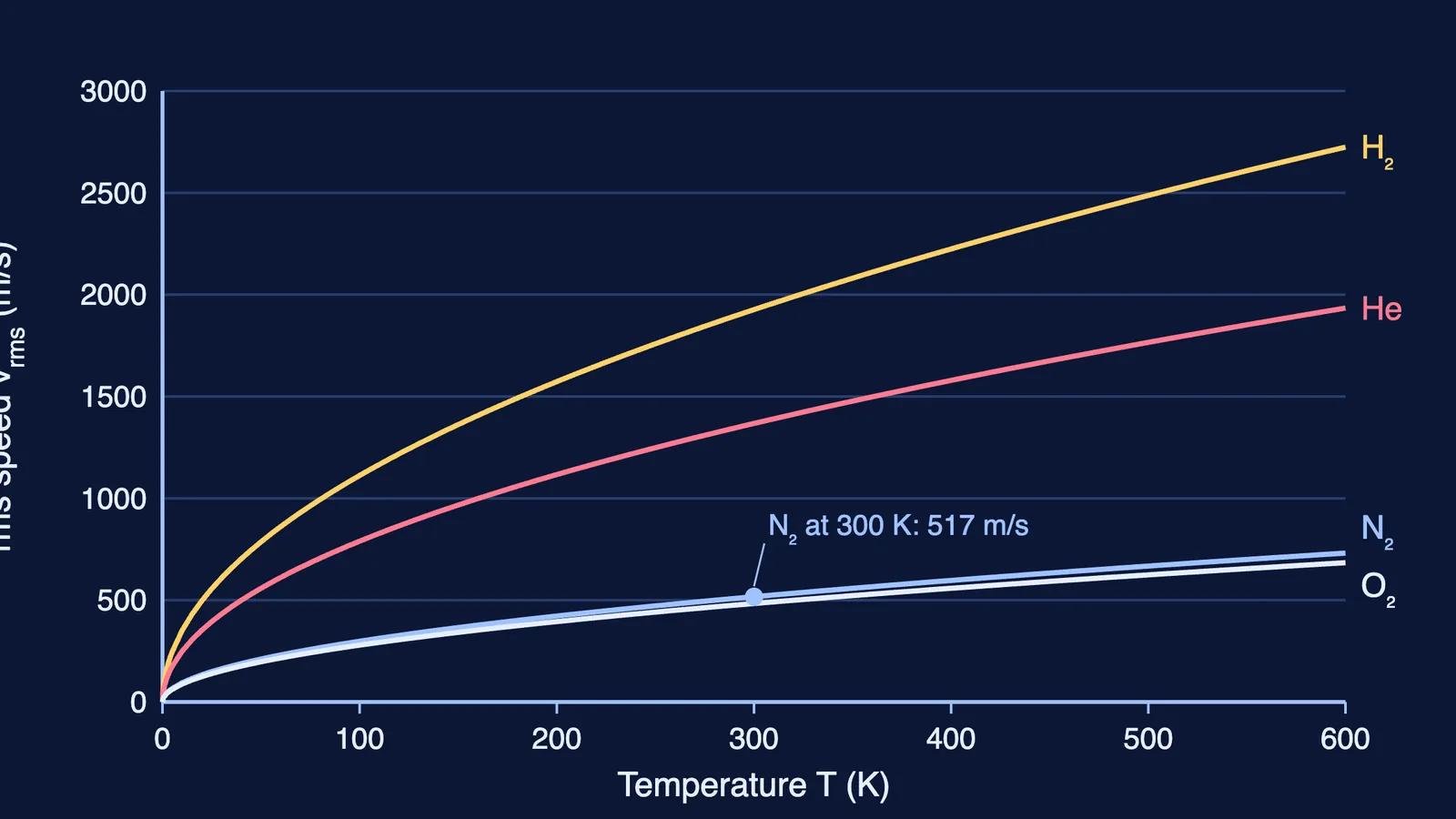
The graph above shows the pattern: vrms grows as √T, and lighter molecules move faster.
What practice questions should you try?
Short answer:
At the same temperature, which has the greater rms speed, hydrogen or oxygen? Give a reason.
State the law of equipartition of energy. How much energy does one vibrational mode carry?
Why does a monatomic gas have Cv = (3/2)R? Find γ for it.
Long answer:
List the assumptions of kinetic theory and derive P = (1/3)nm⟨v²⟩.
Show that each molecule carries an average kinetic energy of (3/2)kBT. By what factor must the absolute temperature rise to double vrms? (Answer: 4.)
Case-based: 2 mol of a rigid diatomic gas sits in a sealed, rigid container at 300 K. (a) Find its internal energy. (b) Find the heat needed to reach 330 K. (c) Would (b) change if the molecules also vibrated?
How should you revise this chapter?
Session one: write the derivation from memory and check it against the book. Session two: the equipartition table (degrees of freedom, Cv, Cp and γ for monatomic and rigid diatomic gases). Session three: mixed numericals. Our weekly plan for Class 11 physics shows how to space this alongside other chapters.
Not sure where to begin? Fermi's AI tutor can work out what you already know and build a plan for the session.