On this page
Hydrocarbons is the last unit of CBSE Class 11 Chemistry, and the one where you start predicting products. Here are the marks, the current NCERT coverage, two worked examples and practice questions.
How many marks is Hydrocarbons in CBSE Class 11?
In the CBSE Chemistry curriculum for 2026-27, Unit 9, Hydrocarbons, carries 10 of the 70 theory marks. It has its own row in the marks table, so the 10 belongs to this unit alone. Only Organic Chemistry: Some Basic Principles and Techniques carries more, at 11.
The curriculum lists the unit's content as classification, alkanes, alkenes, alkynes, aromatic hydrocarbons, and carcinogenicity and toxicity. Your textbook is Unit 9 of NCERT Chemistry Part II, marked Reprint 2026-27. It is the rationalised edition, so prefer it to older guides.
What does the 2026-27 NCERT chapter cover?
The NCERT chapter runs in this order:
Alkanes: IUPAC names and isomers; preparation from unsaturated hydrocarbons, alkyl halides (including the Wurtz reaction) and carboxylic acids (decarboxylation and Kolbe's electrolysis); halogenation, combustion, pyrolysis and other reactions; conformations of ethane.
Alkenes: the double bond, cis and trans isomers, preparation (Lindlar's catalyst, dehydrohalogenation, vicinal dihalides, acidic dehydration of alcohols), and additions including Markovnikov's rule, the peroxide effect, ozonolysis and polymerisation.
Alkynes: the triple bond, preparation from calcium carbide and vicinal dihalides, the acidic character of terminal alkynes, additions, and cyclic polymerisation of ethyne to benzene.
Aromatic hydrocarbons: the structure of benzene, aromaticity by Hückel's (4n + 2) rule, electrophilic substitution (nitration, halogenation, sulphonation, Friedel-Crafts), and ortho/para versus meta directing groups.
Carcinogenicity and toxicity: NCERT notes that benzene and polynuclear hydrocarbons with more than two fused benzene rings are toxic and can cause cancer.
Why is the staggered form of ethane more stable?
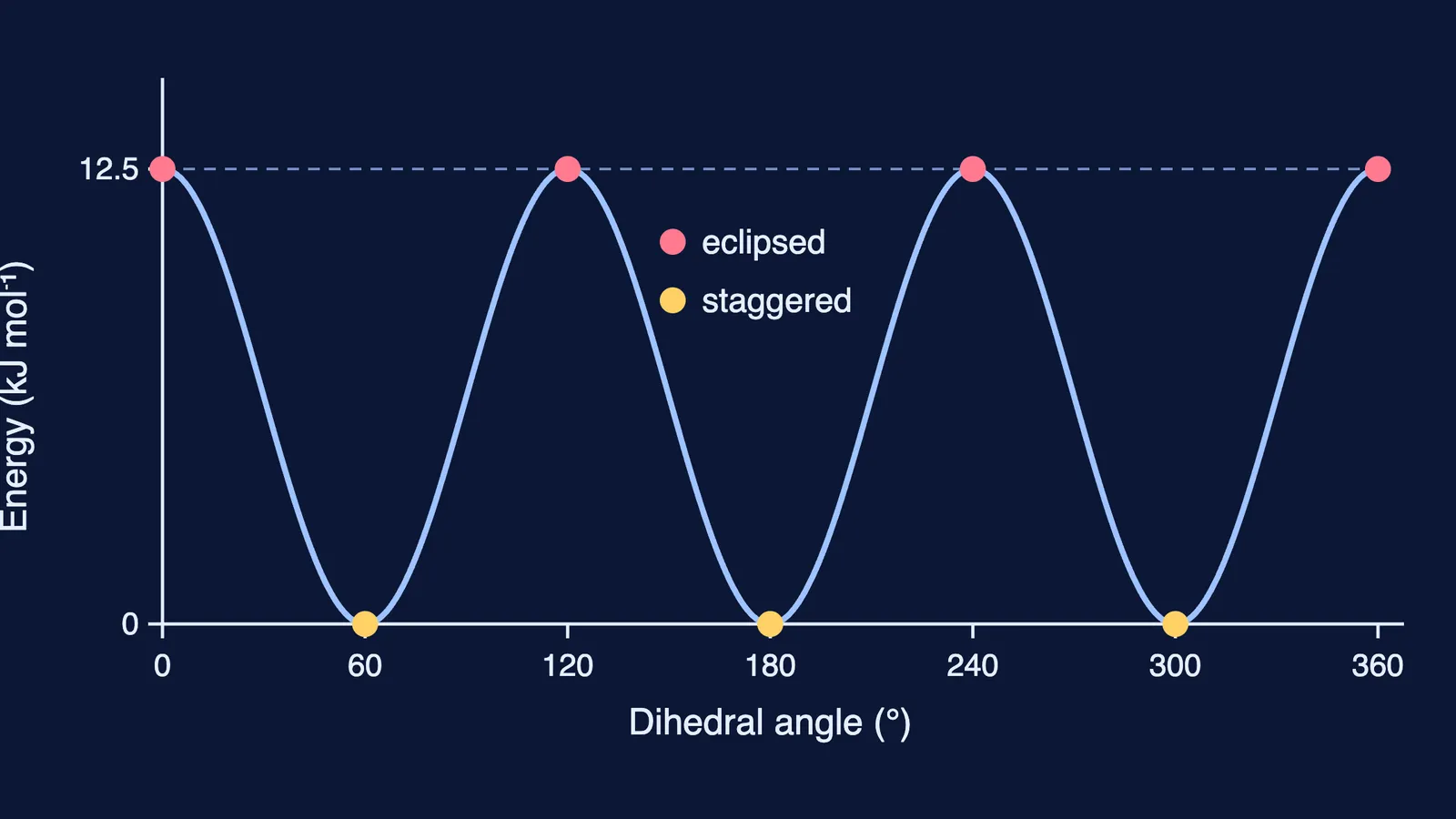
The hero graph shows it. As one carbon of ethane turns against the other, the energy rises to a maximum each time the C–H bonds line up (eclipsed) and falls to a minimum when they sit as far apart as possible (staggered). The NCERT chapter calls this repulsion torsional strain and puts the difference between the two forms at about 12.5 kJ mol⁻¹. Collisions overcome that at room temperature, so ethane's conformers cannot be separated. Practise drawing both forms as Sawhorse and Newman projections.
Two worked examples in board style
Example 1 (combustion). What mass of oxygen is needed to burn 29.0 g of butane completely, and what mass of carbon dioxide forms?
With n = 4 in NCERT's general combustion equation, each mole of C4H10 needs (3n + 1)/2 = 6.5 mol O2. So: 2C4H10 + 13O2 → 8CO2 + 10H2O.
Molar mass of butane = 4(12.0) + 10(1.0) = 58.0 g mol⁻¹, so 29.0 g is 0.500 mol.
Oxygen: 0.500 × 6.5 = 3.25 mol, and 3.25 × 32.0 = 104 g.
Carbon dioxide: 0.500 × 4 = 2.00 mol, and 2.00 × 44.0 = 88.0 g.
Check: water is 2.50 mol, or 45.0 g. Mass in, 29.0 + 104 = 133 g, equals mass out, 88.0 + 45.0 = 133 g.
Example 2 (addition of HBr). Predict the major product when 2-methylpropene, (CH3)2C=CH2, reacts with HBr (a) alone and (b) with benzoyl peroxide.
(a) H⁺ adds to the CH2 end, giving the more stable tertiary carbocation, (CH3)3C⁺. Bromide then attaches to it: 2-bromo-2-methylpropane, as Markovnikov's rule predicts.
(b) A bromine radical adds first, to the CH2 end, giving the more stable tertiary radical. The product is 1-bromo-2-methylpropane. NCERT notes this peroxide effect works only with HBr, not HCl or HI.
Board-style practice questions
We wrote these ourselves. The mark labels are our suggestion of how a school paper might weight them, not CBSE's.
(1 mark) Which conformation of ethane has the greatest torsional strain? *Eclipsed.*
(2 marks) Name the major product when but-1-ene reacts with HBr, first without and then with a peroxide. *2-Bromobutane; 1-bromobutane.*
(3 marks) Give the reagents for converting (a) pent-2-yne into cis-pent-2-ene and (b) benzene into bromobenzene. *(a) H2 over Lindlar's catalyst (palladised charcoal poisoned with quinoline or a sulphur compound). (b) Br2 with anhydrous FeBr3 as the Lewis acid.*
(3 marks) Calculate the mass of oxygen needed to burn 22.0 g of propane completely. *0.500 mol × 5 = 2.50 mol O2 = 80.0 g.*
(5 marks) An alkene of formula C5H10 gives propanone and ethanal on ozonolysis. Identify it, name its major product with HBr, and state whether it shows cis-trans isomerism. *2-Methylbut-2-ene; 2-bromo-2-methylbutane; no, because one double-bond carbon carries two methyl groups.*
How should you revise Hydrocarbons for the school exam?
Make one page per family (alkane, alkene, alkyne, benzene) with its preparations and reactions, conditions included. Then test the reverse: given the products, find the starting compound. For carbocation and radical stability, see our guide to organic chemistry basics for JEE Main. For cis and trans isomers in real food, see trans fat chemistry. Taking JEE too? Our Hydrocarbons for JEE Main guide covers the traps and a two-week plan.
If you do not know where to start, Fermi's AI tutor can work out what you already know and build a plan for the session.