

On this page
Whether a fat's carbon chain is straight or bent decides whether it is a runny oil or a solid block. That shape is the story of trans fat.
What is trans fat, chemically?
A fatty acid is a long carbon chain with a -COOH group at one end. A saturated fatty acid has only single C-C bonds; an unsaturated one has at least one C=C double bond.
A double bond cannot rotate without breaking its pi bond. So the two hydrogen atoms on a double bond are locked either on the same side (cis) or on opposite sides (trans). This is geometric isomerism, the same idea you meet with cis and trans but-2-ene.
FSSAI defines industrial trans fatty acids as the geometrical isomers of mono- and polyunsaturated fatty acids whose carbon-carbon double bonds are in the trans configuration (FSSAI press release, 8 February 2021).
Why does the geometry of the double bond matter?
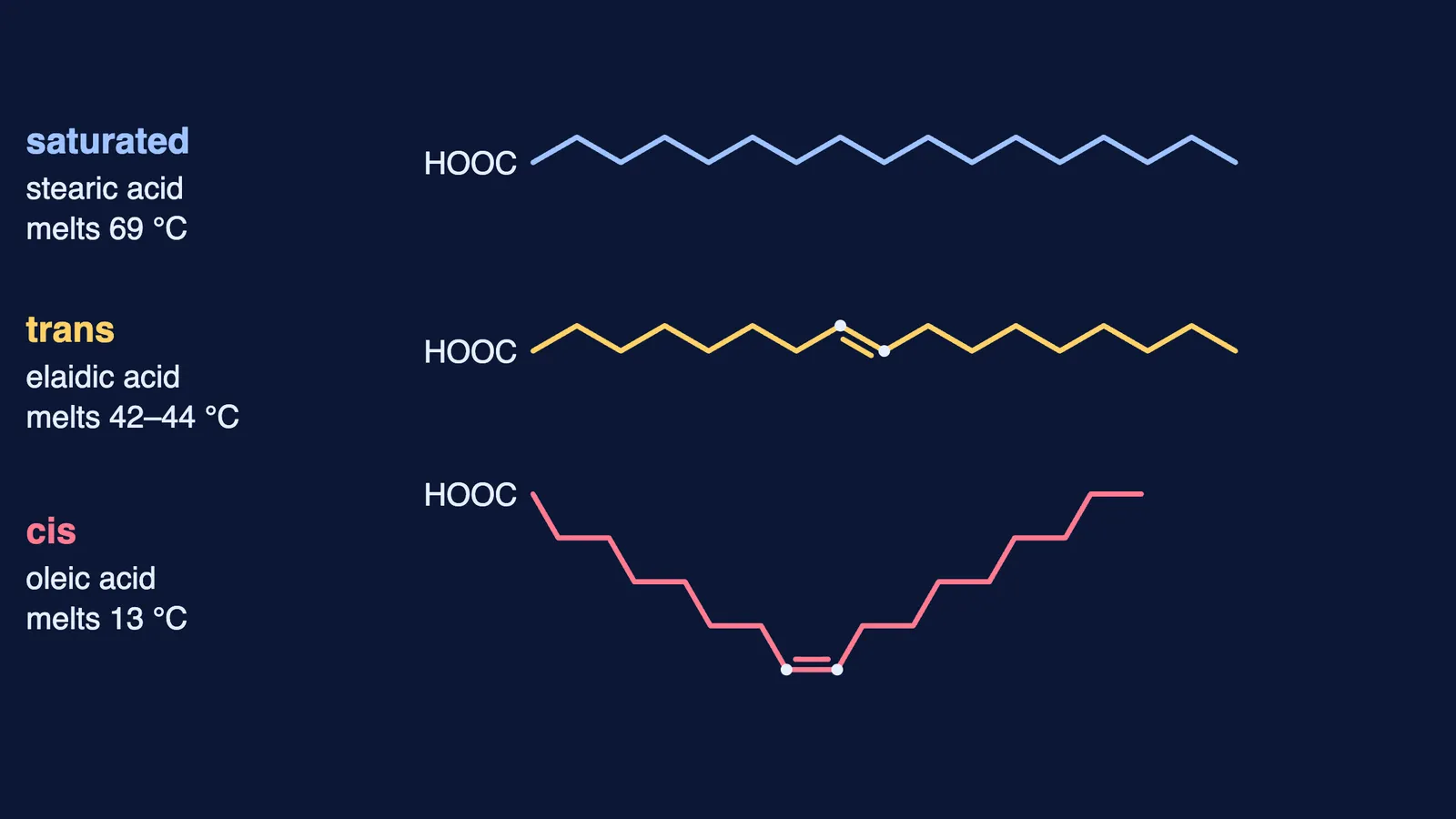
The diagram above shows three 18-carbon acids.
Stearic acid has no double bond. Its zigzag chain is straight, and it melts at 69.3 °C (PubChem: stearic acid).
Oleic acid has a cis double bond at carbon 9. The chain bends there, and it melts at 13.4 °C (PubChem: oleic acid).
Elaidic acid has the same double bond in the trans form. The chain stays almost straight, and it melts at 42-44 °C (PubChem: elaidic acid).
Straight chains lie close together, so the dispersion forces between them add up and you need more heat to pull them apart. A cis kink holds neighbours apart. That is why fats are solid and oils are liquid, and why a trans fat behaves more like a saturated fat than like the oil it came from.
How does hydrogenation of oil make trans fat?
Hydrogenation adds H2 across C=C double bonds on the surface of a metal catalyst such as nickel (catalytic hydrogenation over Ni, Pt and Pd). Stop part-way and you get partially hydrogenated oil, which is solid at room temperature.
One hydrogen adds to one carbon of the double bond, and for a moment the other carbon is held to the metal by a single bond, which can rotate. If that intermediate gives the hydrogen back, the double bond re-forms, and it can re-form in the more stable trans shape.
Partially hydrogenated oil contains on average 25-45% trans fat, according to the WHO trans fat fact sheet. WHO adds that natural trans fat in meat and dairy foods from cows, sheep and goats is equally harmful. In India, FSSAI says trans fats are largely found in vanaspati, margarine, bakery shortenings and other partially hydrogenated oils (FSSAI).
What is India's 2 percent trans fat limit?
FSSAI's rule has two parts (February 2021 press release):
Edible oils and fats: industrial trans fat no more than 3% by January 2021 and no more than 2% by January 2022.
Any food made with edible oils or fats: industrial trans fat no more than 2% by mass of the total oils and fats in the product, from 1 January 2022.
Trans fat from dairy, meat and fish is excluded. The limit matches the first of WHO's two best-practice options, a limit of 2 g of industrial trans fat per 100 g of total fat in all foods; the second is a ban on partially hydrogenated oils (WHO). WHO attributes more than 278,000 deaths a year worldwide to industrial trans fat, and FSSAI cited 2017 estimates that about 71,000 deaths a year in India from coronary heart disease are due to trans fat (FSSAI).
How do you check a food label against the 2% limit?
The limit is a share of the fat, not of the whole food. A worked example with a made-up biscuit pack:
Read the nutrition panel per 100 g: total fat 25 g, trans fat 0.4 g.
Divide trans fat by total fat: 0.4 / 25 = 0.016.
Multiply by 100: 1.6% of the fat is trans fat, under the 2% limit.
Had the panel said 0.6 g, you would get 2.4%, above it.
If the food contains butter, part of that may be dairy trans fat, which the limit does not count. WHO recommends that adults keep trans fat below 1% of total energy intake, which is less than 2.2 g a day on a 2,000-calorie diet (WHO). For advice about your own or a family member's health, talk to a doctor or a registered dietitian.
If the geometry is hard to picture, the Fermi Simulation Lab has interactive simulations for ideas easier to see than read, and the Fermi Concept Library lets you go back to pi bonds or intermolecular forces when a step depends on them.
Next time you pick up a packet of namkeen, find the fat lines and divide.


