

On this page
Butter sets hard in the fridge while groundnut oil stays runny. Both belong to the same family of molecules, so the difference comes from shape.
What makes a fat solid and an oil liquid at room temperature?
Triglycerides that are solid or semisolid at room temperature are called fats, and those that are liquid are called oils, as the LibreTexts organic chemistry chapter on lipids/10%3A_Alkenes/10.06%3A_LipidsPart_2) defines them. Both are one glycerol joined to three fatty acid chains. The same chapter notes that fats are made mostly of saturated fatty acids (only C–C single bonds) while oils are made mostly of unsaturated ones (with C=C double bonds). It gives lard a melting point near 30 °C and olive oil near −6 °C.
So "fat or oil" is really a question about melting point compared with the room you are in. A solid melts when its molecules get enough energy to slide past their neighbours. Long hydrocarbon chains hold each other mainly by London dispersion forces, and those forces grow with how much surface two chains share. The more closely the chains touch, the more heat it takes to separate them.
Why does a cis double bond lower the melting point?
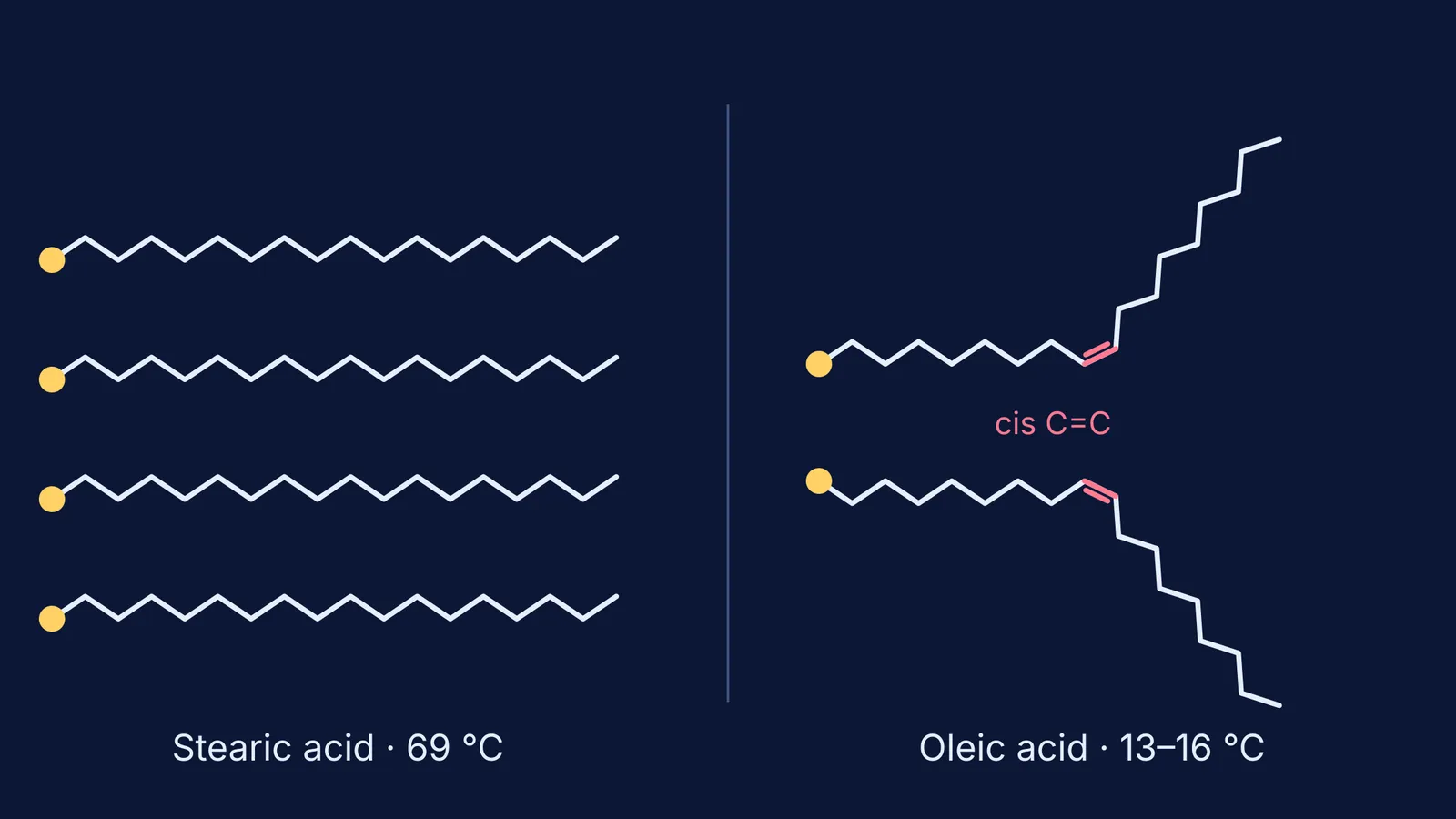
A saturated chain is a zigzag of carbon atoms that can stretch out almost straight. Lay several side by side and they nest like pencils in a box, touching along their whole length.
A double bond changes that. The atoms around C=C cannot rotate, and in natural fatty acids the double bond is almost always cis, according to the LibreTexts lipids chapter/10%3A_Alkenes/10.06%3A_LipidsPart_2). In a cis double bond, both parts of the chain leave from the same side, so the chain bends. Bent chains cannot stack neatly. They leave gaps and touch their neighbours over less length, so the attraction is weaker and the melting point lower.
How big is the effect? Four 18-carbon acids compared
The cleanest test keeps the chain length fixed at 18 carbons and changes only the double bonds. These melting points come from PubChem, the US National Library of Medicine's chemistry database:
Stearic acid, no double bonds: 69.3 °C (PubChem: stearic acid).
Elaidic acid, one trans double bond: 42–44 °C (PubChem: elaidic acid).
Oleic acid, one cis double bond: 13.4–16.3 °C (PubChem: oleic acid).
Linoleic acid, two cis double bonds: −6.9 °C (PubChem: linoleic acid).
One cis double bond takes more than 50 degrees off the melting point, and a second takes off roughly 20 more. Elaidic and oleic acid share the formula C18H34O2, yet the trans one melts about 30 degrees higher, because a trans double bond keeps the chain nearly straight so it packs better. Our post on why cis isomers boil higher but trans isomers melt higher shows the same pattern in smaller molecules.
Chain length is the second dial. Lauric acid is saturated but has only 12 carbons, and it melts at 43.8 °C (PubChem: lauric acid), far below stearic acid's 69.3 °C. A shorter chain has less surface to grip its neighbours.
Why does hydrogenation turn oil into vanaspati?
Add hydrogen across the double bonds and the kinks disappear, so the chains straighten, pack and melt higher. That is how liquid vegetable oil becomes a solid cooking fat, explained step by step in our post on why vegetable oils are hydrogenated to make vanaspati. The LibreTexts chapter/10%3A_Alkenes/10.06%3A_LipidsPart_2) adds a catch: partial hydrogenation can flip some leftover cis bonds to trans, producing trans fats, which it says appear to be associated with increased heart disease. For questions about your own diet, a doctor or registered dietitian is the right person to ask.
How do you write this answer in an exam?
Use these three steps for any "why is X solid and Y liquid" question:
Name the structure: saturated chains are straight; cis-unsaturated chains are kinked.
Name the consequence: straight chains pack closely; kinked chains cannot.
Name the force and the result: closer packing gives stronger London dispersion forces, so a higher melting point.
Worked example: arrange stearic, oleic, linoleic and elaidic acid in increasing order of melting point. All four have 18 carbons, so only the double bonds matter. Linoleic has two cis kinks, so it is lowest. Oleic has one cis kink. Elaidic has one double bond, but it is trans and the chain stays nearly straight. Stearic has no kinks at all. Answer: linoleic < oleic < elaidic < stearic, which matches the PubChem values above.
If intermolecular forces themselves feel shaky, the Fermi Concept Library has its own lesson for every concept in chemistry and biology, so you can revisit London dispersion forces before coming back to fats. For more ordering questions like the one above, the Fermi Problem Library has worked problems with a step-by-step solver that explains the reasoning rather than printing an answer.
The same idea shows up again in cell membranes and NEET biology; see saturated vs unsaturated fatty acids with biology examples next.


