

On this page
Of two geometrical isomers, the cis form usually has the higher boiling point and the trans form the higher melting point. That looks contradictory until you see that boiling and melting test different things. NCERT's Class 11 hydrocarbons chapter notes that the two forms differ in melting point, boiling point and dipole moment. Here is the reasoning behind the pattern, three worked cases, and a way to write the answer.
Why does the cis isomer usually boil higher?
Each bond between a double-bond carbon and a group such as CH3 or Cl has a small bond dipole. In the cis isomer, both groups sit on the same side of the double bond, so their dipoles add up to a net dipole. In the trans isomer they point in opposite directions and cancel.
NCERT gives the dipole moment of cis-but-2-ene as 0.33 D and calls the trans form non-polar (NCERT Class 11 Chemistry, Unit 9). The NIST Computational Chemistry Comparison and Benchmark Database lists a measured dipole moment of 0.257 D for cis-but-2-ene and 0 for trans (NIST CCCBDB). The same table gives 1.900 D for cis-1,2-dichloroethene and 0 for the trans isomer.
In the liquid, polar molecules line up positive end to negative end. These dipole-dipole attractions add to the dispersion forces both isomers share, so the cis isomer needs more energy to escape into vapour.
Why does the trans isomer usually melt higher?
To melt, you have to break up a crystal. A trans isomer is straighter and more symmetrical, so its molecules stack closely with many contacts. A cis isomer has a bend that leaves gaps in the lattice. Better packing means a stronger lattice and a higher melting point. NCERT states that in solids the trans isomer has a higher melting point than the cis form (NCERT Class 11 Chemistry, Unit 9).
What do but-2-ene, dichloroethene and but-2-enedioic acid show?
But-2-ene
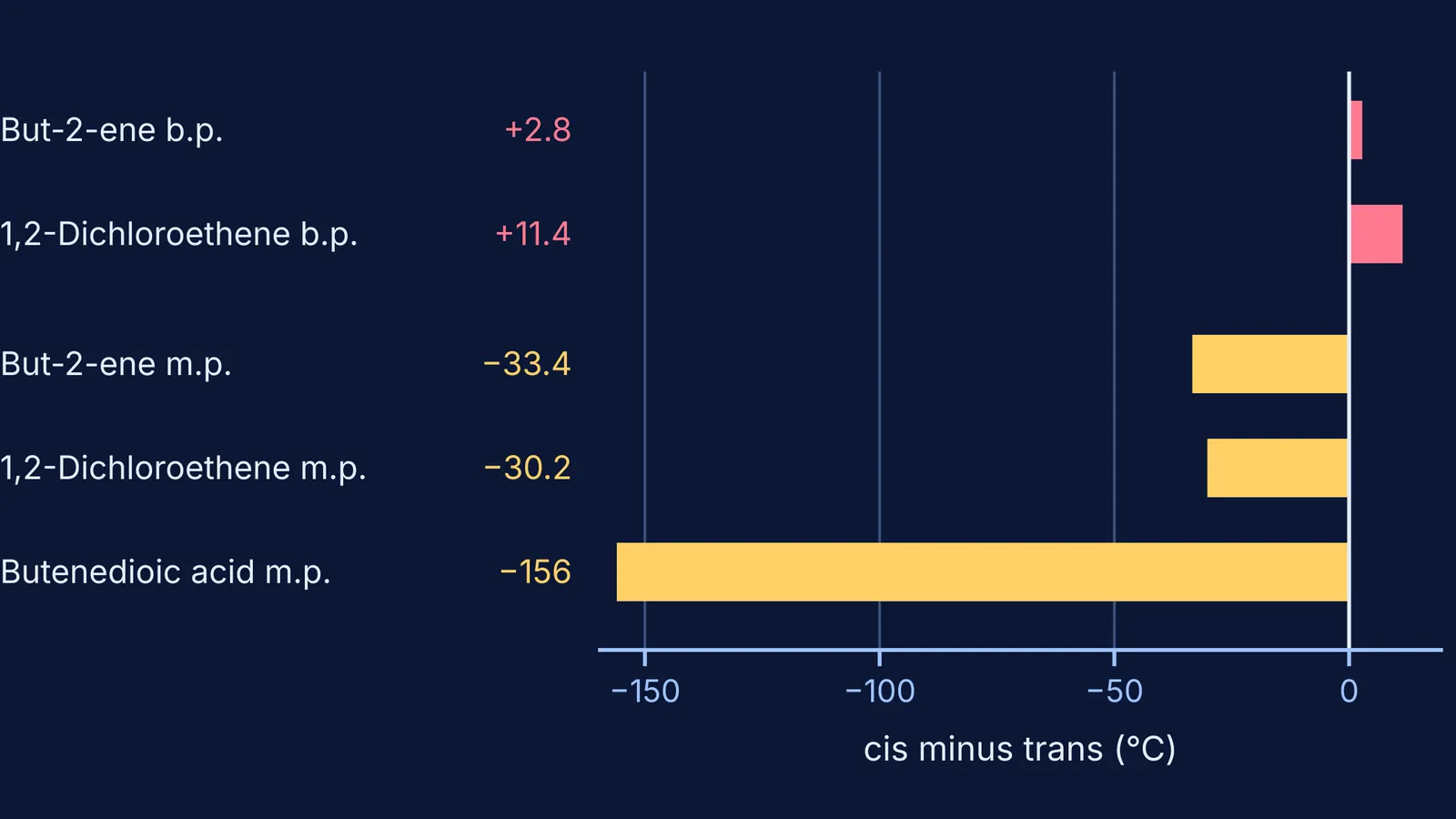
Cis-but-2-ene boils at 3.7 °C and trans-but-2-ene at 0.9 °C (PubChem, cis-2-butene; PubChem, trans-2-butene, both citing the ILO-WHO safety cards). They melt at −138.9 °C and −105.5 °C (US Department of Energy data on the same PubChem pages). The 0.257 D dipole is tiny, so the boiling gap is under 3 °C. The packing gap in melting is over 33 °C.
1,2-Dichloroethene
C–Cl bonds are far more polar than C–CH3 bonds, and the boiling gap grows. Cis-1,2-dichloroethene boils at 60.1 °C and the trans isomer at 48.7 °C (PubChem, cis; PubChem, trans). The melting points still favour trans: −80 °C for cis and −49.8 °C for trans.
But-2-enedioic acid
The cis acid is maleic acid; the trans acid is fumaric acid. Maleic acid melts at 131 °C (PubChem, maleic acid), while fumaric acid melts with decomposition at 287 °C (PubChem, fumaric acid). That is a gap of 156 °C, much larger than in the hydrocarbons, because hydrogen bonding joins the packing effect.
In fumaric acid, the two COOH groups point away from each other, so each can hydrogen-bond to a neighbouring molecule, linking them into chains through the crystal. In maleic acid, the two COOH groups are close enough to hydrogen-bond to each other inside one molecule. That uses up bonding capacity that could have held neighbours together, the same idea as intramolecular hydrogen bonding in o-nitrophenol. PubChem also quotes the Merck Index: maleic acid heated slightly above its melting point is partly converted into fumaric acid.
How do you answer a cis-trans question in an exam?
Draw both isomers and mark the groups on each double-bond carbon.
Check whether the question asks about boiling or melting.
For boiling, sketch the bond dipoles as arrows. Do they add up (net dipole) or cancel?
For melting, ask which shape is straighter and more symmetrical, so packs better.
Check for OH or COOH groups. Can they hydrogen-bond to neighbours, or are they tied up inside the molecule?
Write one line that names the force or effect.
Worked example. Question: which isomer of 1,2-dichloroethene has the higher boiling point, and why? Model answer: "The cis isomer. Its two C–Cl bond dipoles add up to give a net dipole moment, while in the trans isomer they cancel. The cis molecules attract each other through extra dipole-dipole forces, so more energy is needed to boil them." For a "give reasons" paper, our guide to answering give-reasons questions in CBSE Class 12 chemistry shows how to keep this to the point.
If adding bond dipoles as vectors is the shaky step, the Fermi Concept Library covers every concept in chemistry, each with its own lesson and its place in the map. For practice, the Fermi Problem Library has worked problems with a step-by-step solver that explains the reasoning rather than printing an answer.
Next, see how geometry also controls optical isomers in our guide to counting stereoisomers from chiral centres.


