On this page
Thermodynamics is Chapter 5 of NCERT Chemistry Part I, and this guide follows the current NCERT chapter (Reprint 2026-27) for the CBSE Class 11 school exam. For the entrance exam, read how to prepare Chemical Thermodynamics for JEE Main.
How many marks is Thermodynamics in Class 11 Chemistry for 2026-27?
In the CBSE Chemistry curriculum for 2026-27, Unit 5, Chemical Thermodynamics, has its own row in the Class XI theory table: 9 of the 70 theory marks. Only three units carry as many or more.
The unit lists thermodynamic terms, applications, measurement of ∆U and ∆H by calorimetry, reaction enthalpy, enthalpies for different types of reactions, spontaneity, and Gibbs energy change and equilibrium. These match sections 5.1 to 5.7 of the reprint, which ends at ∆rG° = −RT ln K. The curriculum's question paper design sets no chapter-wise weightage.
Which sign convention does chemistry use?
NCERT Chemistry follows the IUPAC convention: the first law is ∆U = q + w, and both q and w are positive when energy goes into the system. Work of expansion against a constant external pressure is w = −pex∆V.
Your Class 11 Physics Thermodynamics chapter writes ∆Q = ∆U + ∆W, with work done by the gas positive. NCERT's own footnote says physics books still use the older convention.
Worked example. A gas absorbs 500 J of heat and does 200 J of work on the surroundings. Chemistry: q = +500 J, w = −200 J, so ∆U = +300 J. Physics: ∆Q = 500 J, ∆W = +200 J, so ∆U = 500 − 200 = +300 J. Same ∆U, opposite sign on work.
How do ∆H = ∆U + ∆ngRT and Hess's law work?
At constant pressure, the heat absorbed equals the enthalpy change, ∆H = qp, and NCERT derives ∆H = ∆U + ∆ngRT, where ∆ng is moles of gaseous products minus moles of gaseous reactants. Count gases only.
Hess's law says a reaction's standard enthalpy is the sum of the enthalpies of any set of steps that add up to it, because H is a state function. Reverse an equation and you flip the sign of ∆H; multiply it and you multiply ∆H.
Worked example. Find ∆fH° of ethene, C2H4(g), given ∆cH° = −1411.0 kJ mol⁻¹ (a given value for this exercise) and NCERT's ∆fH° values of −393.5 kJ mol⁻¹ for CO2(g) and −285.83 kJ mol⁻¹ for H2O(l).
Combustion: C2H4(g) + 3O2(g) → 2CO2(g) + 2H2O(l).
∆cH° = [2(−393.5) + 2(−285.83)] − ∆fH°(C2H4), since ∆fH° of O2 is zero.
−1411.0 = −1358.66 − ∆fH°(C2H4).
∆fH°(C2H4) = +52.34 kJ mol⁻¹.
For more cycles of this kind, see our guide to building Hess's law cycles.
When is a reaction spontaneous: entropy or Gibbs energy?
A fall in enthalpy alone cannot decide spontaneity: NCERT shows endothermic reactions that are spontaneous. Entropy S measures disorder, and for a spontaneous process ∆Stotal = ∆Ssys + ∆Ssurr > 0. For the system alone, the test is the Gibbs equation, ∆G = ∆H − T∆S: a process is spontaneous at constant temperature and pressure when ∆G is negative.
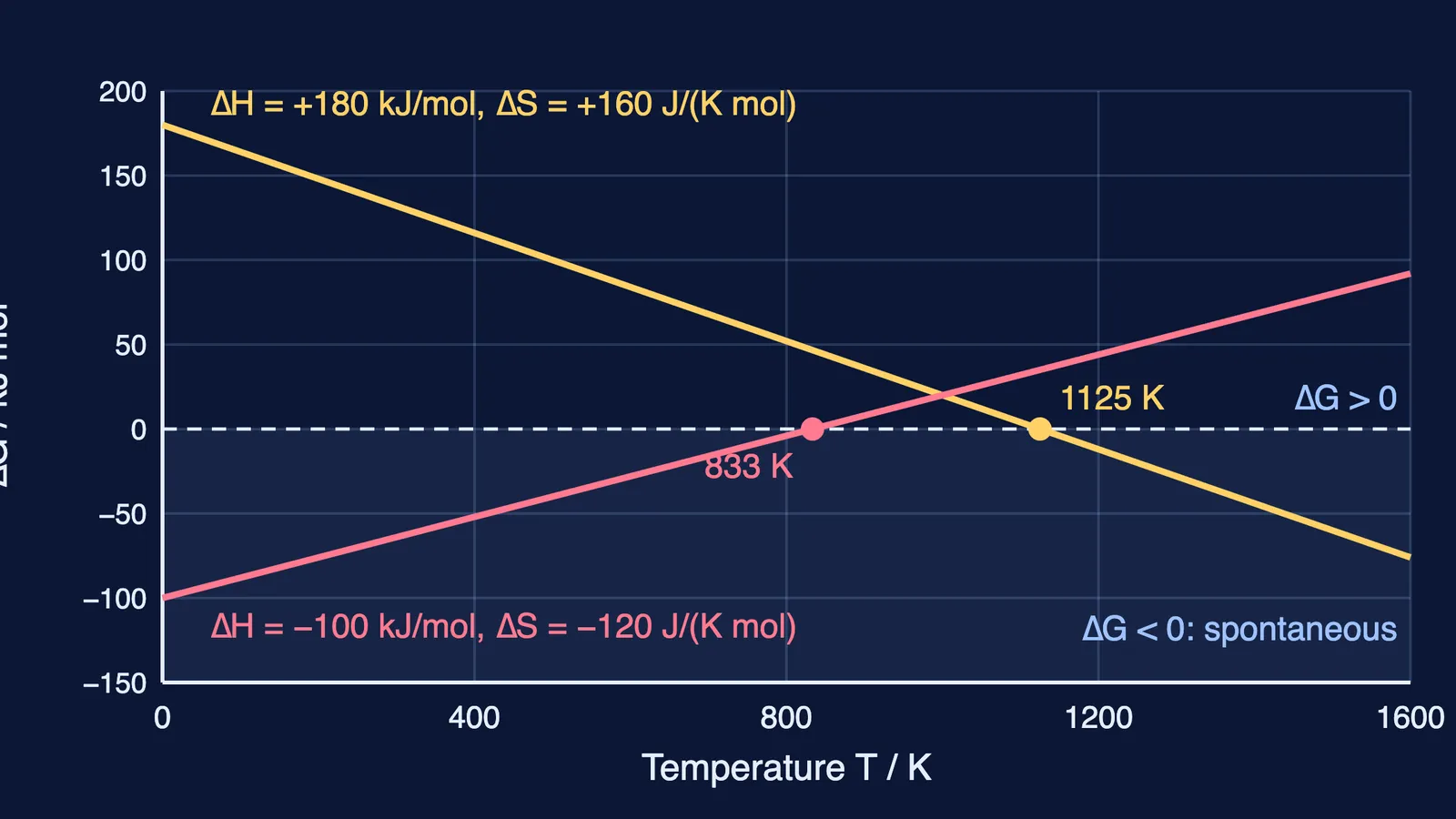
Worked example. A reaction has ∆H = +180 kJ mol⁻¹ and ∆S = +160 J K⁻¹ mol⁻¹. First convert ∆S to 0.160 kJ K⁻¹ mol⁻¹.
At 298 K: ∆G = 180 − 298 × 0.160 = +132.3 kJ mol⁻¹, so not spontaneous.
∆G = 0 when T = ∆H/∆S = 180/0.160 = 1125 K.
At 1300 K: ∆G = 180 − 208 = −28 kJ mol⁻¹, so spontaneous.
The diagram above plots this line and a second reaction with both signs negative, which is spontaneous only below 833 K. NCERT's Table 5.4 sets out all four sign combinations.
Board-style practice questions
Our own questions; the mark labels are our suggestion, and your school sets the paper. The 2026-27 Class XII Chemistry sample paper shows the formats CBSE uses (1-mark MCQs, then 2-, 3-, 4- and 5-mark questions) and does not allow calculators.
(1 mark) Which of these is not a state function: U, H, q or G? Answer: q.
(2 marks) A system releases 120 J of heat and does 80 J of work. Find ∆U using the IUPAC convention. Answer: −200 J.
(3 marks) For 2CO(g) + O2(g) → 2CO2(g), ∆U = −563.5 kJ mol⁻¹ at 298 K. Find ∆H (R = 8.314 J K⁻¹ mol⁻¹). Answer: ∆ng = −1, so ∆H = −566.0 kJ mol⁻¹.
(3 marks) A reaction has ∆H = −100 kJ mol⁻¹ and ∆S = −120 J K⁻¹ mol⁻¹. Find ∆G at 300 K and the temperature above which it stops being spontaneous. Answer: −64 kJ mol⁻¹; about 833 K.
(5 marks) Starting from H = U + pV, derive ∆H = ∆U + ∆ngRT, and say when ∆H and ∆U are nearly equal. Answer: when ∆ng = 0 or only solids and liquids take part.
If a step keeps going wrong, Fermi's AI tutor can work out what you already know and build a plan for the session, so you sit down to a clear next step.