On this page
Thermodynamics is Chapter 11 of NCERT Physics Part II, and this guide follows the current NCERT text (Reprint 2026-27) for the CBSE school exam. For the entrance exam, read how to prepare Thermodynamics for JEE Main.
What does Thermodynamics cover in the 2026-27 CBSE syllabus?
The CBSE Physics curriculum for 2026-27 puts the chapter in Unit VIII: thermal equilibrium and the zeroth law; heat, work and internal energy; the first and second laws; state variables and the equation of state; and isothermal, adiabatic, reversible, irreversible and cyclic processes.
Marks are printed per group of units: Units VII, VIII and IX (Chapters 8 to 12) share one cell of 20 of the 70 theory marks; there is no separate figure for Thermodynamics. For Class XI the curriculum says content NCERT marks as excluded for 2026-27 is not to be tested by schools. The reprint ends at 11.11, the Carnot engine; heat engines and refrigerators have no sections of their own.
Which sign convention does NCERT use in the first law?
NCERT writes the first law as ∆Q = ∆U + ∆W, where ∆Q is heat supplied to the system and ∆W is work done by the system. So:
Heat absorbed: ∆Q positive; heat released: negative.
Gas expands: ∆W positive; gas compressed: negative.
∆U positive: internal energy (for an ideal gas, temperature) rises.
∆U depends only on the start and end states; ∆Q and ∆W depend on the path. On a P-V diagram, work is the area under the curve; for a cycle it is the enclosed area, positive when the loop runs clockwise.
Worked example: a three-step cycle on a P-V diagram
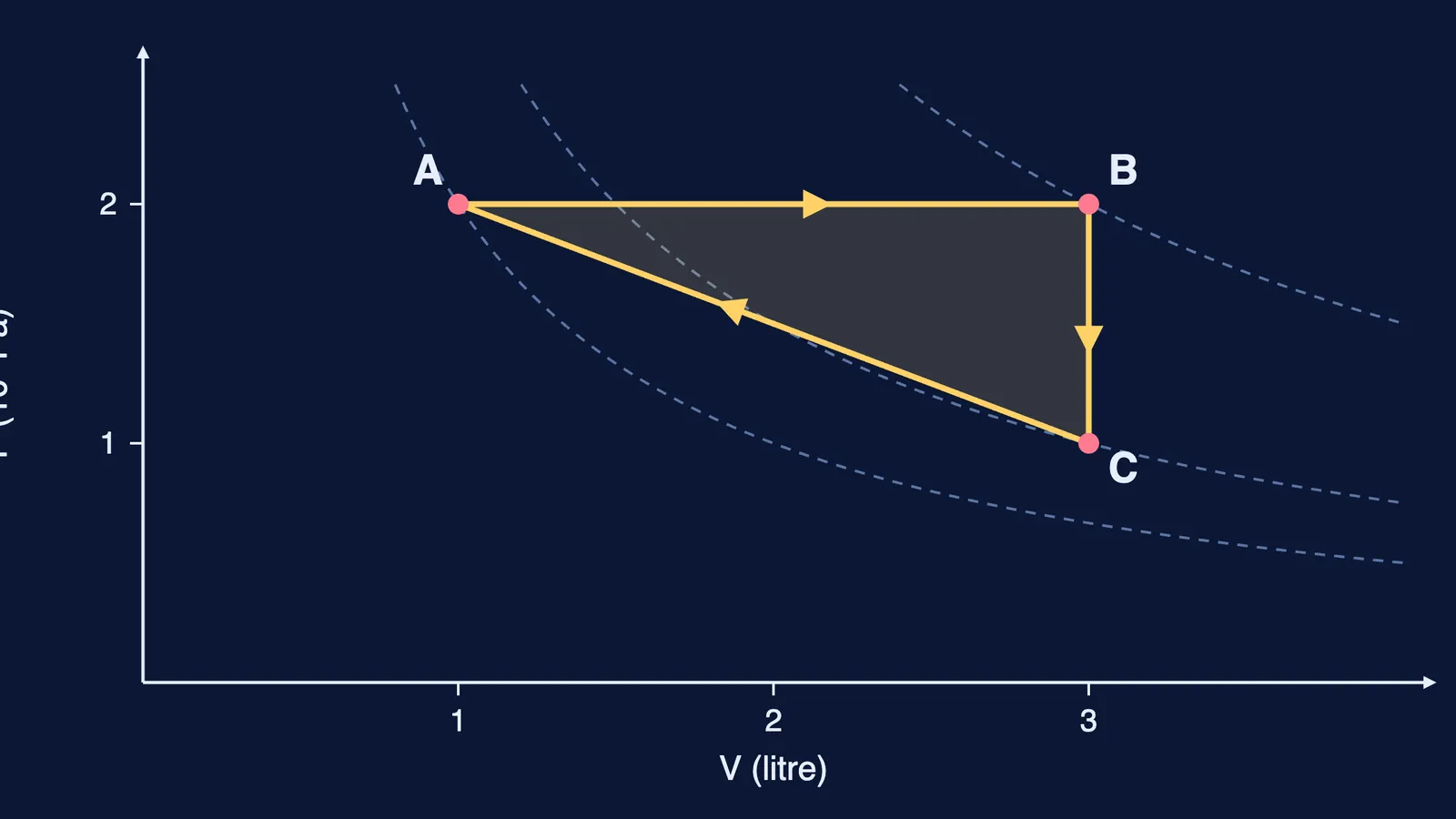
A gas goes round the cycle in the diagram. A to B: constant pressure 2.0 × 10⁵ Pa, volume 1.0 L to 3.0 L, absorbing 1000 J. B to C: constant volume, pressure falls to 1.0 × 10⁵ Pa, releasing 450 J. C to A: a straight line back to A. Find ∆W, ∆U and ∆Q for each step (1 L = 10⁻³ m³).
A to B (isobaric). ∆W = P∆V = 2.0 × 10⁵ × 2.0 × 10⁻³ = +400 J. ∆U = ∆Q − ∆W = 1000 − 400 = +600 J.
B to C (isochoric). ∆V = 0, so ∆W = 0 and ∆U = ∆Q = −450 J.
C to A. Compression, so work is negative; the area under the line is a trapezium: ∆W = −½(1.0 + 2.0) × 10⁵ × 2.0 × 10⁻³ = −300 J. Over the full cycle ∆U = 0, so ∆U for C to A = −(600 − 450) = −150 J, and ∆Q = ∆U + ∆W = −150 − 300 = −450 J.
Check. Net work = 400 + 0 − 300 = +100 J, the triangle's area. Net heat = 1000 − 450 − 450 = +100 J, equal to net work, as a cycle requires.
What do the four processes do to ∆Q, ∆W and ∆U?
Isothermal (ideal gas): ∆U = 0, so ∆Q = ∆W = µRT ln(V₂/V₁).
Adiabatic: ∆Q = 0 and PV^γ = constant, so ∆U = −∆W. Expansion cools; compression heats.
Isochoric: ∆W = 0, so ∆Q = ∆U.
Isobaric: ∆W = P(V₂ − V₁); heat splits between ∆U and work.
What does the second law add, and where does Carnot fit?
NCERT gives two equivalent statements: Kelvin-Planck rules out turning heat from a reservoir completely into work as the sole result, and Clausius rules out heat passing from colder to hotter as the sole result. So no heat engine reaches 100% efficiency.
A Carnot engine (two isothermal and two adiabatic steps) is the reversible engine between a hot reservoir T₁ and a cold one T₂, with η = 1 − T₂/T₁. Example: between 500 K and 300 K, η = 0.40. If it absorbs Q₁ = 2000 J, then W = 800 J and Q₂ = 1200 J; Q₁/Q₂ = 5/3 = T₁/T₂.
Board-style practice questions
(1 mark) What is ∆U for an ideal gas in an isothermal expansion? Answer: zero.
(2 marks) 250 J of work is done on a gas in an insulated cylinder. Find ∆Q, ∆W, ∆U; does T rise? Answer: 0, −250 J, +250 J; it rises.
(3 marks) A Carnot engine works between 600 K and 400 K and absorbs 900 J per cycle. Find η, W and Q₂. Answer: 1/3, 300 J, 600 J.
(5 marks) Derive an expression for the work an ideal gas does when it expands at constant temperature; find it for 1 mol at 300 K as the volume doubles (R = 8.314 J mol⁻¹ K⁻¹). Answer: 1.73 × 10³ J.
The curriculum points to the 2026-27 Class XII Physics sample paper for question design: 1-mark MCQs and assertion-reason items, 2-, 3- and 5-mark questions, and 4-mark case studies.
To fit the chapter into your term, use our study plan for Class 11 Physics. If a step stays unclear, Fermi's AI tutor can work out what you already know and build a plan for the session, so you sit down to a clear next step.