On this page
Most Waves marks in Class 11 come from four skills: reading a wave equation, finding wave speed, fitting standing waves into strings and pipes, and solving beats. Below: the syllabus, four solved numericals and practice questions.
What does the CBSE 2026-27 syllabus include in Waves?
The CBSE Physics curriculum for 2026-27 puts Waves in Unit X, Oscillations and Waves, as Chapter 14. It lists transverse and longitudinal waves, wave speed, the progressive wave relation, superposition, reflection, standing waves in strings and organ pipes, harmonics and beats.
Marks are printed for groups of units. Unit X has one merged cell of 10 out of 70 theory marks, shared by Chapters 13 and 14, so Waves has no separate figure.
Its practical list includes two sonometer experiments and the speed of sound with a resonance tube, so this chapter also feeds your lab exam.
The current NCERT Class 11 Physics Part II chapter (Reprint 2026-27) runs from 14.1 Introduction to 14.7 Beats. It has no Doppler effect section, so leave Doppler out.
Which formulas and derivations do you need?
From the NCERT chapter, in its notation:
Progressive wave. y(x, t) = a sin(kx – ωt + φ), with k = 2π/λ, ω = 2πν and v = ω/k = νλ.
Speed on a stretched string. v = √(T/μ), where μ is mass per unit length.
Speed of sound. Newton's isothermal formula v = √(P/ρ) gives 280 m s⁻¹ for air at STP, about 15% below the measured 331 m s⁻¹. Laplace's adiabatic correction gives v = √(γP/ρ).
Reflection. Phase reversal at a rigid boundary; none at an open one.
Standing wave on a string. y(x, t) = [2a sin kx] cos ωt. Adjacent nodes are λ/2 apart. With both ends fixed, ν = nv/2L, n = 1, 2, 3...
Pipe closed at one end. ν = (n + ½)v/2L, n = 0, 1, 2..., so only odd multiples of v/4L. A pipe open at both ends has ν = nv/2L.
Beats. ν_beat = ν₁ ~ ν₂.
Practise deriving result 5 and the Laplace correction; both make natural long answers.
How do you solve Class 11 waves numericals?
These use our own numbers.
1. Read a wave equation. y = 0.02 sin(8.0x – 400t), in SI units. k = 8.0 rad m⁻¹, so λ = 2π/8.0 = 0.785 m. ω = 400 rad s⁻¹, so ν = 400/2π = 63.7 Hz. v = ω/k = 50 m s⁻¹. Opposite signs on x and t mean it moves along +x.
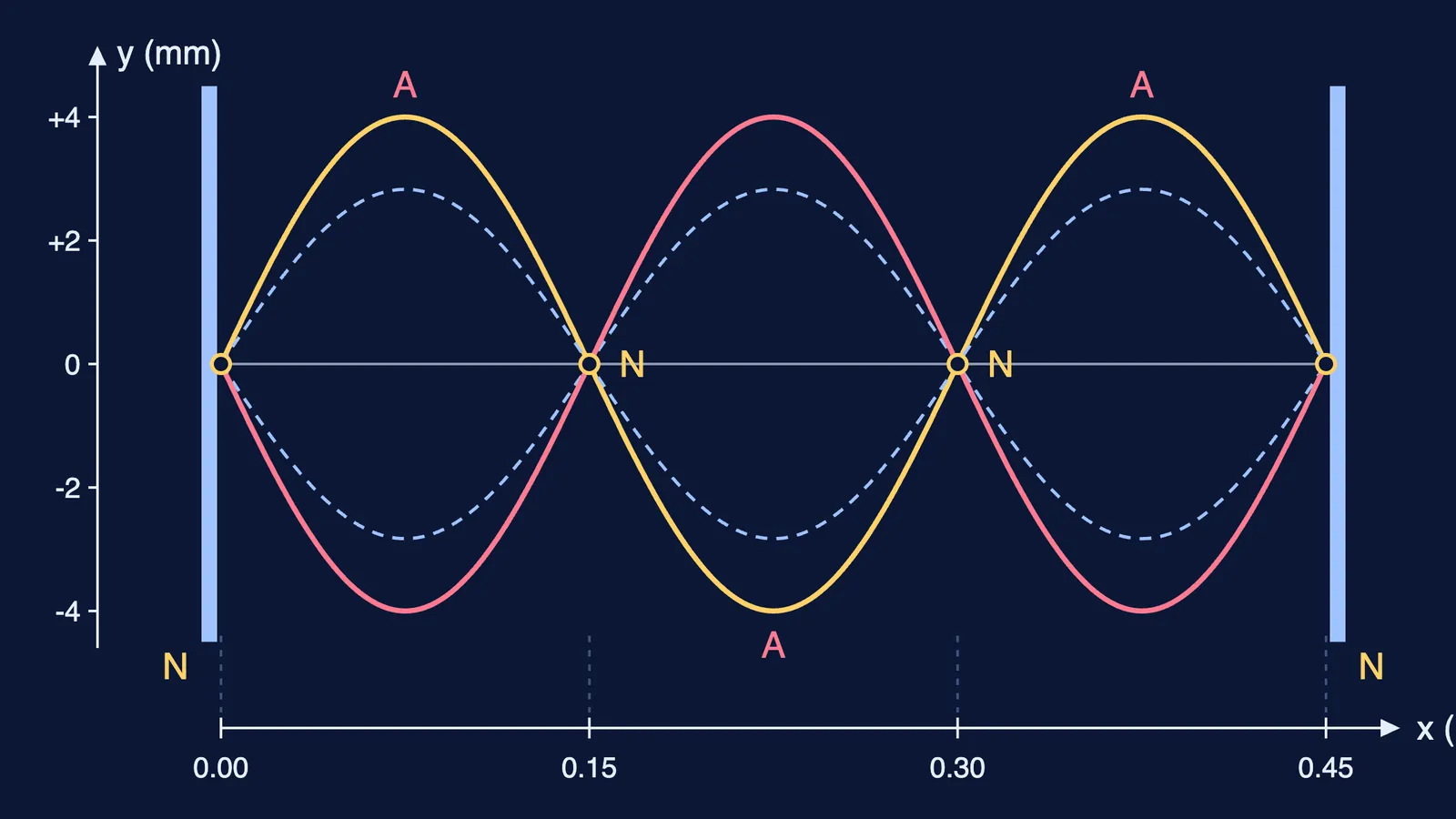
2. A sonometer wire. Tension T = 81 N, μ = 0.010 kg m⁻¹, vibrating length L = 0.45 m. v = √(81/0.010) = √8100 = 90 m s⁻¹. Fundamental: ν₁ = v/2L = 90/0.90 = 100 Hz. Third harmonic: 300 Hz, with λ = 2L/3 = 0.30 m and nodes at 0, 0.15, 0.30 and 0.45 m (the diagram). Four times the tension doubles v, so ν₁ becomes 200 Hz.
3. Resonance tube. A 512 Hz fork gives resonances at air columns of 16.0 cm and 49.6 cm. Successive resonances are λ/2 apart, so λ = 2 × (49.6 – 16.0) = 67.2 cm and v = νλ = 512 × 0.672 = 344 m s⁻¹. The first resonance is λ/4 = 16.8 cm, so the end correction is 16.8 – 16.0 = 0.8 cm.
4. Beats with loading. An unknown fork gives 7 beats per second with a 384 Hz fork, so it is 377 Hz or 391 Hz. Wax lowers its frequency, and the beats rise to 9 per second. Lowering 391 Hz would reduce the beats, so the fork was 377 Hz.
What questions can you practise for the exam?
(1 mark, assertion-reason) Assertion: sound cannot travel through vacuum. Reason: sound is a mechanical wave and needs a medium. *Both are true, and the reason explains the assertion.*
(2 marks) A pipe 21.5 cm long is closed at one end. Taking v = 344 m s⁻¹, find its two lowest frequencies. *v/4L = 400 Hz, then 3v/4L = 1200 Hz.*
(2 marks) How long must a pipe open at both ends be to have the same fundamental as the pipe in Q2? *v/2L = 400 Hz gives L = 0.43 m.*
(3 marks) Why does Newton's formula underestimate the speed of sound in air? State Laplace's correction. *The changes are adiabatic, so B = γP.*
(5 marks) Superpose a sin(kx – ωt) and a sin(kx + ωt). Locate the nodes and antinodes, and derive ν = nv/2L for a string fixed at both ends.
How should you revise Waves before the exam?
Write the seven results from a blank page in one session; spend a second on mixed numericals, labelling each error as wrong formula, wrong count of half wavelengths or arithmetic.
If you also sit JEE Main, our Waves and sound for JEE Main guide adds harder numericals and a one-week plan. To fit this chapter into your year, use this study plan for Class 11 physics.
If you are not sure where to start, Fermi's AI tutor can work out what you already know and build a plan for the session.