On this page
Mechanical Properties of Solids is where a "rigid" body finally stretches. This guide is for the CBSE Class 11 school exam: what the 2026-27 syllabus keeps, how the marks are printed, a worked Young's modulus numerical and board-style practice. For the entrance-exam angle, see our Properties of Solids and Liquids for JEE Main guide.
What does the 2026-27 CBSE syllabus include, and how many marks?
In the CBSE Physics curriculum for 2026-27, this is Chapter 8 in Unit VII, Properties of Bulk Matter, with the fluids and thermal properties chapters. The marks table prints one merged figure of 20 marks for Units VII, VIII (Thermodynamics) and IX (Behaviour of Perfect Gases and Kinetic Theory of Gases) together, out of 70 for the 3-hour theory paper. There is no separate figure for this chapter.
The syllabus lists elasticity, stress-strain, Hooke's law, Young's, bulk and shear moduli, Poisson's ratio and elastic energy. The shear modulus and the applications of elastic behaviour are marked "qualitative idea only", so explain those in words. Study from the current NCERT Physics Part II chapter (Reprint 2026-27), sections 8.1 to 8.6.
What are stress, strain and the elastic moduli?
Definitions as in the NCERT chapter:
Stress is the restoring force divided by the area, F/A, in N m⁻² or pascal (Pa).
Strain is the fractional change in a dimension: ΔL/L, shearing strain θ, or ΔV/V. It has no unit.
Hooke's law: for small deformations, stress is proportional to strain.
Young's modulus Y = σ/ε = (F × L)/(A × ΔL).
Shear modulus G = F/(A × θ); for most materials G ≈ Y/3.
Bulk modulus B = −p/(ΔV/V). The minus sign keeps B positive; its reciprocal is the compressibility k.
Poisson's ratio is lateral strain over longitudinal strain; NCERT gives 0.28 to 0.30 for steels.
Elastic energy per unit volume of a stretched wire is u = ½ σ ε.
How do you read the stress-strain curve?
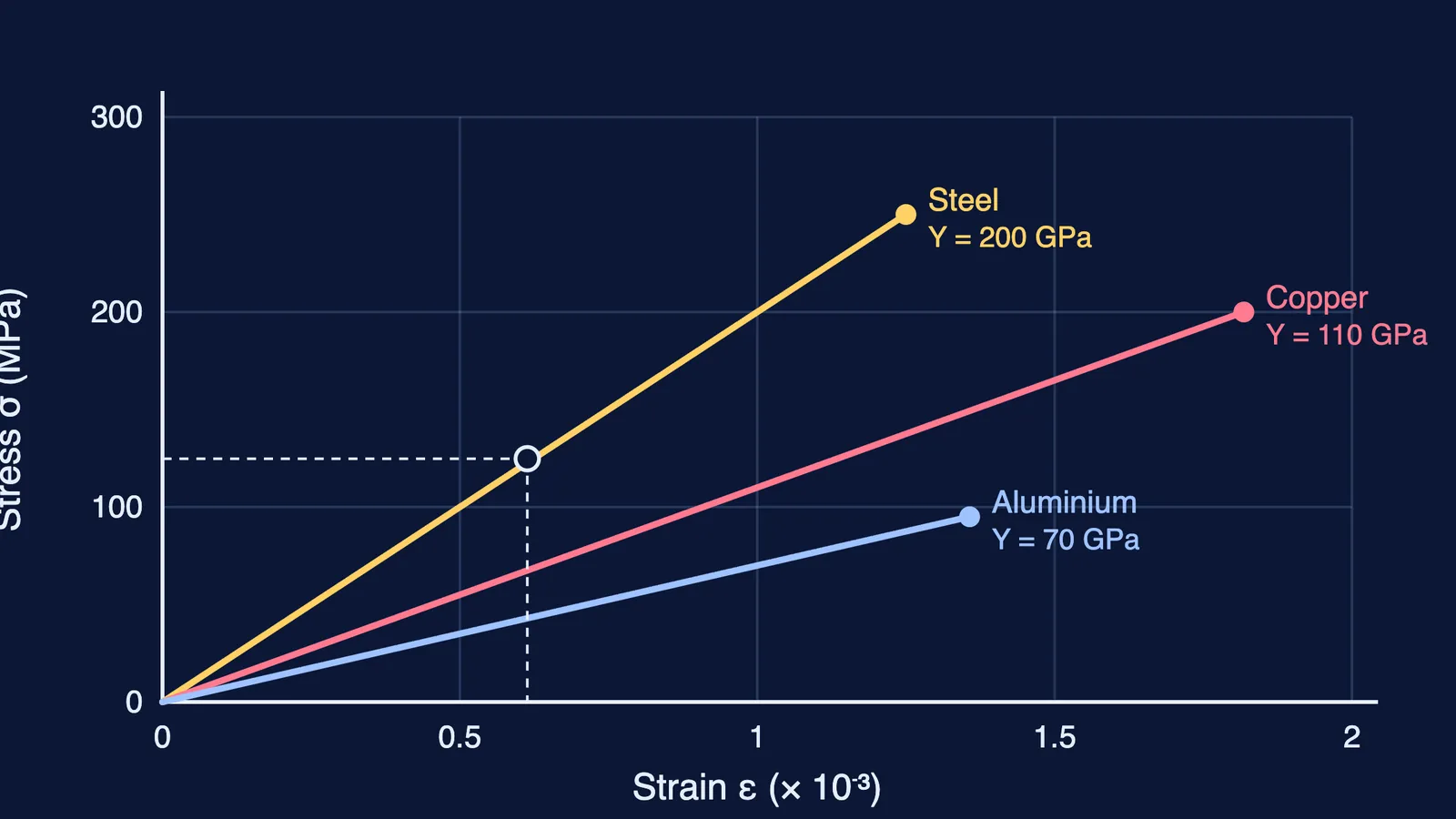
On NCERT's curve for a metal, O to A is a straight line: Hooke's law holds and the slope is Y. From A to B the line bends, but the wire still recovers. B is the yield point (elastic limit), at the yield strength σy. Beyond B, unloading leaves a permanent set. D is the ultimate tensile strength σu, and the wire fractures at E. A small gap between D and E means a brittle material; a wide gap means a ductile one.
The hero image draws the straight part, extended to the yield strength, for three metals from NCERT's Table 8.1: steel (Y = 200 GPa, yield strength 250 MPa), copper (110 GPa, 200 MPa) and aluminium (70 GPa, 95 MPa). The steeper the line, the larger Y.
Worked example: Young's modulus of a steel wire
A steel wire 1.5 m long, radius 0.50 mm, is stretched 0.92 mm by a 10 kg load. Take g = 9.8 m s⁻². Find (a) Y, (b) the energy stored, (c) the largest load before it yields (σy = 250 MPa).
A = πr² = 3.142 × (0.50 × 10⁻³ m)² = 7.85 × 10⁻⁷ m², and F = mg = 98 N.
σ = F/A = 98/(7.85 × 10⁻⁷) = 1.25 × 10⁸ N m⁻².
ε = ΔL/L = (0.92 × 10⁻³)/1.5 = 6.13 × 10⁻⁴.
(a) Y = σ/ε = 2.0 × 10¹¹ N m⁻², as NCERT's Table 8.1 gives for steel.
(b) U = ½ × F × ΔL = ½ × 98 × 0.92 × 10⁻³ = 4.5 × 10⁻² J.
(c) F max = σy × A = 2.5 × 10⁸ × 7.85 × 10⁻⁷ = 196 N, about 20 kg; 98 N is half that, so the wire stays linear.
Write the formula first, convert mm to m, and give every answer a unit.
What board-style questions should you practise?
The curriculum's question paper design splits the 70 theory marks into 27 for remembering and understanding, 22 for applying and 21 for analysing, evaluating and creating, and points schools to the Class XII 2026-27 sample paper for format: MCQs and assertion-reason items, 2-, 3- and 5-mark questions and case studies. Try these:
(1 mark) Which modulus applies to liquids and gases too? *Bulk modulus.*
(Assertion-reason) A: Steel is more elastic than rubber. R: Steel has the larger Young's modulus. *Both true; R explains A.*
(2 marks) Two wires of one metal carry equal loads. P has length L, radius r; Q has 2L and 2r. Find the ratio of P's extension to Q's. *ΔL ∝ L/r², so 2 : 1.*
(3 marks) A copper wire 3.0 m long, cross-section 1.0 mm², stretches 0.50 mm. With Y = 1.1 × 10¹¹ N m⁻², find the force and energy stored. *18 N; 4.6 × 10⁻³ J.*
(5 marks) Sketch and label a metal's stress-strain curve, and explain how it separates brittle from ductile materials.
To place this chapter in your term, use our Class 11 physics weekly study plan. Stuck on a step? Fermi's AI tutor works out what you already know, builds a plan for the session and checks understanding as it goes.