On this page
Oscillations ties circular motion, Newton's second law and energy into one idea: simple harmonic motion (SHM). Below: the 2026-27 syllabus, the derivations, a solved numerical and practice questions.
What does the CBSE 2026-27 syllabus include in Oscillations?
The CBSE Physics curriculum for 2026-27 lists Oscillations as Chapter 13 in Unit X, Oscillations and Waves. It covers periodic motion, SHM and uniform circular motion, phase, the loaded spring, energy in SHM and the simple pendulum's period.
Marks are printed for units, not chapters: Oscillations and Waves share one merged cell of 10 out of 70 theory marks, so Oscillations has no separate figure.
The current NCERT Class 11 Physics Part II chapter (Reprint 2026-27) runs from 13.1 Introduction to 13.8 The simple pendulum. It has no sections on damped or forced oscillations or resonance, and the syllabus does not list them. The curriculum's practicals include pendulum experiments and a helical spring's force constant.
How is SHM the projection of uniform circular motion?
Motion is simple harmonic when displacement varies as x(t) = A cos(ωt + φ), with amplitude A, angular frequency ω and phase constant φ (NCERT, section 13.3).
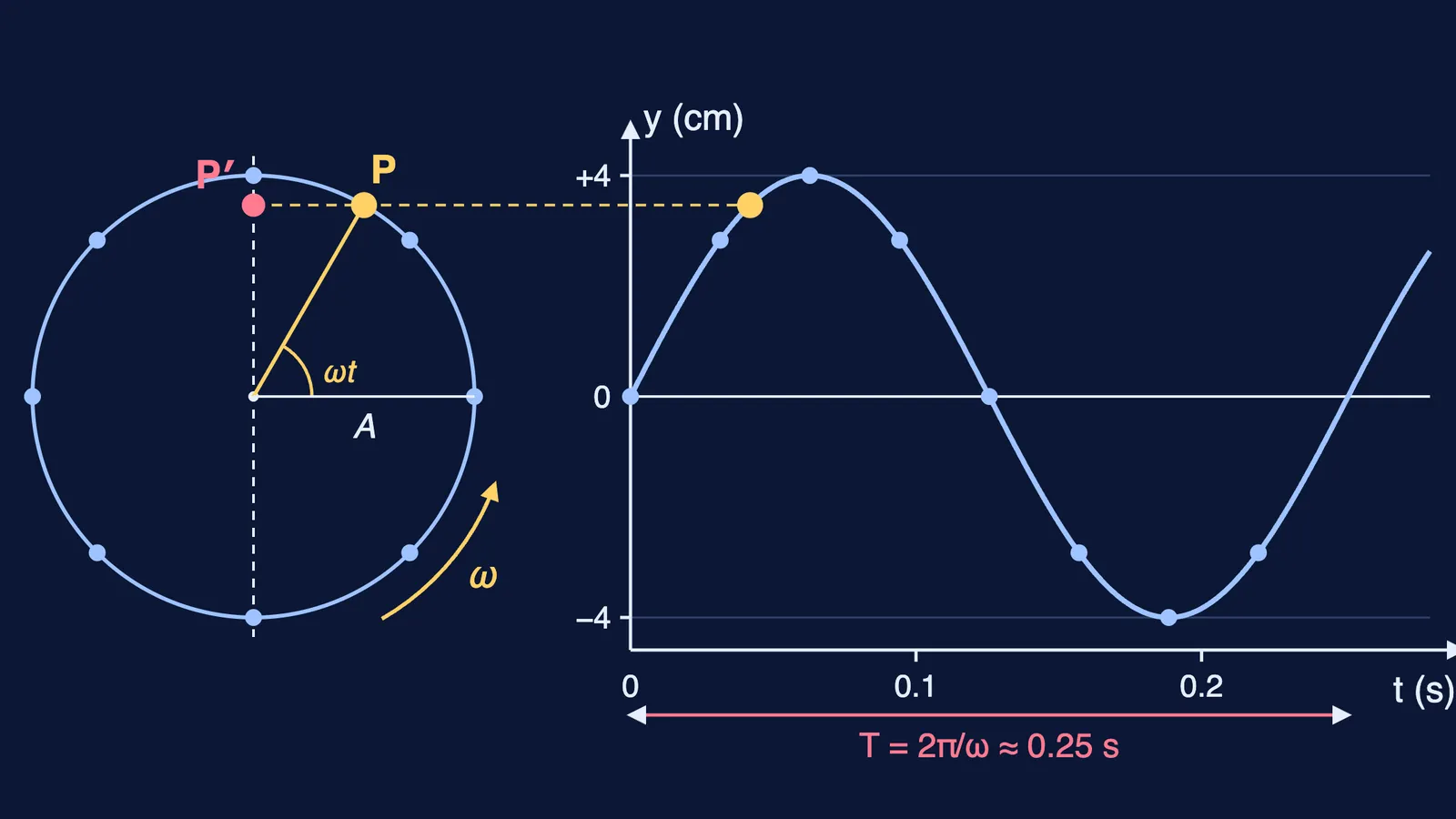
Let a reference particle P move on a circle of radius A at constant angular speed ω. Its projection P′ on a diameter moves between +A and −A, at exactly A cos(ωt + φ), or A sin(ωt + φ) on the perpendicular diameter. In the diagram, eight equally spaced positions of P map onto eight points of a sine curve one period T = 2π/ω long.
P's speed is ωA, so P′ has v(t) = −ωA sin(ωt + φ). P's centripetal acceleration is ω²A, so P′ has a(t) = −ω²x. The test for SHM: acceleration proportional to displacement and directed towards the mean position.
How do you derive the spring and simple pendulum periods?
Loaded spring. The restoring force is F = −kx, so ma = −kx. Compare with a = −ω²x: ω = √(k/m) and T = 2π√(m/k).
Simple pendulum. For a bob of mass m on a string of length L, only the tangential component mg sin θ gives a torque about the support: τ = −L(mg sin θ). With τ = Iα and I = mL², α = −(g/L) sin θ.
Small angles. For small θ, sin θ ≈ θ, so α = −(g/L)θ. This matches a = −ω²x, giving ω = √(g/L) and T = 2π√(L/g).
State the assumptions: a massless, inextensible string and a small θ. NCERT's table in section 13.8 shows sin θ stays close to θ up to about 20 degrees. The mass cancels, which the practical with bobs of different masses tests. Quick check: T = 1.5 s needs L = gT²/4π² = 9.8 × 2.25 / 39.48 = 0.56 m.
How does energy change in SHM?
Kinetic energy is K = ½kA² sin²(ωt + φ) and potential energy is U = ½kx² = ½kA² cos²(ωt + φ). Their sum, E = ½kA², is constant. K and U each repeat every T/2.
Solved numerical (3 marks). A 0.40 kg block on a smooth floor, attached to a spring of k = 250 N m⁻¹, oscillates with amplitude 4.0 cm. Find the period, maximum speed and acceleration, and K and U at x = 2.0 cm.
ω = √(250/0.40) = √625 = 25 rad s⁻¹, so T = 2π/25 = 0.25 s.
Maximum speed ωA = 25 × 0.040 = 1.0 m s⁻¹; maximum acceleration ω²A = 625 × 0.040 = 25 m s⁻².
E = ½kA² = ½ × 250 × (0.040)² = 0.20 J.
At x = 0.020 m, U = ½ × 250 × (0.020)² = 0.050 J, so K = 0.20 − 0.050 = 0.15 J.
Check: v = ω√(A² − x²) = 25 × √0.0012 = 0.87 m s⁻¹, and ½ × 0.40 × 0.87² = 0.15 J.
What questions can you expect in the exam?
CBSE's 2026-27 Class 12 Physics sample paper uses 1-mark MCQs and assertion-reason items, 2- and 3-mark short answers, 4-mark case-based questions and 5-mark long answers. Practise in those shapes.
(1 mark) In SHM of period T, kinetic energy repeats after (a) T/4 (b) T/2 (c) T (d) 2T.
(1 mark) Assertion: a particle in SHM has its greatest acceleration at the extreme positions. Reason: a = −ω²x.
(2 marks) A pendulum's length is made nine times longer. By what factor does its period change?
(3 marks) A particle moves as x = 0.05 cos(4t + π/2) in SI units. Find its amplitude, period and maximum speed.
(5 marks) Show that a simple pendulum performs SHM for small angles and derive its period.
Answers: 1 (b). 2 Both true; the reason explains the assertion. 3 Triples, since T ∝ √L. 4 0.05 m, 1.57 s, 0.20 m s⁻¹. 5 See the steps above.
Preparing for entrance exams too? Read Oscillations for JEE Main: how to prepare, and fit this chapter into your year with the Class 11 physics study plan. If a step will not click, Fermi's AI tutor works out what you already know and builds a plan for the session.