On this page
Most marks in this chapter come from three equations used carefully: ΔQ = ms ΔT, Q = mL and heat lost = heat gained.
How many marks does Thermal Properties of Matter carry in CBSE 2026-27?
In the CBSE Class XI Physics curriculum for 2026-27, Chapter 10 sits in Unit VII, Properties of Bulk Matter. Units VII, VIII and IX (Chapters 8 to 12) share one merged cell of 20 marks out of 70 in theory. CBSE prints no separate figure for this chapter.
It lists thermal expansion (with water's anomaly), specific heat, Cp and Cv, calorimetry, latent heat, conduction, convection and radiation, thermal conductivity, and qualitative blackbody radiation with Wien's and Stefan's laws. Its practicals include specific heat by the method of mixtures and a cooling curve.
Your text is NCERT Class 11 Physics Part II, Chapter 10 (Reprint 2026-27). Its section 10.10, Newton's law of cooling, is not named in the curriculum's theory list, though the cooling-curve experiment uses it, so ask your teacher whether it is tested in theory.
Which formulas from Chapter 10 must you know?
From NCERT Chapter 10, in its notation:
Linear expansion: Δl = αl l ΔT. For a solid, αv = 3αl.
Water contracts on heating from 0 °C to 4 °C, so it is densest at 4 °C.
Heat capacity S = ΔQ/ΔT; specific heat capacity s = ΔQ/(m ΔT), in J kg⁻¹ K⁻¹. Read specific heat vs heat capacity if the two blur.
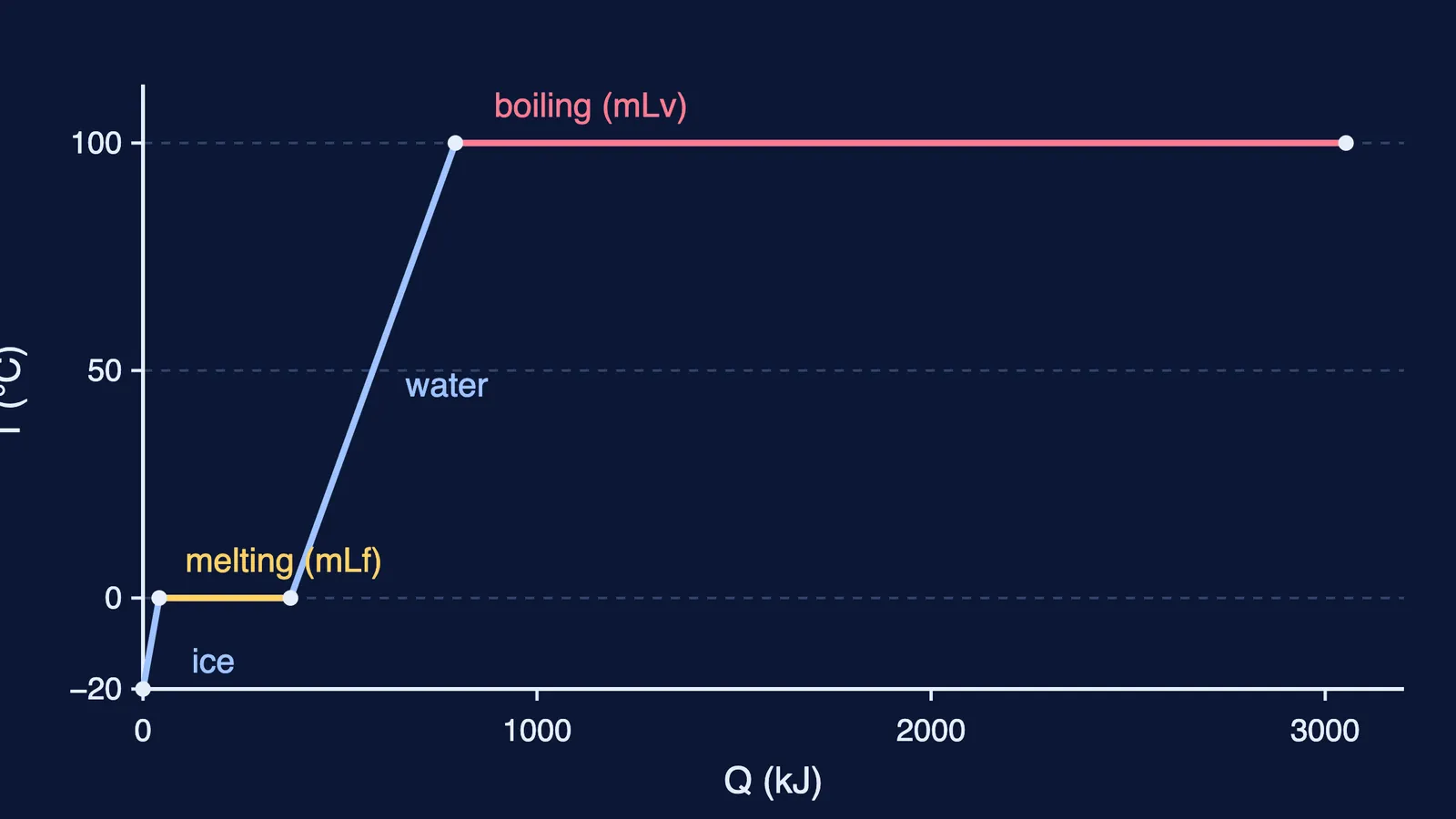
Latent heat: Q = mL. For water, Lf = 3.33 × 10⁵ J kg⁻¹ and Lv = 22.6 × 10⁵ J kg⁻¹.
Conduction: H = KA(TC − TD)/L.
Stefan-Boltzmann: H = AσT⁴ for a perfect radiator, σ = 5.67 × 10⁻⁸ W m⁻² K⁻⁴.
Wien's law: λm T = 2.9 × 10⁻³ m K.
With NCERT's values, boiling away 1 kg of water takes 2260 kJ, against 333 kJ to melt 1 kg of ice: the long flat line in the graph above.
How do you solve a calorimetry numerical with ice?
Question (5 marks). 0.06 kg of ice at 0 °C is dropped into 0.20 kg of water at 80 °C in a copper calorimeter of mass 0.15 kg. Find the final temperature. Take sw = 4200 J kg⁻¹ K⁻¹, scu = 400 J kg⁻¹ K⁻¹ and Lf = 3.36 × 10⁵ J kg⁻¹ (rounded for hand working).
First pass: one energy balance.
Heat capacity of water and calorimeter: 0.20 × 4200 + 0.15 × 400 = 840 + 60 = 900 J K⁻¹.
Does all the ice melt? Cooling to 0 °C releases 900 × 80 = 72 000 J; melting needs 0.06 × 3.36 × 10⁵ = 20 160 J. Yes.
Heat lost = heat gained: 900(80 − T) = 20 160 + 0.06 × 4200 × T.
72 000 − 900T = 20 160 + 252T, so 1152T = 51 840 and T = 45 °C.
Second pass: melt, then mix. Melting takes 20 160 J, leaving 51 840 J, so the hot side cools to 51 840/900 = 57.6 °C. Mixing in 0.06 kg of meltwater at 0 °C: T = 900 × 57.6/(900 + 252) = 45 °C. Both routes agree.
How should you set out board-style answers?
CBSE publishes sample papers for Class X and XII only; your school sets the Class 11 paper. The curriculum gives 22 of 70 theory marks to applying knowledge. The Class XII Physics sample paper 2026-27 shows the CBSE pattern: 1-mark MCQs and assertion-reason, then 2-, 3-, 4-mark case-study and 5-mark questions, with no calculators.
Set out numericals as formula, substitution with units, then answer with units.
Practice questions in CBSE style
Written by us; answers in brackets.
(1 mark) Assertion: a burn from steam at 100 °C is worse than one from water at 100 °C. Reason: condensing steam releases latent heat on the skin. (Both true; the reason explains the assertion.)
(2 marks) An aluminium rod is 2.0 m long at 20 °C. Taking αl = 2.5 × 10⁻⁵ K⁻¹, find its increase in length at 60 °C. (2.0 mm)
(3 marks) A copper rod 0.50 m long, of cross-section 2.0 cm², has ends at 100 °C and 0 °C. With K = 385 W m⁻¹ K⁻¹ and Lf = 3.33 × 10⁵ J kg⁻¹, find the heat current and the ice melted at the cold end in 10 minutes. (15.4 W; about 28 g)
(2 marks) A star's radiation peaks at 500 nm. Estimate its surface temperature. (5800 K)
(5 marks) (a) Show that αv = 3αl for a solid. (b) Use water's anomalous expansion to explain why ponds freeze from the top. (2 + 3)
What should you do next?
Our Thermodynamics for JEE Main guide takes Cp and Cv further for that exam. Fit both chapters into a weekly study plan for Class 11 Physics.
If you don't know where to begin, Fermi's AI tutor can work out what you already know and build a plan for the session.