On this page
Mechanical Properties of Fluids is Chapter 9 of NCERT Class 11 Physics Part II. It explains how a small push lifts a car, why a raindrop stops speeding up and why water climbs a thin tube. Here are the 2026-27 marks, what the current chapter keeps, three solved numericals and board-style practice questions.
How many marks is Mechanical Properties of Fluids in Class 11?
The CBSE Physics curriculum for 2026-27 sets a 70-mark theory paper and a 30-mark practical. Fluids sits in Unit VII, Properties of Bulk Matter. In the marks table, one merged cell gives 20 marks jointly to Units VII, VIII and IX: Mechanical Properties of Solids, Mechanical Properties of Fluids, Thermal Properties of Matter, Thermodynamics and Kinetic Theory. CBSE prints no separate figure for this chapter.
The same curriculum lists two practical experiments from this chapter: surface tension of water by capillary rise, and the coefficient of viscosity from terminal velocity. Its question-paper design puts about 38% of theory marks on remembering and understanding, 32% on applying, and 30% on analysing, evaluating and creating.
What does the 2026-27 NCERT chapter cover?
The current NCERT chapter is marked Reprint 2026-27. After the introduction it covers pressure, streamline flow, Bernoulli's principle, viscosity and surface tension. It has no Reynolds number and no venturimeter, so skip them; critical speed appears only as the speed beyond which steady flow turns turbulent.
Key results, in NCERT's symbols:
Pressure at depth h: P = Pa + ρgh, where P − Pa is the gauge pressure.
Pascal's law: a pressure change in a confined fluid reaches every part of it unchanged, so F2 = F1(A2/A1) in a hydraulic lift.
Equation of continuity: Av = constant for an incompressible fluid.
Bernoulli's principle: P + ½ρv² + ρgh = constant along a streamline; Torricelli's law v = √(2gh) follows from it.
Stokes' law: F = 6πηav, giving terminal velocity vt = 2a²(ρ − σ)g/(9η).
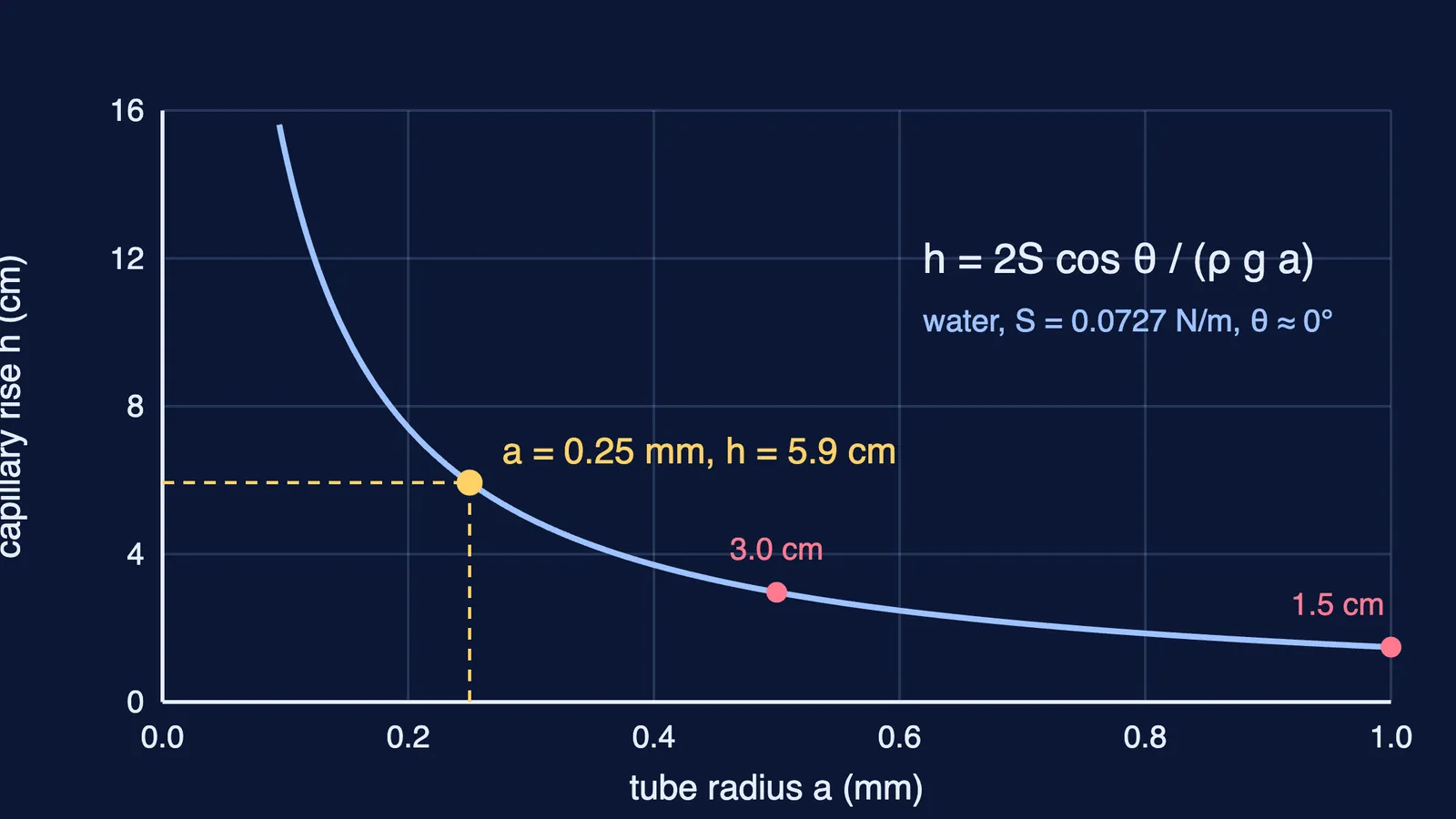
Excess pressure: 2S/r inside a drop, 4S/r inside a soap bubble; capillary rise h = 2S cos θ/(ρga).
NCERT gives atmospheric pressure at sea level as 1.013 × 10⁵ Pa and the surface tension of water at 20 °C as 0.0727 N m⁻¹. Practise deriving pressure at depth, Bernoulli's equation, terminal velocity, excess pressure and capillary rise; each makes a long answer.
Solved numericals with our own numbers
Take g = 9.8 m s⁻², ρ = 1000 kg m⁻³ for water, and S from the NCERT table.
1. Hydraulic lift. A force of 150 N acts on a piston of diameter 2.0 cm. The output piston has diameter 30 cm. Areas scale as diameter squared, so F2 = 150 × (30/2.0)² = 150 × 225 = 3.4 × 10⁴ N.
2. Speed of efflux. An open tank has a small hole 1.8 m below the water surface. By Torricelli's law, v = √(2 × 9.8 × 1.8) = √35.28 = 5.9 m s⁻¹. For a hole of area 2.0 cm², the flow rate is Av = 2.0 × 10⁻⁴ × 5.94 = 1.2 × 10⁻³ m³ s⁻¹, about 1.2 litres per second.
3. Capillary rise. A glass tube of radius 0.25 mm stands in water, with θ ≈ 0°. Then h = 2S/(ρga) = (2 × 0.0727)/(1000 × 9.8 × 0.25 × 10⁻³) = 0.1454/2.45 = 0.059 m, or 5.9 cm. Double the radius and h halves to 3.0 cm (see the graph above).
Practice questions in board style
These questions are our own. The marks in brackets are our suggestion, not CBSE's.
(1 mark) Why does a liquid at rest exert the same pressure at all points on the same horizontal level?
(2 marks) State Pascal's law and explain how hydraulic brakes use it.
(2 marks) A soap bubble of radius 2.0 cm is made from a solution with S = 0.030 N m⁻¹. Find the excess pressure inside it. (Answer: 6.0 Pa)
(3 marks) A steel ball of radius 1.5 mm and density 7.8 × 10³ kg m⁻³ falls through oil of density 0.90 × 10³ kg m⁻³ and viscosity 0.50 Pa s. Find its terminal velocity. (Answer: 6.8 cm s⁻¹)
(3 marks) Use Bernoulli's principle to explain dynamic lift on an aircraft wing.
(5 marks) Derive the expression for the rise of a liquid in a capillary tube. Explain why mercury is depressed in a glass tube.
How should you revise this chapter?
Give one session each to pressure, flow and Bernoulli, and viscosity with surface tension: write each derivation from memory, then solve one numerical. Fit these into the weekly rhythm in our study plan for Class 11 physics. For common reasoning traps, see pressure, buoyancy and Bernoulli mistakes to avoid.
Preparing for entrance exams too? Our Properties of Solids and Liquids for JEE Main guide covers harder multi-step problems; for the school exam, the curriculum list is your boundary.
If you are not sure where to start, Fermi's AI tutor works out what you already know and builds a plan for the session, so you sit down to a clear next step.