On this page
Kinetic Theory of Gases explains the gas laws through molecules in motion. Most of its numericals are direct formula work: pick the right relation and keep SI units.
What does the JEE Main syllabus include in Kinetic Theory of Gases?
Unit 9 of the official Syllabus for JEE (Main) - 2027, linked as "Syllabus" on the NTA JEE Main website, lists the perfect gas equation, work done on compressing a gas, kinetic theory assumptions, pressure, the kinetic meaning of temperature, rms speed, degrees of freedom, equipartition and specific heats of gases, mean free path and Avogadro's number.
The matching chapter is Chapter 12, Kinetic Theory, in NCERT Class 11 Physics Part II (Reprint 2026-27). It covers everything except work done on compressing a gas, which is in Chapter 11, Thermodynamics; mean free path is section 12.7.
How do you get pressure and rms speed from molecular motion?
NCERT derives P = (1/3)nm⟨v²⟩, with n molecules per unit volume, each of mass m (NCERT section 12.4). With ρ = nm, P = (1/3)ρv²rms, so vrms = √(3P/ρ). With average kinetic energy per molecule (3/2)kBT, vrms = √(3RT/M).
Example 1. A gas has density 1.5 kg/m³ at 1.2 × 10⁵ Pa. vrms = √(3 × 1.2 × 10⁵ / 1.5) = √(2.4 × 10⁵) ≈ 490 m/s. Check: (1/3) × 1.5 × 490² ≈ 1.2 × 10⁵ Pa.
Example 2. Oxygen (M = 0.032 kg/mol) at 47 °C = 320 K: vrms = √(3 × 8.314 × 320 / 0.032) = √249420 ≈ 499 m/s. Per molecule, √(3kBT/m) with m ≈ 5.31 × 10⁻²⁶ kg gives the same.
What are the ratios of rms, mean and most probable speed?
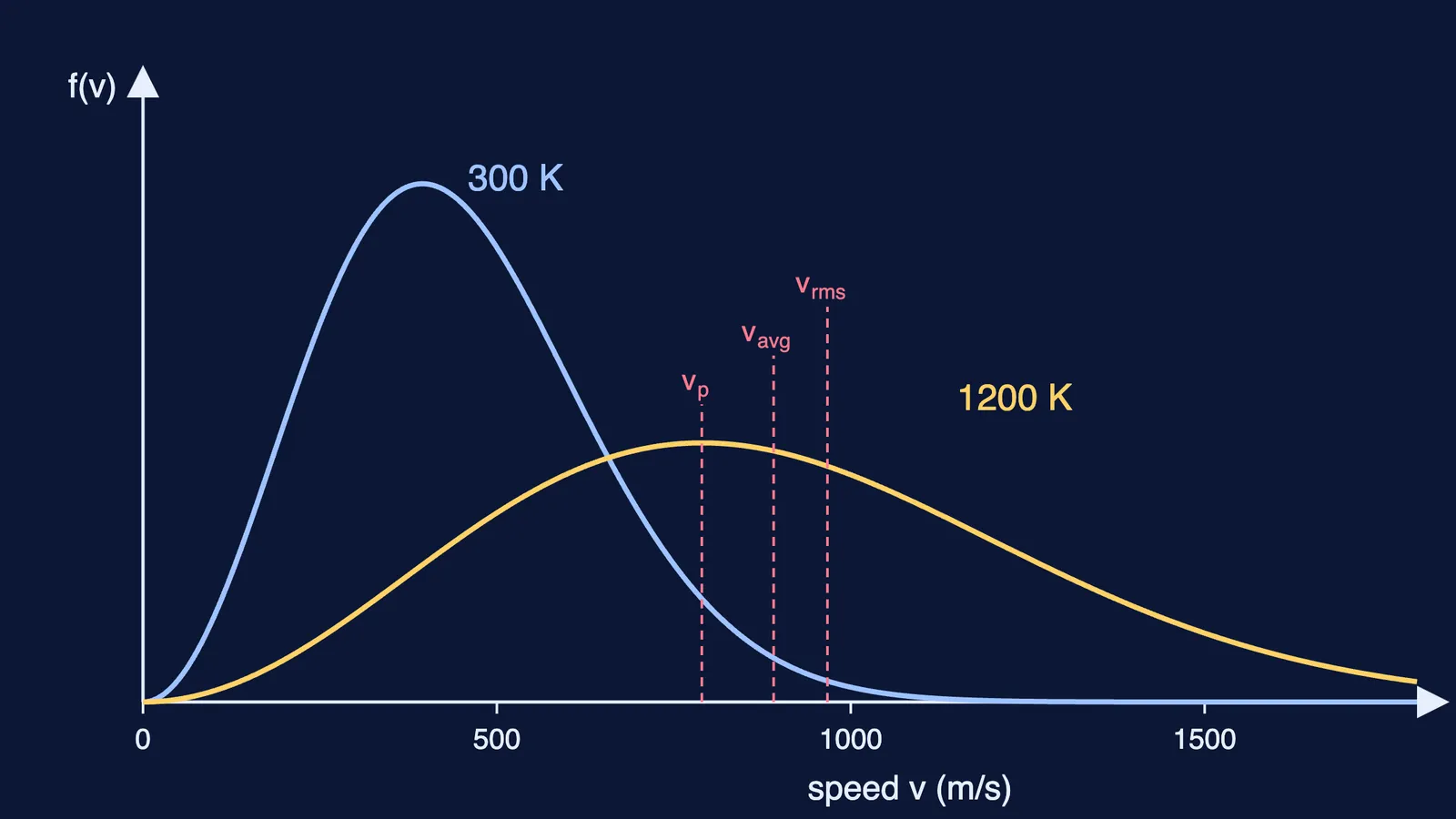
NTA names only rms speed; questions still compare all three. From the Maxwell speed distribution, vp = √(2RT/M), v̄ = √(8RT/πM) and vrms = √(3RT/M) (OpenStax University Physics Volume 2, section 2.4). So vrms : v̄ : vp = √3 : √(8/π) : √2 ≈ 1.73 : 1.60 : 1.41 for any gas.
For oxygen at 320 K: vp ≈ 408 m/s, v̄ ≈ 460 m/s and vrms ≈ 499 m/s. The diagram above shows oxygen at 300 K and 1200 K: four times the temperature doubles every speed and halves the peak, since each curve's area stays 1.
If the distribution is hard to picture, the Fermi Simulation Lab has interactive simulations for ideas that are easier to see than to read.
How do degrees of freedom and equipartition give Cv and γ?
Equipartition gives each squared term in a molecule's energy ½kBT (NCERT section 12.5). For a mole with f such terms, U = (f/2)RT, so Cv = (f/2)R, Cp = Cv + R and γ = 1 + 2/f (NCERT section 12.6):
Monatomic (He, Ar): f = 3, Cv = 3R/2, Cp = 5R/2, γ = 5/3 ≈ 1.67
Rigid diatomic (O₂, N₂): f = 5, Cv = 5R/2, Cp = 7R/2, γ = 7/5 = 1.4
Non-linear polyatomic, no vibration: f = 6, Cv = 3R, Cp = 4R, γ = 4/3 ≈ 1.33
A vibrating diatomic has Cv = 7R/2 and γ = 9/7 (NCERT Eq. 12.35); use rigid values unless told otherwise.
Example 3 (mixture). 3 mol argon plus 1 mol oxygen. Add internal energies, never γ values: Cv = (3 × 3R/2 + 1 × 5R/2) / 4 = 7R/4 ≈ 14.5 J/(mol K). Then Cp = 11R/4 and γ = 11/7 ≈ 1.57. Check: 4/(γ − 1) = 3/(2/3) + 1/(0.4) = 4.5 + 2.5 = 7, so γ = 1 + 4/7 = 11/7. This γ sets the speed of sound in a gas mixture and feeds adiabatic work in our Thermodynamics for JEE Main guide.
How do you calculate mean free path?
Mean free path is the average distance a molecule travels between collisions, l = 1/(√2 nπd²), where d is the molecular diameter (NCERT section 12.7). Writing n = P/(kBT) gives l = kBT/(√2 πd²P), rising with temperature and falling with pressure.
Example 4. Gas at 300 K, 1.013 × 10⁵ Pa, d = 3.0 × 10⁻¹⁰ m. Then n = 1.013 × 10⁵ / (1.381 × 10⁻²³ × 300) ≈ 2.45 × 10²⁵ m⁻³, and l = 1 / (1.414 × 2.45 × 10²⁵ × π × 9.0 × 10⁻²⁰) ≈ 1.0 × 10⁻⁷ m, over 300 diameters.
How should you plan practice for this unit?
Day 1: NCERT 12.1 to 12.4; derive P = (1/3)nm⟨v²⟩ once, then redo Examples 1 and 2 without notes.
Day 2: speed ratios. Every speed goes as √(T/M); write five one-line questions changing T or M.
Day 3: the equipartition table from memory, then two mixtures by both routes.
Day 4: mean free path, then a mixed timed set; log each error as unit, formula or concept.
When an answer is off by a factor, the Fermi Problem Library has worked problems with a step-by-step solver that explains the reasoning rather than printing an answer.
Most of these suit the first pass of a three-pass JEE Main attempt strategy.