On this page
Gravitation is a short unit in JEE Main physics, and most of its questions rest on a handful of results you can derive in a page. Rebuild those results and run the numbers yourself, and the unit stops being a list of formulas.
What does the JEE Main syllabus include in Gravitation?
Unit 6 of the official Syllabus for JEE (Main) - 2027, linked from the NTA JEE Main website, lists the universal law of gravitation, acceleration due to gravity and its variation with altitude and depth, Kepler's laws, gravitational potential energy and potential, escape velocity, and the motion of a satellite: orbital velocity, time period and energy.
That maps onto Chapter 7, Gravitation, in the NCERT Class 11 Physics Part I textbook (2026-27 reprint), sections 7.2 Kepler's laws to 7.10 energy of an orbiting satellite.
How should you prepare Gravitation for JEE Main?
A plan for one week, about an hour a day:
Day 1: derive g = GM/R², then g at height h and at depth d, from a blank page.
Day 2: derive orbital speed and period by setting gravity equal to the centripetal force; check Kepler's third law falls out.
Day 3: derive potential energy −GMm/r and escape speed from energy conservation.
Day 4: derive kinetic, potential and total energy of a satellite. Our explainer on why a satellite's energies are in the ratio 1 : −2 : −1 walks through it.
Days 5 and 6: twenty mixed questions a day, timed, then mark every error by type: wrong formula, wrong r, or arithmetic.
Day 7: redo only the questions you got wrong, without looking at your old working.
If a derivation stalls, the Fermi Problem Library has worked problems with a step-by-step solver that explains the reasoning rather than printing an answer, so you can see which step you skipped.
How does g change with height and depth?
Take g = 9.8 m/s² and Earth's radius R = 6400 km, the values used in the NCERT Gravitation chapter.
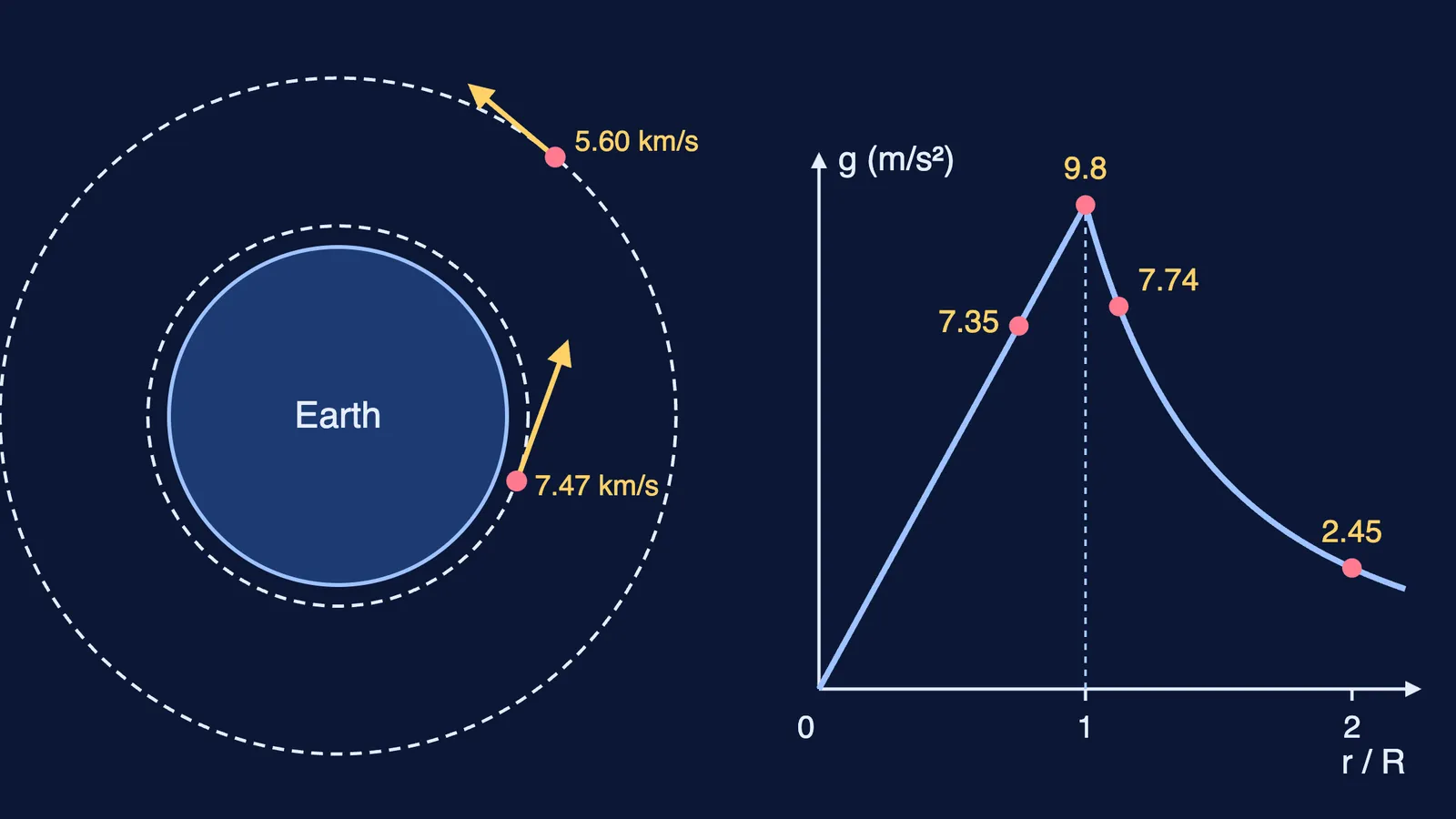
Height 800 km. Use the exact form g' = g(R/(R + h))² = 9.8 × (6400/7200)² = 9.8 × 0.790 = 7.74 m/s².
Depth 1600 km. Inside a uniform Earth, g' = g(1 − d/R) = 9.8 × (1 − 0.25) = 7.35 m/s².
For a uniform Earth, g rises linearly from zero at the centre to its surface value and then falls as 1/r² outside. Our post on how gravity changes inside Earth shows that graph step by step.
How do you find orbital speed, period and escape speed?
Write GM as gR² = 9.8 × (6.4 × 10⁶ m)² = 4.01 × 10¹⁴ m³/s², with g and R as in the NCERT chapter. With G = 6.67 × 10⁻¹¹ N m² kg⁻² and Earth's mass 6.0 × 10²⁴ kg, GM = 4.00 × 10¹⁴ m³/s², within 0.3%.
For a satellite 800 km up, r = 7.2 × 10⁶ m:
Orbital speed v = √(gR²/r) = √(5.58 × 10⁷) = 7.47 km/s.
Period T = 2πr/v = 6060 s, about 101 minutes.
Escape speed from the surface = √(2gR) = √(1.254 × 10⁸) = 11.2 km/s.
Escape speed from that orbit = √2 × 7.47 = 10.6 km/s.
Check with Kepler's third law: at r = 12 800 km, the radius grows by a factor of 16/9, so T grows by (16/9)^(3/2) = 2.37, to about 239 minutes. Computing v directly gives 5.60 km/s and the same period. To watch how launch speed decides whether a body falls back, orbits or escapes, try our escape velocity simulation, or explore orbits in the Fermi Simulation Lab, which has interactive simulations for the ideas that are easier to see than to read.
How much energy does it take to raise a satellite's orbit?
Take a 500 kg satellite. Total energy in a circular orbit is E = −GMm/2r, using gR² from the NCERT chapter values.
At r = 7.2 × 10⁶ m: E₁ = −(4.01 × 10¹⁴ × 500)/(2 × 7.2 × 10⁶) = −1.39 × 10¹⁰ J. Kinetic energy is +1.39 × 10¹⁰ J and potential energy −2.79 × 10¹⁰ J.
At r = 1.28 × 10⁷ m: E₂ = −7.84 × 10⁹ J.
Energy needed = E₂ − E₁ = 6.10 × 10⁹ J.
The satellite ends up slower but with more total energy, so "faster means more energy" is the wrong instinct.
Which traps cost marks in Gravitation?
Using h where the formula needs r = R + h.
Applying the 1 − 2h/R shortcut when h is not small.
Forgetting that orbital speed and period do not depend on the satellite's mass.
Writing potential energy as positive; with zero at infinity, it is negative at every finite distance.
Mixing km and m inside a square root.
Start tonight with Day 1 and a blank page.