On this page
Gravitation questions in JEE Main and school exams often ask for one energy of an orbiting satellite and hand you another. You can grind through GMm/r every time, or use one ratio that does the work in a line.
What is the ratio of kinetic, potential and total energy of a satellite?
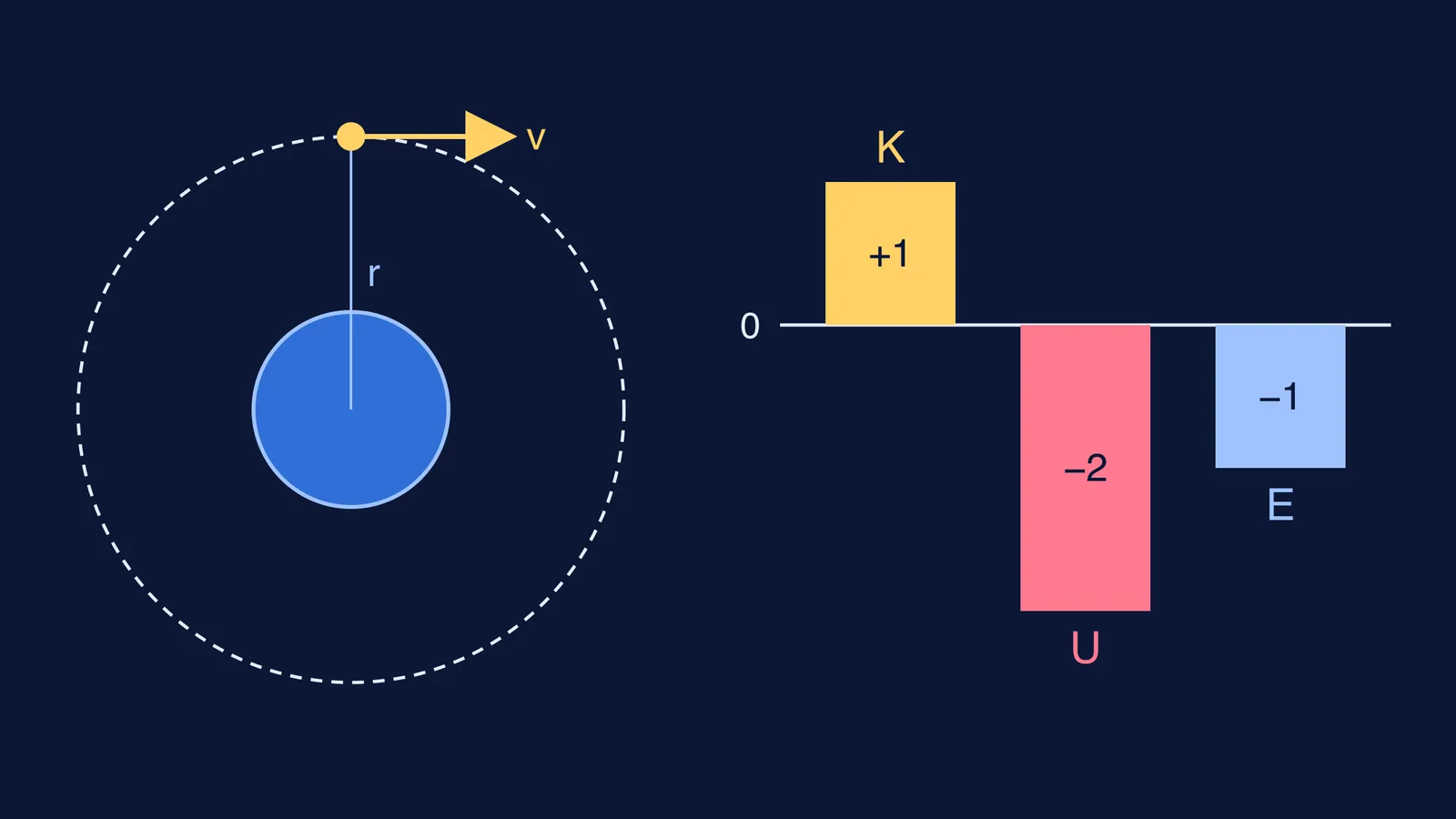
For a satellite of mass m in a circular orbit of radius r around a planet of mass M, the kinetic energy is K = GMm/2r, as derived in OpenStax University Physics, section 13.4. The potential energy, measured from zero at infinity, is U = −GMm/r. Adding them gives the total energy E = −GMm/2r.
Put the three side by side and the pattern is clear:
K = +GMm/2r
U = −2 × (GMm/2r)
E = −1 × (GMm/2r)
So K : U : E = 1 : −2 : −1. OpenStax states it in words: for circular orbits, the kinetic energy is exactly half the size of the potential energy.
Why is the kinetic energy exactly half the potential energy?
It comes from one line of Newton's second law, the same step OpenStax section 13.4 uses. Gravity supplies the centripetal force, so GMm/r² = mv²/r. Multiply both sides by r/2 and you get ½mv² = GMm/2r. For a given planet and satellite, the kinetic energy is fixed by the orbit's radius alone.
The negative signs come from the choice of zero. If potential energy is zero at infinity, anything bound to a planet has less than zero; we explain this in why gravitational potential energy is negative. A negative total energy means the satellite is bound: left alone, it cannot escape.
How do you use the ratio to answer energy questions quickly?
Here are four question types, each solved with the ratio from the OpenStax orbit energies and no fresh algebra.
One energy given, find the others. A satellite has total energy −3.2 × 10⁹ J. Then K = +3.2 × 10⁹ J and U = −6.4 × 10⁹ J. Done in two lines.
Energy to free a satellite from orbit. To reach infinity with zero speed, the final total energy is 0. The energy you must supply is 0 − E = −E, which equals K. So the binding energy of a circular orbit equals its kinetic energy.
Moving from radius r to 2r. Every energy scales as 1/r, so all three halve in size. E goes from −GMm/2r to −GMm/4r, so the work needed is GMm/4r, which is half the original kinetic energy. The kinetic energy also halves, so the higher orbit is slower even though you added energy.
Air drag in low orbit. Drag takes energy away, so E becomes more negative. Since K = −E, the kinetic energy goes up: the satellite speeds up as it sinks. We work through this puzzle in the satellite drag paradox.
What does this look like for a real spacecraft?
OpenStax gives the International Space Station an altitude of 400 km and an orbital speed of 7.67 × 10³ m/s (OpenStax, section 13.4). Work per kilogram so you don't need the station's mass.
Kinetic energy per kg: ½ × (7.67 × 10³)² ≈ 2.94 × 10⁷ J, or about 29.4 MJ.
Total energy per kg: −29.4 MJ, using E = −K.
Potential energy per kg: −58.8 MJ, using U = 2E.
You never touched G or Earth's mass.
When does the 1 : −2 : −1 ratio not apply?
Check three conditions before you use it.
The orbit must be circular. On an ellipse the speed changes around the path, faster near the planet and slower far away, so K and U change from point to point and their ratio is not fixed.
The force must be inverse-square. The derivation used GMm/r². If a question invents a different force law, redo the force balance from scratch.
Zero of potential energy at infinity. If a problem sets U = 0 at the planet's surface, the signs and the ratio change.
The same 1 : −2 : −1 pattern shows up in the Bohr model of hydrogen, because the electric force between electron and nucleus is also inverse-square. If you have met it there, our post on kinetic, potential and total energy in Bohr orbits shows the match line by line.
How should you practise this?
Take five past orbit questions and, before solving each one, write which of K, U or E the question gives and which it wants. Then solve using only the three rules above. If you get stuck on a step, the Fermi Problem Library has worked problems with a step-by-step solver that explains the reasoning rather than printing an answer. If the gap is the idea of gravitational potential itself, the topic has its own lesson in the Fermi Concept Library.