On this page
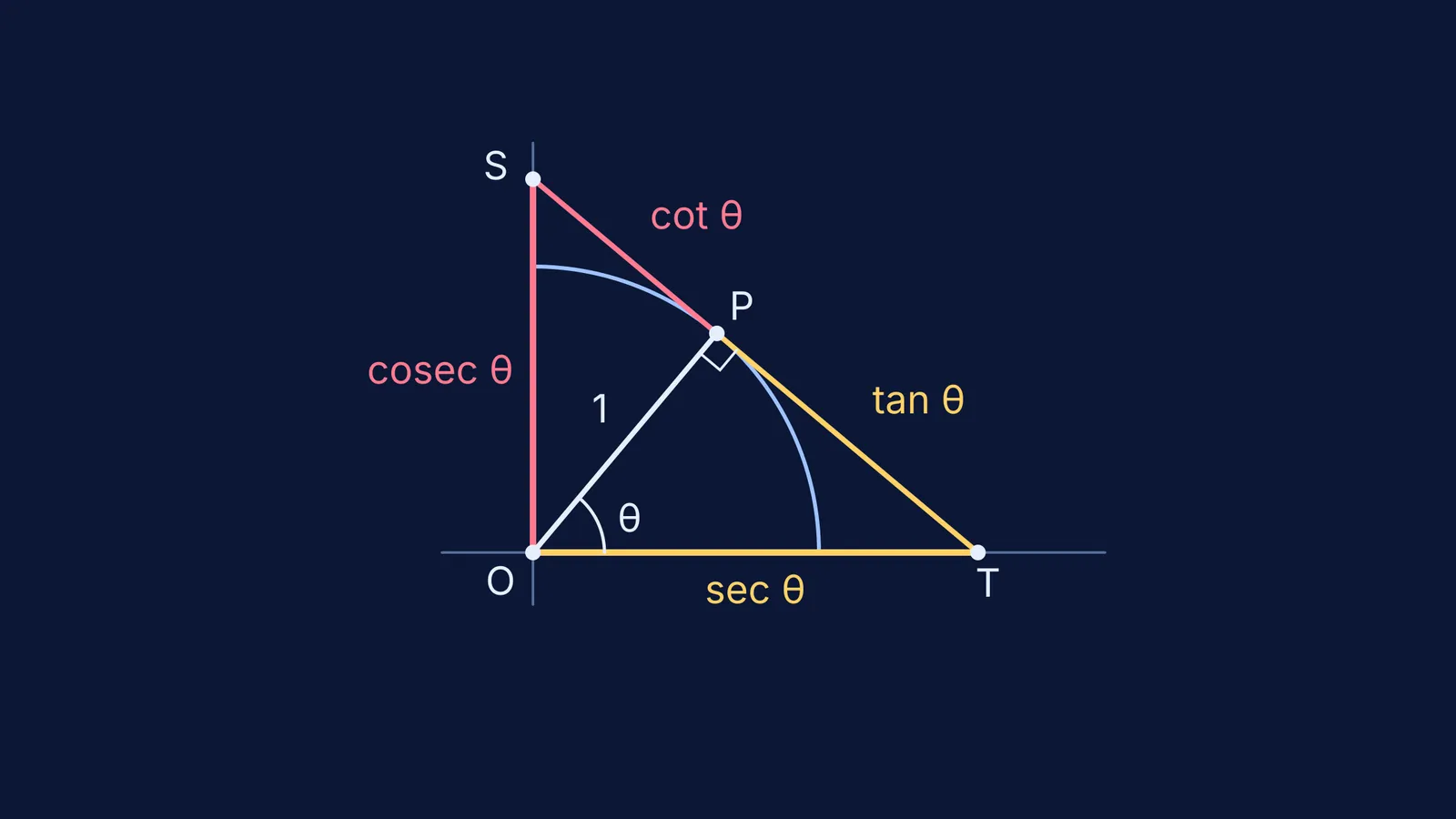
You can spot this identity before you finish reading a question: a sec beside a tan, or a cosec beside a cot, with a square nearby. Here is where sec²θ − tan²θ = 1 comes from, three ways to use it in CBSE-style problems, and three worked examples.
Why is sec²θ − tan²θ always equal to 1?
It is Pythagoras' theorem divided through. In the NCERT Class 10 chapter Introduction to Trigonometry, section 8.4 starts with a triangle ABC right-angled at B, so AB² + BC² = AC².
Divide by AC² and you get cos²A + sin²A = 1.
Divide by AB² and you get 1 + tan²A = sec²A.
Divide by BC² and you get cot²A + 1 = cosec²A.
The same NCERT chapter states the limits: 1 + tan²A = sec²A holds for 0° ≤ A < 90°, because tan 90° and sec 90° are not defined, and cosec²A = 1 + cot²A holds for 0° < A ≤ 90°. For angles of any size, dividing sin²θ + cos²θ = 1 by cos²θ gives the same result for every angle where cos θ is not zero.
How do you use sec²θ − tan²θ = 1 in problems?
Three moves cover most questions.
Replace a square. Swap sec²θ for 1 + tan²θ, or the reverse, so only one ratio is left. For example, 9sec²A − 9tan²A = 9(sec²A − tan²A) = 9.
Factor it. sec²θ − tan²θ is a difference of squares, so (sec θ − tan θ)(sec θ + tan θ) = 1. That means sec θ − tan θ = 1/(sec θ + tan θ), and in the same way cosec θ − cot θ = 1/(cosec θ + cot θ).
Hide a 1. When a proof has a stray 1 or −1, try writing it as sec²θ − tan²θ or tan²θ − sec²θ. NCERT's Example 12 uses the same fact in reverse: after multiplying by (tan θ − sec θ), it replaces tan²θ − sec²θ with −1 to prove that (sin θ − cos θ + 1)/(sin θ + cos θ − 1) = 1/(sec θ − tan θ).
Worked problem 1: given sec θ + tan θ = p, find sin θ
Factor: sec θ − tan θ = 1/p.
Add the two equations: 2 sec θ = p + 1/p, so sec θ = (p² + 1)/(2p).
Subtract them: 2 tan θ = p − 1/p, so tan θ = (p² − 1)/(2p).
Divide: sin θ = tan θ/sec θ = (p² − 1)/(p² + 1).
Check with θ = 45°: p = √2 + 1, p² = 3 + 2√2, and (2 + 2√2)/(4 + 2√2) = 1/√2 = sin 45°.
Worked problem 2: an NCERT one-liner
NCERT's Exercise 8.3 asks for (1 + tan²A)/(1 + cot²A). Write the top as sec²A and the bottom as cosec²A. Then sec²A/cosec²A = sin²A/cos²A = tan²A.
Worked problem 3: prove tan⁴θ + tan²θ = sec⁴θ − sec²θ
Start from the left: tan⁴θ + tan²θ = tan²θ(tan²θ + 1) = tan²θ · sec²θ. Now replace tan²θ with sec²θ − 1: (sec²θ − 1)sec²θ = sec⁴θ − sec²θ, which is the right-hand side.
For the three general ways of setting out a proof, see how to prove trig identities in Class 10.
Which identity should you reach for?
sec and tan together: think 1 + tan²θ = sec²θ.
cosec and cot together: think 1 + cot²θ = cosec²θ.
sec θ ± tan θ or cosec θ ± cot θ in a denominator: multiply by the conjugate so the bottom becomes 1.
Mixed ratios and nothing clicks: convert everything to sin and cos, as NCERT's hint suggests for Exercise 8.3, question 4(iii).
Given the value of one ratio: use the identity to find the others. NCERT's own example takes tan A = 1/√3 and gets sec²A = 1 + 1/3 = 4/3.
What mistakes cost marks?
Writing sec θ − tan θ = 1. Only the squares differ by 1.
Ignoring where the ratios exist. In the Class 10 range, sec and tan are not defined at 90°, and cosec and cot are not defined at 0°, so the identities do not apply at those angles.
Working on both sides at once and cancelling across the equals sign. Go from one side to the other, or simplify each side separately, as NCERT's hints for 4(iv) and 4(ix) suggest.
Squaring both sides to prove an identity. Squaring can make a false statement look true: −1 = 1 is false, but squaring both sides gives 1 = 1.
If a proof stalls halfway, the Fermi Problem Library has worked problems with a step-by-step solver that explains the reasoning rather than printing an answer. If the gap is earlier, in what sec and cosec mean, the Fermi Concept Library gives each concept its own lesson.
The same swap returns in Class 12: tan²x = sec²x − 1 is what makes integrating tan⁴x manageable, and both identities set up the minimum of a sec²x + b cosec²x. Start with Exercise 8.3 tonight and use the checklist on every proof.