On this page
Question 4 of Exercise 8.3 in the NCERT Class 10 trigonometry chapter asks you to prove ten identities. When a proof stalls, the problem is often not the formulas but knowing where to begin. Three moves cover most of these proofs; each is used below on a real NCERT question.
What does CBSE expect when you prove an identity?
CBSE's Class X Mathematics curriculum for 2026-27 lists "Proof and applications of the identity sin²A + cos²A = 1" and adds "Only simple identities to be given." The same document gives the Trigonometry unit 12 of the paper's 80 marks, and that unit also includes heights and distances.
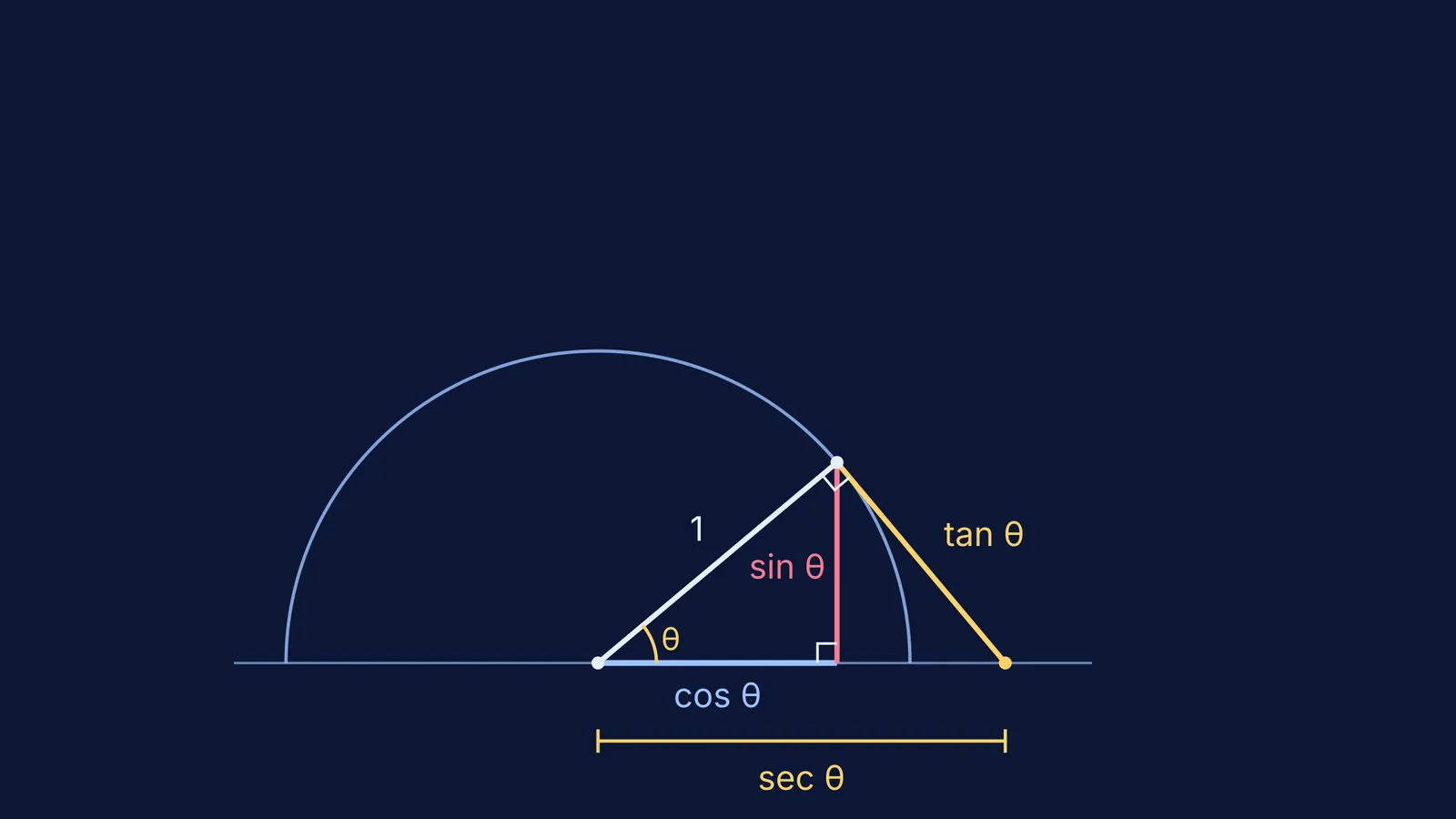
NCERT defines a trigonometric identity as an equation involving trigonometric ratios that is true for all values of the angle(s) involved (NCERT, section 8.4). The chapter proves three of them from Pythagoras' theorem:
sin²A + cos²A = 1, for 0° ≤ A ≤ 90°
1 + tan²A = sec²A, for 0° ≤ A < 90°
cot²A + 1 = cosec²A, for 0° < A ≤ 90°
The proofs in Exercise 8.3 all lean on these three, most often the first.
Why should you work on one side only?
An identity is a statement you have to prove, not an equation you solve. If you cross-multiply, square both sides or move terms across the equals sign, you treat the statement as already true. That proves nothing unless every step can be reversed, and squaring often cannot.
The safe layout is the one NCERT uses in its worked examples: write "LHS =", change the expression one step at a time, and finish with "= RHS". When both sides are messy, NCERT's own hint for some questions is "Simplify LHS and RHS separately". That is still fine, because each side is reduced on its own.
Which method should you try first?
Read the question for clues before you write anything:
tan, cot, sec or cosec everywhere: convert to sin and cos.
1 + sin A, 1 − cos A and similar in a denominator or under a square root: multiply by the conjugate, because (1 − sin A)(1 + sin A) = cos²A.
One side much longer than the other: start from the longer side and simplify towards the shorter one.
1 − sin²A or 1 − cos²A appears: replace it straight away with cos²A or sin²A.
How do the three methods work on NCERT Exercise 8.3?
Proof 1: convert to sin and cos. Prove (cosec A − sin A)(sec A − cos A) = 1/(tan A + cot A). This is part (ix), with the hint to simplify both sides separately.
LHS = (1/sin A − sin A)(1/cos A − cos A)
= [(1 − sin²A)/sin A] × [(1 − cos²A)/cos A]
= (cos²A/sin A) × (sin²A/cos A) = sin A cos A
RHS = 1/(sin A/cos A + cos A/sin A) = 1/[(sin²A + cos²A)/(sin A cos A)]
= sin A cos A, because sin²A + cos²A = 1
Both sides reduce to sin A cos A, so the identity holds.
Proof 2: multiply by the conjugate. Prove √[(1 + sin A)/(1 − sin A)] = sec A + tan A. This is part (vi).
Multiply the top and bottom inside the root by (1 + sin A): LHS = √[(1 + sin A)²/(1 − sin²A)]
= √[(1 + sin A)²/cos²A]
= (1 + sin A)/cos A, since A is acute, so cos A and 1 + sin A are positive
= 1/cos A + sin A/cos A = sec A + tan A = RHS
Proof 3: start from the messier side. Prove (cosec θ − cot θ)² = (1 − cos θ)/(1 + cos θ). This is part (i). The left side is the messier one, so start there.
LHS = (1/sin θ − cos θ/sin θ)² = (1 − cos θ)²/sin²θ
= (1 − cos θ)²/(1 − cos²θ)
= (1 − cos θ)²/[(1 − cos θ)(1 + cos θ)]
= (1 − cos θ)/(1 + cos θ) = RHS
Line 2 is the key step: the target has only cos θ, so sin²θ becomes 1 − cos²θ, which then factorises.
What should you do when a proof gets stuck?
Go back to the last line and ask what the target side contains. If the RHS has only cos, remove sin with sin²θ = 1 − cos²θ. If you see a sum of two fractions, put them over a common denominator. If neither helps, start again from the other side.
For a warm-up, try finding every trig ratio from one given ratio or the Class 10 introduction to ratios and identities. If you use a chatbot, learn how to check an AI's proof of a trigonometric identity.
When you can't see why a step works, the Fermi Problem Library has worked problems with a step-by-step solver that explains the reasoning rather than printing an answer.