

On this page
Questions like "If sin A = 8/17, find the other five trigonometric ratios" are a staple of Class 10 and Class 11 maths, and the same skill comes back in JEE Main trigonometry. They take three moves: draw a triangle, use Pythagoras, then check the quadrant.
If sin A is given, how do you find the other ratios?
In a right triangle, sin A is the side opposite A divided by the hypotenuse, as defined in NCERT Class 10 Mathematics, Chapter 8. The same chapter defines cos A as adjacent/hypotenuse and tan A as opposite/adjacent. Cosec, sec and cot are their reciprocals.
The chapter also shows, using similar triangles, that the trigonometric ratios of an angle do not depend on the size of the triangle, only on the angle (NCERT Class 10, Section 8.2). So you can call the sides k and 3k (for sin A = 1/3, as NCERT does), or simply use the numbers in the fraction.
Here is the method for sin A = 8/17, with A acute:
Draw a right triangle and mark angle A. Write 8 on the side opposite A and 17 on the hypotenuse.
Find the adjacent side with Pythagoras: adjacent² = 17² − 8² = 289 − 64 = 225, so the adjacent side is 15. Take the positive root, because a side length cannot be negative.
Read off every ratio from the definitions: cos A = 15/17, tan A = 8/15.
Flip them for the reciprocals: cosec A = 17/8, sec A = 17/15, cot A = 15/8.
Check: (8/17)² + (15/17)² = (64 + 225)/289 = 1. If your answer fails this check, go back to step 2.
What changes when the angle is not acute?
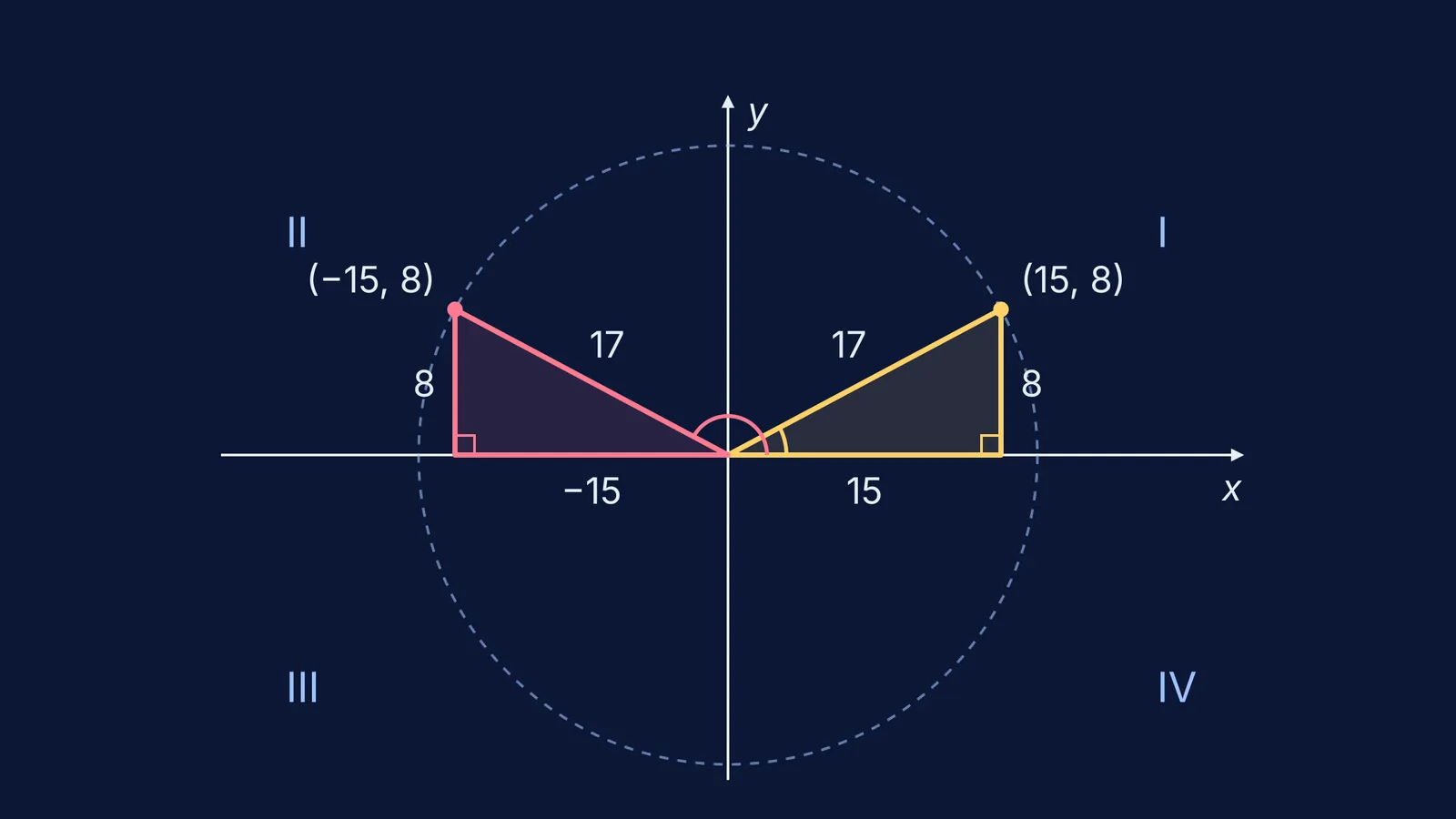
In Class 11 the definition moves from a triangle to the unit circle. For a point P(a, b) on that circle, cos x = a and sin x = b, and that is where sin²x + cos²x = 1 for every real x comes from (NCERT Class 11 Mathematics, Chapter 3). The triangle method still gives you the sizes. The quadrant decides each sign.
The sign table in Section 3.3.1 of the same chapter is the one to learn (NCERT Class 11, Chapter 3):
Quadrant I (0 to 90°): all six ratios are positive.
Quadrant II (90° to 180°): only sin and cosec are positive.
Quadrant III (180° to 270°): only tan and cot are positive.
Quadrant IV (270° to 360°): only cos and sec are positive.
A common memory aid is "All Silver Tea Cups", going anticlockwise from quadrant I; our guide to the ASTC rule for signs of trig functions goes through it quadrant by quadrant. A reciprocal always has the same sign as its partner, so you only need the signs of sin, cos and tan.
Worked example: sin A = 8/17 with A in the second quadrant
Keep the 8-15-17 triangle, but place it to the left of the y-axis. The point on the terminal side becomes (−15, 8), with radius 17. Only the horizontal side has turned negative.
cos A = −15/17 (cos is negative in quadrant II)
tan A = −8/15
cosec A = 17/8
sec A = −17/15
cot A = −15/8
NCERT works the same pattern in Class 11. In Example 6, cos x = −3/5 in the third quadrant gives sin x = −4/5 and tan x = 4/3. In Example 7, cot x = −5/12 in the second quadrant gives sec x = −13/5 and sin x = 12/13 (NCERT Class 11, Chapter 3). If you prefer to start from a point's coordinates, our guide to finding trig ratios from a point on the terminal side uses the same idea.
Which mistakes cost marks most often?
Taking the root of 17² + 8² instead of 17² − 8². You only add the squares when the hypotenuse is the side you're looking for.
Making cos negative in quadrant II but forgetting that sec, tan and cot turn negative with it.
Labelling the adjacent and opposite sides from the wrong angle, which swaps sin and cos.
The same sign habit comes back in choosing the sign in the half-angle formula.
To practise, choose a fraction such as 20/29 or 7/25. Find all six ratios for each of the four quadrants, then check each set with sin² + cos² = 1. If your answers keep coming out wrong, the Fermi Problem Library has worked problems with a step-by-step solver that explains the reasoning rather than printing an answer. If the trouble is the unit circle itself, start with its lesson in the Fermi Concept Library.


