

On this page
When you derive the half-angle formula for sine, you begin with the standard cosine double-angle identity: cos 2θ = 1 − 2 sin² θ. Substituting θ = x/2 transforms the expression into cos x = 1 − 2 sin²(x/2). Rearranging this relationship to isolate the squared term produces sin²(x/2) = (1 − cos x) / 2.
The ambiguity enters during the extraction of the square root. Taking the principal square root on both sides yields |sin(x/2)| = √((1 − cos x) / 2). Because the absolute value can represent either a positive or negative quantity depending on the angle, mathematicians write the identity as sin(x/2) = ±√((1 − cos x) / 2). The radical expression itself, √((1 − cos x) / 2), is by definition non-negative because −1 ≤ cos x ≤ 1. The ± symbol is not an inherent property of the formula's calculation; it is an external algebraic operator that you must decide based on the coordinate plane.
Which quadrant determines the sign of sin(x/2)?
The single most common mistake in school and competitive examinations is looking at the quadrant of the original angle x rather than the half-angle x/2. If a problem states that x lies in Quadrant III, students frequently notice that sine is negative in the third quadrant and hastily assign a minus sign to the formula.
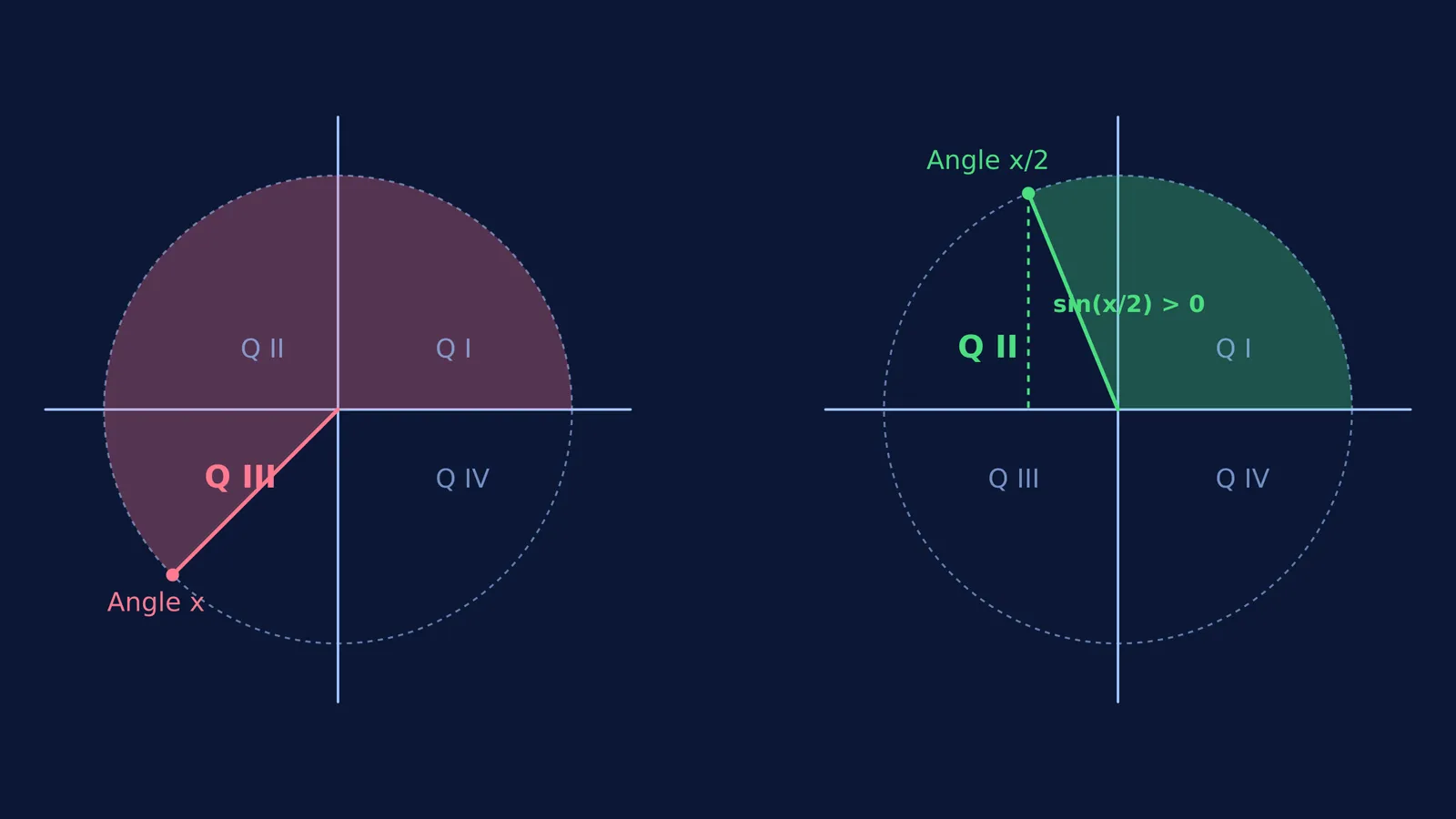
That reasoning is backwards. The value being calculated is sin(x/2), which represents the vertical y-coordinate of the terminal ray of x/2 on the unit circle. The sign must therefore match the quadrant of x/2. To find the correct quadrant, you must divide the bounding inequality of x by 2:
If x is in Quadrant I (0 < x < π/2), dividing by 2 gives 0 < x/2 < π/4. The half-angle lies in Quadrant I, so sin(x/2) is positive.
If x is in Quadrant II (π/2 < x < π), dividing by 2 gives π/4 < x/2 < π/2. The half-angle lies in Quadrant I, so sin(x/2) is positive.
If x is in Quadrant III (π < x < 3π/2), dividing by 2 gives π/2 < x/2 < 3π/4. The half-angle lies in Quadrant II, so sin(x/2) is positive.
If x is in Quadrant IV (3π/2 < x < 2π), dividing by 2 gives 3π/4 < x/2 < π. The half-angle lies in Quadrant II, so sin(x/2) is positive.
This reveals a striking mathematical fact: for any angle x within the standard primary revolution (0 < x < 2π), x/2 lies strictly between 0 and π. In coordinate geometry, the range (0, π) covers only Quadrants I and II—the upper half of the Cartesian plane where y is positive. Consequently, if 0 < x < 2π, sin(x/2) is always positive. The negative root only comes into play when the domain of x extends beyond a single positive cycle, such as negative angles (−2π < x < 0) or multi-revolution rotations (2π < x < 4π).
This quadrant-halving principle is taught in Chapter 3 of the Class 11 mathematics curriculum by the National Council of Educational Research and Training (NCERT), where students learn to link angle boundaries to the allied angles and the ASTC rule.
How do you find sin(x/2) when cos x is negative?
To see the method in action, consider a classic textbook problem from NCERT Class 11: given cos x = −1/3 with x in Quadrant III (π < x < 3π/2), find the exact values of sin(x/2), cos(x/2), and tan(x/2).
Establish the domain of the half-angle:
Dividing the inequality π < x < 3π/2 by 2 gives π/2 < x/2 < 3π/4. This places x/2 between 90° and 135°, which is Quadrant II.
Determine the sign of each ratio in Quadrant II:
According to coordinate definitions, any ray in Quadrant II has a positive y-coordinate and a negative x-coordinate. Thus, sin(x/2) > 0, cos(x/2) < 0, and tan(x/2) < 0.
Calculate sin(x/2):
Using the half-angle formula with a positive sign: sin(x/2) = +√((1 − cos x) / 2) = √((1 − (−1/3)) / 2) = √((4/3) / 2) = √(2/3) = √6 / 3.
Calculate cos(x/2) and tan(x/2) to observe the contrast:
Using the cosine half-angle formula with a negative sign: cos(x/2) = −√((1 + cos x) / 2) = −√((1 + (−1/3)) / 2) = −√((2/3) / 2) = −√(1/3) = −√3 / 3. Dividing the two values gives tan(x/2) = sin(x/2) / cos(x/2) = (√6 / 3) / (−√3 / 3) = −√2.
Notice that while cos x was negative, sin(x/2) emerged positive, whereas cos(x/2) was negative. Both signs align with the position of x/2 in Quadrant II. The Fermi Problem Library provides worked problems with a step-by-step solver that explains the reasoning rather than printing an answer, helping students identify such boundary conditions before executing calculations.
Why do sign errors in trigonometry derail calculus?
Mistakes in trigonometric sign conventions do not remain confined to school algebra; they propagate directly into calculus. In a mixed-methods investigation published in *PEOPLE: International Journal of Social Sciences*, Dr. Flordeliza P. Ferrer found that difficulties in integral calculus rarely stem from the integration formulas themselves, but rather from deficiencies in prerequisite trigonometric manipulation (Ferrer, 2016).
In definite integration, evaluating expressions such as √(1 − cos x) requires writing the integrand as √2 |sin(x/2)|. Forgetting the absolute value or misjudging the quadrant of x/2 results in incorrect negative areas or erroneous cancellations across integration bounds. Similar difficulties appear when integrating 1/(a + b cos x) with the tan(x/2) substitution or simplifying expressions using triple-angle formulas.
To bypass the sign ambiguity when working with tangents, mathematicians often employ the alternative rational identities: tan(x/2) = sin x / (1 + cos x) = (1 − cos x) / sin x. Because these rational forms do not involve square roots, the signs of sin x and cos x automatically generate the correct algebraic sign for tan(x/2).
For students working through multi-topic mathematics, the Fermi Concept Library has every concept in mathematics, each with its own lesson and its place in the map, showing how coordinate geometry, angle identities, and integration connect.


