

On this page
When you first learn trigonometry, sine and cosine appear strictly as ratios between right-triangle sides. That picture works for acute angles between 0° and 90°, but breaks down as soon as an angle rotates into obtuse territory, sweeps past a straight line, or turns negative. To evaluate angles of any magnitude, mathematics shifts from side lengths to Cartesian coordinates.
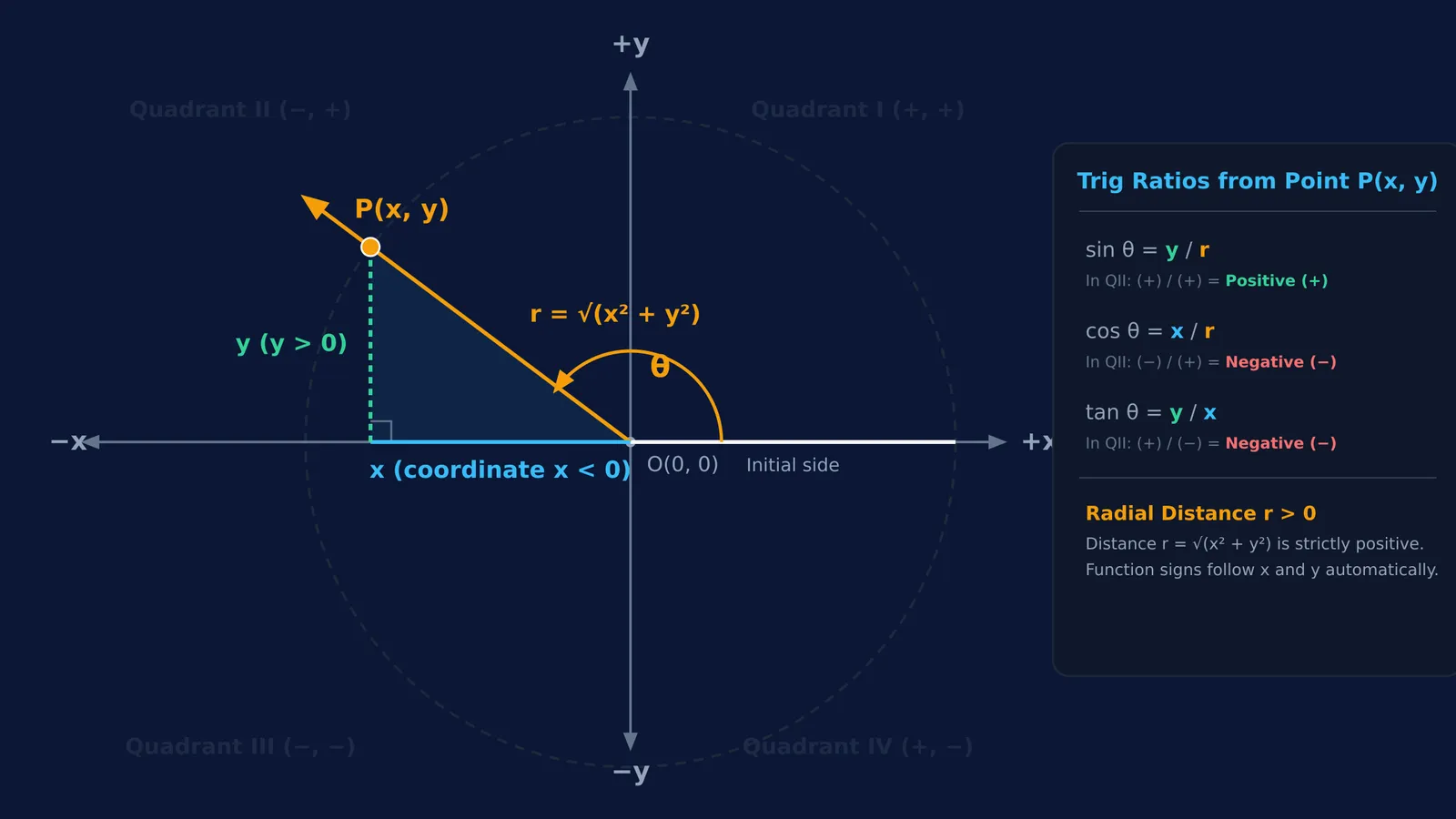
By placing an angle in standard position—anchoring its vertex at the origin (0, 0) and aligning its initial side along the positive x-axis—you describe the entire angle through any point on its terminal side.
How do you find the six trig ratios from a terminal point?
Let P(x, y) be any point other than the origin on the terminal side of an angle θ in standard position. The distance from the origin (0, 0) to P(x, y) is the radius r = √(x² + y²). Because distance is geometric length, r is always strictly positive (r > 0).
As defined in OpenStax Precalculus 2e, coordinates determine the primary trigonometric ratios:
sin θ = y/r
cos θ = x/r
tan θ = y/x (where x ≠ 0)
Their reciprocal functions follow directly, as described in OpenStax Precalculus 2e:
csc θ = r/y (where y ≠ 0)
sec θ = r/x (where x ≠ 0)
cot θ = x/y (where y ≠ 0)
The specific choice of point on the ray does not change the ratios. If you pick a point at distance 2r from the origin, coordinates scale to (2x, 2y) and radial distance doubles to 2r. In every ratio, the common factor cancels completely.
Why do coordinates determine quadrant signs automatically?
In right-triangle trigonometry, side lengths are positive numbers, so every ratio is positive. As detailed in OpenStax Precalculus 2e, Cartesian coordinates keep radial distance r positive, while x and y can be positive, negative, or zero depending on the quadrant:
Quadrant I (x > 0, y > 0): All six ratios are positive.
Quadrant II (x < 0, y > 0): Sine and cosecant are positive; cosine, secant, tangent, and cotangent are negative.
Quadrant III (x < 0, y < 0): Tangent and cotangent are positive; sine, cosine, secant, and cosecant are negative.
Quadrant IV (x > 0, y < 0): Cosine and secant are positive; sine, cosecant, tangent, and cotangent are negative.
Many classrooms teach mnemonics like "All Silver Tea Cups" to memorize positive functions, an approach covered in our guide to allied angles and the ASTC rule. Reading ratios directly from coordinates makes mnemonics redundant: the sign of each ratio is simply the algebraic sign of x, y, or their quotient.
What happens when a terminal point lies on a coordinate axis?
When an angle terminates on a coordinate axis, it is called a quadrantal angle. According to OpenStax Precalculus 2e, these occur at integer multiples of 90° (or π/2 radians), such as 0°, 90°, 180°, and 270°. Right triangles cannot represent these angles because a triangle cannot have two right angles or a zero-degree angle. Coordinate definitions handle them naturally:
On the y-axis (x = 0): Points have coordinates (0, y). Here, cos θ = 0/r = 0 and cot θ = 0/y = 0. However, tan θ = y/0 and sec θ = r/0 involve division by zero and are undefined.
On the x-axis (y = 0): Points have coordinates (x, 0). Here, sin θ = 0/r = 0 and tan θ = 0/x = 0. Conversely, csc θ = r/0 and cot θ = x/0 are undefined.
This coordinate perspective mirrors the technique used when finding the principal argument of complex numbers, where tracking signed horizontal and vertical projections resolves ambiguous angles across the plane.
Worked example: how do you evaluate ratios for (-3, -4)?
Suppose the terminal side of an angle θ in standard position passes through point P(-3, -4). Here is how to find all six ratios:
Identify coordinates: x = -3 and y = -4, placing the ray in Quadrant III.
Compute radial distance: r = √((-3)² + (-4)²) = √(25) = 5. Because distance is positive, r = 5.
Primary ratios: sin θ = y/r = -4/5, cos θ = x/r = -3/5, and tan θ = y/x = 4/3.
Reciprocal ratios: csc θ = r/y = -5/4, sec θ = r/x = -5/3, and cot θ = x/y = 3/4.
Pythagorean check: sin² θ + cos² θ = (-4/5)² + (-3/5)² = 16/25 + 9/25 = 1.
Signs take care of themselves. You do not need to memorize whether tangent is positive in the third quadrant; dividing -4 by -3 produces positive 4/3 automatically. When wrong-method mistakes occur in calculating ratios or determining quadrant signs, the Fermi Problem Library provides worked problems with a step-by-step solver that explains the reasoning rather than printing an answer.
Why do students struggle when moving beyond right triangles?
The transition from triangle geometry to coordinate functions is a frequent obstacle in secondary mathematics. In a 2018 study in the International Journal of Mathematical Education in Science and Technology, mathematics education researchers Dina Kamber and Djurdjica Takači investigated how secondary students reason about trigonometric concepts. They found that students who rely heavily on right-triangle procedures struggle to make sense of trigonometric functions for general angles.
Kamber and Takači observed that students often treat quadrant signs as disconnected memorized rules. When students view trigonometry solely through triangle side ratios, negative values appear contradictory because physical lengths cannot be negative. By establishing coordinate definitions early, students connect geometry with function graphs, eliminating arbitrary sign errors.
To see how coordinate definitions connect across topics, the Fermi Concept Library covers every concept in physics, chemistry, biology, mathematics and computing, each with its own lesson and its place in the map.


