

On this page
The values of sine, cosine, and tangent are not always positive. As an angle grows beyond 90°, the trigonometric ratios alternate between positive and negative values. Knowing which functions are positive in which quadrant is a fundamental step for solving equations or finding the principal argument of a complex number.
To remember the signs of trigonometric functions across the four quadrants, mathematicians use the ASTC rule.
What is the ASTC rule for trigonometry quadrants?
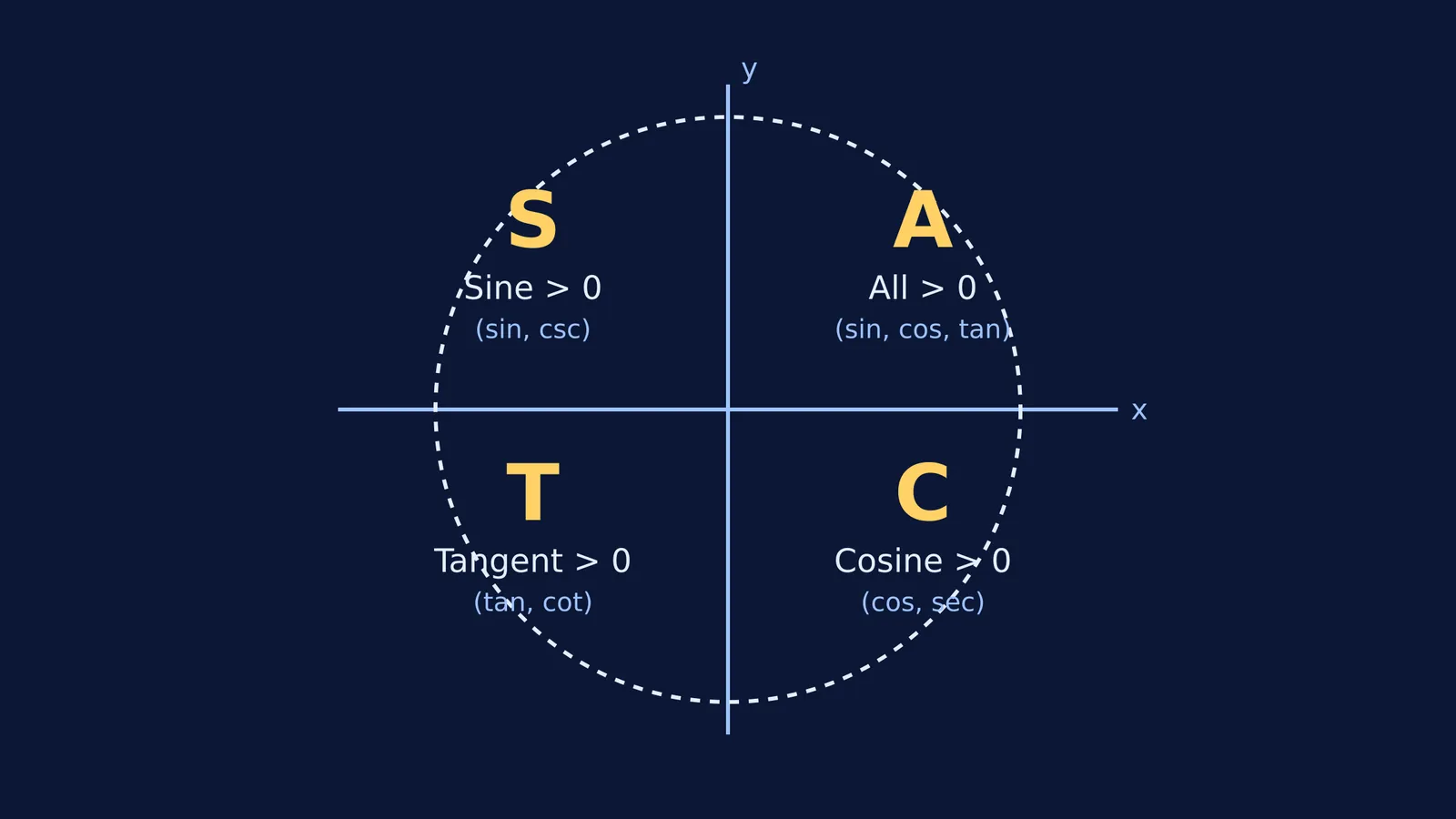
The ASTC rule is a simple memory aid—often taught as "All Students Take Calculus"—that tells you which trigonometric functions are positive in each quadrant of the coordinate plane. According to standard definitions (Wikipedia), the rule works counter-clockwise starting from the top right:
Quadrant I (0° to 90°): All trigonometric functions (sin, cos, tan, and their reciprocals) are positive.
Quadrant II (90° to 180°): Only Sine and its reciprocal (cosecant) are positive. The rest are negative.
Quadrant III (180° to 270°): Only Tangent and its reciprocal (cotangent) are positive.
Quadrant IV (270° to 360°): Only Cosine and its reciprocal (secant) are positive.
Why do the signs of trig functions change?
The signs change because trigonometric functions are defined by the x and y coordinates of a point moving around a unit circle.
Imagine a circle with a radius r drawn on a graph. For any angle θ, the point where the angle hits the circle has coordinates (x, y). The trigonometric functions are defined as:
sin θ = y / r
cos θ = x / r
tan θ = y / x
Because the radius r is a distance, it is always positive. This means the sign of sin θ depends entirely on the y-coordinate, and the sign of cos θ depends entirely on the x-coordinate.
In the second quadrant (top left), the x-coordinate is negative but the y-coordinate is positive. Therefore, sin θ (which uses y) remains positive, but cos θ (which uses x) becomes negative. Because tan θ is the ratio of y to x, a positive divided by a negative makes the tangent negative as well.
In the third quadrant, both x and y coordinates are negative. This makes both sine and cosine negative, but their ratio (tangent) becomes positive. Finally, in the fourth quadrant, the x-coordinate is positive while the y-coordinate is negative, making cosine positive and sine negative.
If you are struggling to picture how angles map to these coordinates, the Fermi Concept Library has a lesson for every concept in mathematics, showing exactly how the unit circle connects to trigonometric graphs.
How to use the quadrant rules to find missing ratios?
Exam problems often give you the value of one trigonometric ratio and the quadrant the angle lies in, asking you to find the others.
Here is a step-by-step method to solve these:
Ignore the sign temporarily and use a right-angled triangle to find the lengths of the opposite, adjacent, and hypotenuse sides.
Calculate the numerical value of the required trigonometric ratio.
Apply the ASTC rule to determine the correct sign based on the given quadrant.
Worked Example If cos θ = −3/5 and θ lies in the third quadrant, find the value of sin θ.
First, ignore the negative sign. In a right triangle where the adjacent side is 3 and the hypotenuse is 5, Pythagoras' theorem (3² + opposite² = 5²) tells us the opposite side is 4. This makes the numerical value of sine equal to 4/5.
Next, check the quadrant. The angle is in the third quadrant. The ASTC rule tells us that only tangent (and cotangent) are positive in the third quadrant. Therefore, sine must be negative. The final answer is sin θ = −4/5.
For more practice with deriving exact values across different quadrants, you can look at how to find the exact values of sin 18° and cos 36°. If you get stuck on the algebra, the Fermi Problem Library features a step-by-step solver that explains the reasoning behind each algebraic step instead of just printing the final answer.
What happens with inverse trigonometric functions?
When you use a calculator to find an angle using an inverse function like sin⁻¹, it will only ever give you one answer, known as the principal value. However, because of the ASTC rule, there are usually two quadrants where a function has the same sign.
For example, if you know that sin θ = 0.5, the angle θ could be in the first quadrant (where all are positive) or the second quadrant (where sine is positive). Your calculator will only tell you that θ = 30°. It is up to you to use the ASTC rule to find the second possible angle, which would be 180° − 30° = 150°.
This is why understanding the signs in each quadrant is so critical: it ensures you do not miss valid solutions when solving equations. Without the ASTC rule, it is easy to find one solution and completely miss the other, which will cost you marks in an exam. If you frequently lose track of these multiple solutions, drawing a quick "A-S-T-C" cross on your rough paper before you begin can help you keep your signs straight.


