

On this page
An AI's neat proof ending in "Hence proved" tells you nothing on its own. Here are three checks, then two AI-style proofs that look fine and are not.
Why can't you trust an AI proof just because it looks tidy?
A language model can write something that looks like a proof even when the steps are wrong. In Proof or Bluff?, Ivo Petrov, Jasper Dekoninck and colleagues had expert annotators grade full solutions from reasoning models on the six 2025 USA Mathematical Olympiad problems: Gemini-2.5-Pro scored 25%, and every other model scored under 5%. Olympiad problems are far harder than Class 11 identities, but a confident final line can still hide broken reasoning.
In the GSM-Symbolic study, adding a single clause that seems relevant to a question, but plays no part in the answer, caused performance drops of up to 65% in state-of-the-art models. Our explainer on why AI makes maths mistakes covers the reasons.
What does it mean to prove a trigonometric identity?
A trigonometric identity is an equality between trigonometric expressions that is true for every value of the variable for which both sides are defined (List of trigonometric identities). So one angle where both sides are defined but differ is enough to sink a claimed identity, and a proof must not quietly divide by zero anywhere. The safest format starts from one side and transforms it, line by line, into the other.
How do you check an AI's trig proof step by step?
Substitute angles. Put angles from every quadrant, such as 30°, 120°, 200° and 300°, into both sides. Testing only 30°, 45° and 60° can miss errors that appear where sine or cosine is negative. Passing does not prove the identity; failing disproves it.
Ask whether each step runs backwards. A step is safe only if you could also go from the next line back to the previous one.
Circle every division and cancellation. Write down the angles where that expression is zero, and check what the proof claims there.
A quick reference for the second check:
Adding the same expression to both sides, or swapping in a known identity such as sin²θ + cos²θ = 1: reversible.
Multiplying or dividing by an expression: reversible only where it is not zero.
Squaring both sides: not reversible, because a² = b² only tells you a = b or a = −b.
Taking a square root: √(x²) is the absolute value of x, so the sign matters.
Flawed AI proof 1: what goes wrong when you square both sides?
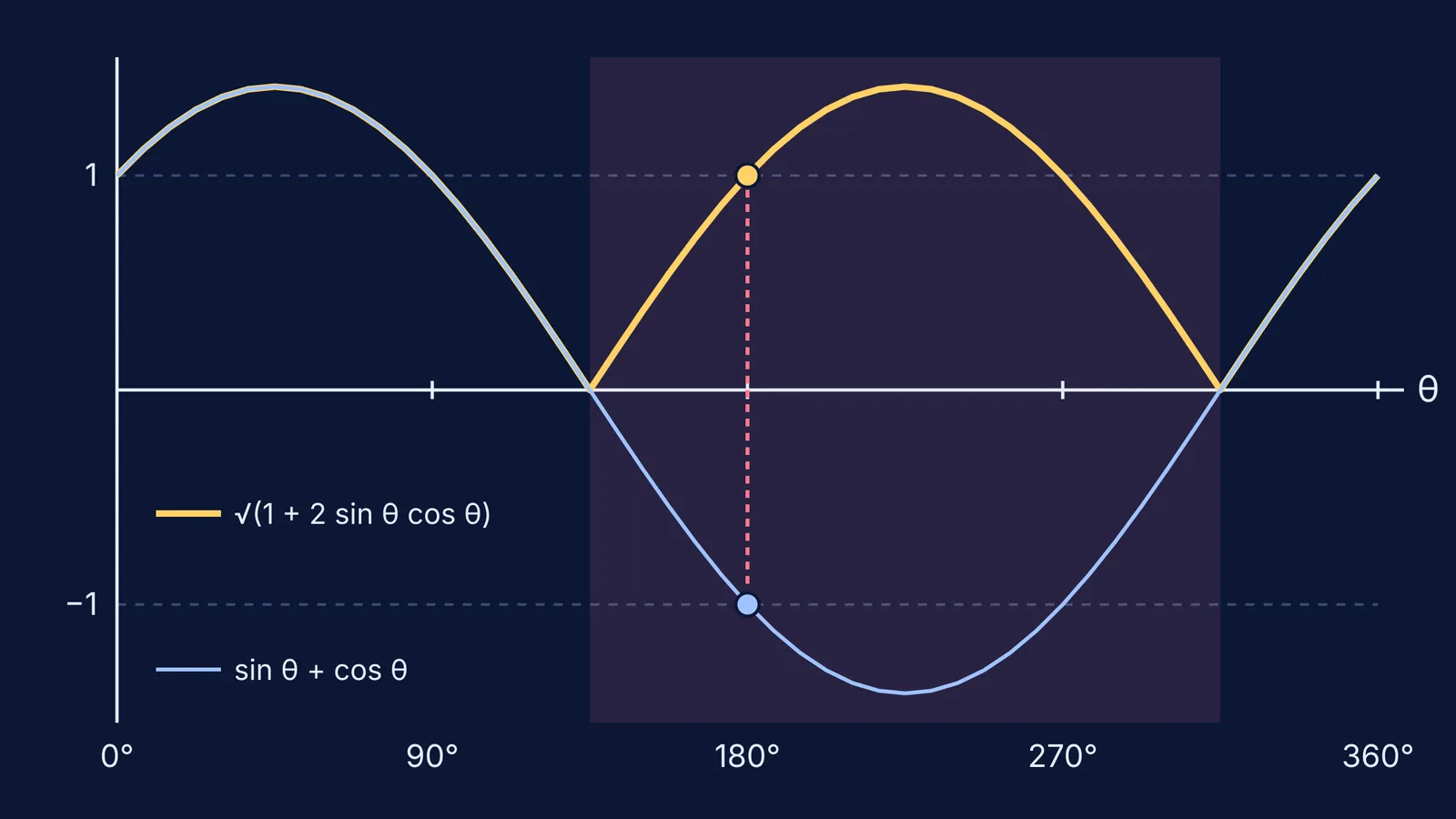
Claim: sin θ + cos θ = √(1 + 2 sin θ cos θ).
The AI's proof: "Squaring both sides, sin²θ + 2 sin θ cos θ + cos²θ = 1 + 2 sin θ cos θ. Since sin²θ + cos²θ = 1, both sides equal 1 + 2 sin θ cos θ. Hence proved."
Every line is correct algebra, and the claim even passes at 30°, where both sides come to about 1.366. At 180°, though, the left side is −1 and the right side is 1. The claim is false.
The faulty step is the first. Squaring turned a = b into a² = b², which is also true when a = −b, so the chain cannot run backwards. In fact √(1 + 2 sin θ cos θ) equals the absolute value of sin θ + cos θ, and the AI's two sides disagree for every θ strictly between 135° and 315°, as the graph at the top shows.
Flawed AI proof 2: where is the hidden division by zero?
Claim: (1 − cos 2θ) / sin 2θ = tan θ for all θ.
The AI's proof: "1 − cos 2θ = 2 sin²θ and sin 2θ = 2 sin θ cos θ. Cancelling 2 sin θ gives sin θ / cos θ = tan θ. Hence proved for all θ."
Cancelling 2 sin θ assumes sin θ is not zero. At θ = 0° the left side is 0/0, undefined, while tan 0° = 0. The result holds only when θ is not a multiple of 90°, so "for all θ" is wrong.
This matters: solving (1 − cos 2θ) / sin 2θ = 0 via tan θ = 0 gives θ = 0°, 180° and so on, but each of those makes the left side 0/0, so the equation has no solution.
What should you ask the AI after you find a problem?
Paste one of these back:
"Check your claim at θ = 180° and show both sides as numbers."
"Which steps divide or cancel? For each one, at which angles is that expression zero?"
"Rewrite the proof starting from the left side only, without squaring or changing the right side."
To practise, try our trigonometric identities practice set and our guide to proof writing for INMO.
If the same slip keeps showing up in your own working, the Fermi Problem Library has worked problems with a step-by-step solver that explains the reasoning rather than printing an answer, and Fermi's AI tutor notices where a student is stuck and decides whether to explain, ask or show.


