

On this page
Minimising trigonometric functions is a standard challenge in competitive exams like JEE. While you could use calculus to find where the derivative is zero, expressions involving squares of secant and cosecant often hide an elegant algebraic shortcut.
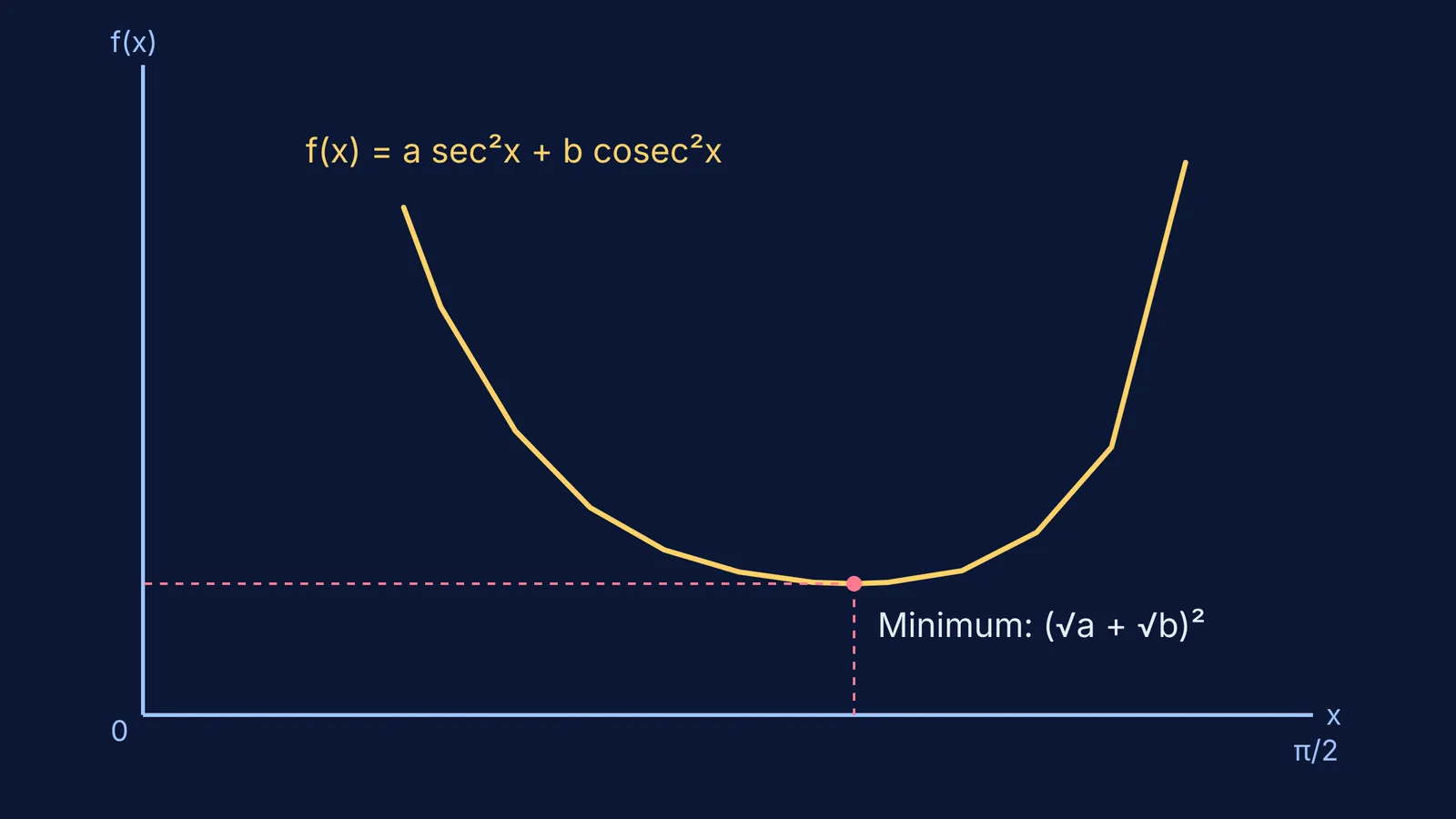
What is the minimum value of a sec² x + b cosec² x?
The minimum value of the expression a sec² x + b cosec² x (where a and b are positive constants, and x is an angle in the first quadrant) is always (√a + √b)².
To see why, you first rewrite the expression using the fundamental Pythagorean identities. We know that sec² x = 1 + tan² x, and cosec² x = 1 + cot² x. Substituting these into the original expression gives:
a(1 + tan² x) + b(1 + cot² x)
If you expand the brackets and group the terms, you get:
a + b + a tan² x + b cot² x
The constants "a + b" are fixed. To find the minimum value of the whole expression, you only need to find the minimum value of the variable part: a tan² x + b cot² x.
If you want to review how to differentiate expressions directly, see our guide to finding the absolute maximum and minimum on a closed interval.
How do you use the AM-GM inequality?
To minimise a tan² x + b cot² x, we use a fundamental mathematical principle. The inequality of arithmetic and geometric means (AM-GM) states that the arithmetic mean of non-negative real numbers is always greater than or equal to their geometric mean.
For two non-negative numbers u and v, this means: (u + v) / 2 ≥ √(uv) Which rearranges to: u + v ≥ 2√(uv)
Let u = a tan² x and v = b cot² x. Since a and b are positive, and squares are always non-negative, both terms are non-negative. Applying the inequality gives:
a tan² x + b cot² x ≥ 2√(a tan² x × b cot² x)
Because tan x and cot x are reciprocals, their product is 1. Therefore, tan² x × cot² x = 1. The right side of the inequality simplifies beautifully:
a tan² x + b cot² x ≥ 2√(ab)
This tells us that the variable part of our expression can never be smaller than 2√(ab). If you are looking to see how other standard trigonometric forms are tackled, we have also worked through integrating 1/(a + b cos x).
When does the minimum occur?
Now, bring back the constant a + b that we separated earlier. The minimum value of the entire expression is:
a + b + 2√(ab)
If you look closely, this is a perfect square. It can be written as:
(√a + √b)²
The AM-GM inequality also tells us that the minimum value is reached exactly when the two terms are equal. So, the minimum occurs when:
a tan² x = b cot² x
Since cot² x = 1 / tan² x, you can multiply both sides by tan² x:
a tan⁴ x = b tan⁴ x = b / a tan x = (b / a)^(1/4)
How does this look in a worked example?
To make this concrete, let us find the minimum value of 4 sec² x + 9 cosec² x.
In this problem, our constants are a = 4 and b = 9. You could expand this out manually into sines and cosines, but using our derived formula makes it immediate.
Substitute the values into our formula (√a + √b)²: (√4 + √9)² = (2 + 3)² = 5² = 25
The minimum value of the expression is exactly 25.
Here is your checklist for tackling similar minimisation problems:
Check that the expression can be converted into reciprocal pairs (like tan and cot).
Separate the fixed constants from the variable terms.
Apply the AM-GM inequality to the variable terms to find the minimum.
Add the fixed constants back to get the final answer.
If you do not know where to start on a new question, Fermi's AI tutor works out what you already know, builds a plan for the session, and teaches through it. Once you know the method, the Fermi Problem Library has worked problems with a step-by-step solver that explains the reasoning rather than printing an answer.


