On this page
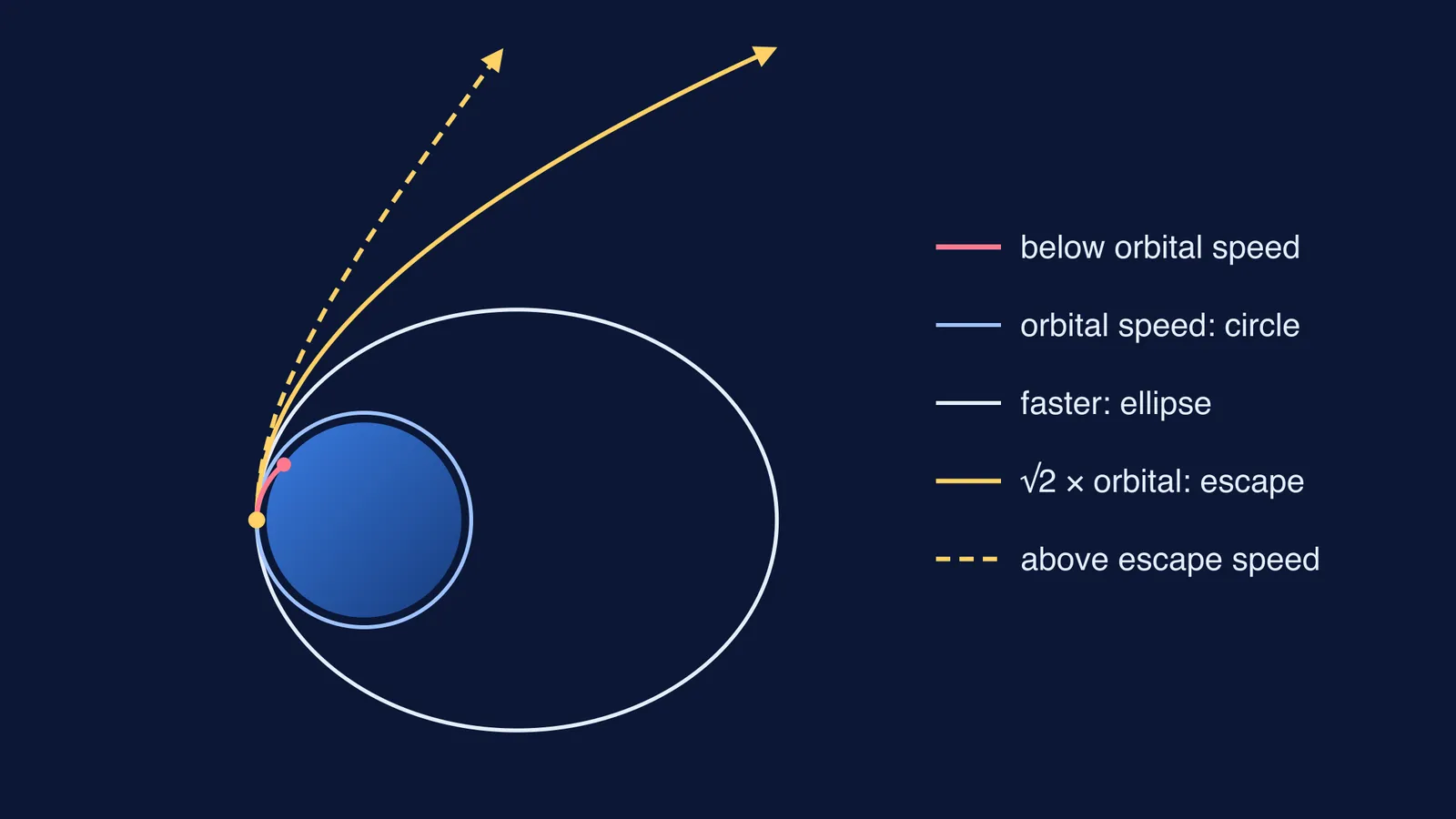
Picture Isaac Newton's thought experiment: a cannon on an impossibly tall mountain, firing sideways, with air drag ignored. NASA's Basics of Space Flight walks through it. A slow shot lands some distance from the mountain, a faster one lands farther away, and a fast enough one never touches down because it "falls completely around Earth". Push the speed higher still and, as the energy argument below shows, the ball never comes back.
A launch-speed simulation lets you run that experiment yourself. Predict each result before you press play, then explain every surprise.
What is escape velocity, and why is it 11.2 km/s?
Escape velocity is the smallest launch speed that carries an object infinitely far from a planet, with no further push and no air. OpenStax University Physics derives it by setting the total energy to zero, which gives v = √(2GM/R).
NASA's Earth fact sheet lists Earth's escape velocity as 11.186 km/s, which textbooks round to 11.2 km/s.
The same fact sheet gives Earth's GM as 398,600 km³/s² and its mean radius as 6,371 km. Put those into v = √(GM/R) and you get the speed of a circular orbit just above the surface: about 7.9 km/s. OpenStax points out that escape velocity is exactly √2 times this orbital speed, and 7.91 × 1.414 = 11.19 km/s, so the two numbers agree.
If you want the algebra line by line, our post on how to derive the escape velocity formula goes through it, and why a satellite falls but never lands covers the circular case.
What happens at each launch speed?
Set up the simulation with an airless Earth and launch sideways, along the ground. Write your prediction for each speed first. These are the answers we worked out from NASA's GM and radius above, using energy conservation and the orbit equations in OpenStax:
7 km/s: falls back. It is slower than orbital speed, so it curves into the ground straight away.
7.9 km/s: a circle just above the surface, going round once in about 84 minutes.
10 km/s: an ellipse. It swings out to about 19,000 km above the far side of Earth and comes back to the launch point.
11 km/s: still an ellipse, but a very long one. It climbs to about 180,000 km and takes about 3.5 days to come back.
11.2 km/s, the escape speed: escapes on a parabola, slowing towards zero speed as it gets very far away.
13 km/s: escapes on a hyperbola and is still moving at about 6.6 km/s when it is very far from Earth, since √(13² − 11.19²) ≈ 6.6.
OpenStax sorts these by total energy: below zero the object is bound and returns, at exactly zero it has "just escaped", and above zero it keeps some kinetic energy forever.
The direction changes the path but not the escape speed, as long as the shot clears the ground. Our post on whether escape velocity depends on the angle of projection shows why.
Why does the mass of the projectile not matter?
Write the escape condition as an energy balance: ½mv² = GMm/R. The projectile's mass m sits on both sides and cancels. In the words of OpenStax, "The escape velocity is the same for all objects, regardless of mass."
Test it: launch a 1 kg ball and a 1,000 kg probe at 11 km/s. The two paths lie exactly on top of each other. What changes is the energy you have to supply. Using NASA's 11.186 km/s, the 1 kg ball needs ½ × 1 × 11,186² ≈ 63 MJ of kinetic energy, and the 1,000 kg probe needs about 63 GJ. Heavier payloads need bigger rockets, but the speed target is the same.
Watch for this in board and JEE Main questions: "a heavier body needs a higher escape velocity" is false. Escape velocity depends only on the planet's mass and the launch distance from its centre.
How should you run an escape velocity simulation?
Use this plan so the simulation tests your thinking. The formula, like most simulations, assumes the whole speed is given at once with no air, so treat 11.2 km/s as an energy benchmark rather than a real rocket's launch speed.
Turn air drag off and launch from the surface.
Write a prediction for each of the six speeds above: path shape, and whether it comes back.
Run them one at a time. Note the highest point and, if it returns, how long it took.
Change only the mass. Check that the path does not move.
At 11.2 km/s, change the launch angle upward. Check that it still escapes.
For every wrong prediction, write one sentence explaining it in terms of energy.
If orbits are easier to see than to read, the Fermi Simulation Lab has interactive simulations, including orbits, where you can run predictions like these. And if you get stuck on why a result came out the way it did, Fermi's AI tutor can run the simulation with you and check your understanding as it goes.