On this page
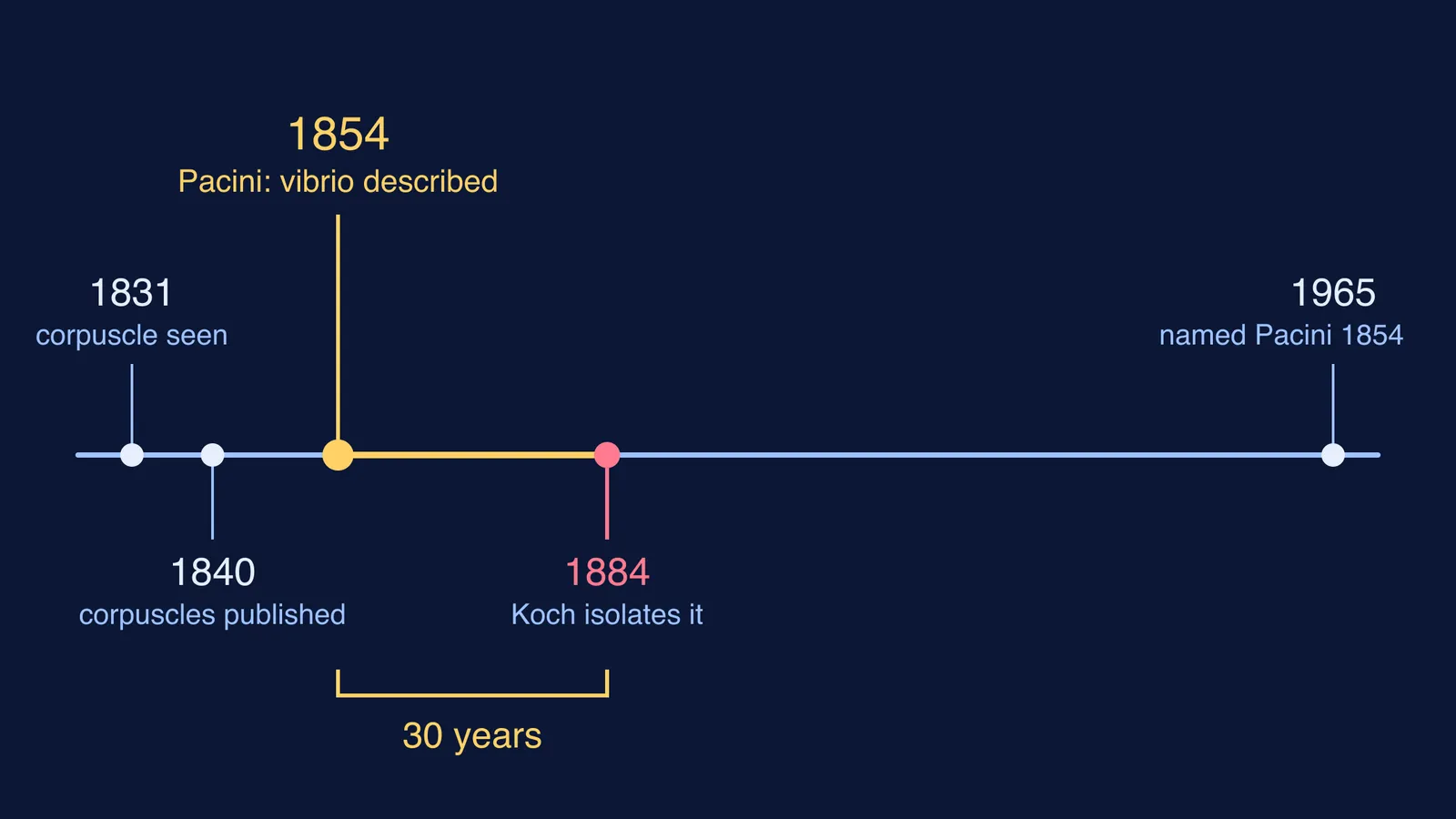
In 1854 cholera reached Florence. Filippo Pacini, an anatomist who had already discovered a new kind of sense organ in the human body, looked at the intestines of people who had died of the disease under his microscope. He found huge numbers of tiny curved bacteria, the vibrios. His paper, *Osservazioni microscopiche e deduzioni patologiche sul cholera asiatico* (Microscopic observations and pathological deductions on Asiatic cholera), appeared in the Gazzetta Medica Italiana on 12 December 1854.
Who discovered the cholera bacterium first?
Filippo Pacini did, in 1854. In the words of an essay in the journal Emerging Infectious Diseases, Pacini "described vibrios in the intestinal contents of cholera victims and was amazed at their large numbers in the mucus and desquamated epithelial cells."
Robert Koch reached the same germ 30 years later. In 1883 Koch travelled to Egypt and then to Calcutta to investigate cholera outbreaks. By 1884 he had found the comma-shaped bacillus, isolated it in the laboratory and named it *Vibrio cholerae*.
Credit took longer than science. In 1965 the Judicial Committee on Bacteriological Nomenclature ruled that the organism should be known as *Vibrio cholerae* Pacini 1854, according to the same Emerging Infectious Diseases essay. The year in the official name is the year of Pacini's paper.
Why did Koch get the credit for cholera?
Seeing a germ and proving that it causes a disease are different jobs. Pacini described the vibrios and linked them to the disease. Koch isolated the bacterium in the laboratory, and his work tied infection to drinking contaminated water; water filtration then stopped the disease in Calcutta. Our post on Robert Koch's postulates for linking a microbe to a disease explains the tests his era used.
The story did not end with Koch; for an Indian chapter, read about the cholera work of Sambhu Nath De. And the disease is not history: the WHO estimates 1.3 to 4.0 million cholera cases and 21,000 to 143,000 deaths worldwide each year. The same WHO fact sheet notes that most people with cholera can be treated with oral rehydration solution.
What are Pacinian corpuscles, and how did Pacini find them?
Long before cholera, Pacini made his name with touch. As a medical student he noticed small sensory organs during a dissection class in 1831, first discussed them in Florence in 1835 and published them in 1840 as *Nuovi organi scoperti nel corpo umano* (New organs discovered in the human body).
A 2026 history in Neurological Sciences says Pacini first described these specialised mechanoreceptors and recognised their connection to nerves and their role in touch, even though his early work got little attention. The structures now carry his name: Pacinian corpuscles.
Pacinian corpuscles are among the most sensitive mechanoreceptors in vertebrates and are tuned to vibrations from 100 to 2000 Hz, according to a 2025 study in Science Advances. The same study found that the layered cells wrapped around the nerve ending actively boost that sensitivity. For the molecules that turn a press into a nerve signal, see our piece on Ardem Patapoutian and the touch receptors he found.
What can you learn from Pacini's 1854 discovery?
Pacini's story gives you a simple tool for any science claim, from a textbook line to your own practical. Call it the evidence ladder:
Observe: you saw something. Pacini saw vibrios in cholera victims.
Describe: you wrote it down so others could check it. Pacini's December 1854 paper.
Test: you showed the thing causes the effect. Koch's lab isolation and the water evidence.
Accept: other people use the result. Water filtration in Calcutta, and the 1965 naming ruling.
Here is a worked example. Take the sentence "Koch discovered the cholera bacterium." Ask which rung it describes. Koch did not climb rung 1 first; Pacini did. But Koch climbed rung 3, which Pacini had not. So a fair version reads: "Pacini first observed the cholera bacterium in 1854; Koch isolated it in the laboratory in 1884 and tied it to contaminated water."
Use the same ladder on your own work:
When you write up a biology practical, say which rung you reached: "I saw X in my slides; I have not tested whether X causes Y."
When an exam question asks who discovered something, check the verb: first observed, isolated, named or proved.
When you read a health claim on WhatsApp, ask which rung it stands on before you forward it.
If the step from "I saw it" to "it causes it" feels slippery in your own chapters, the Fermi Concept Library gives every concept in biology its own lesson and its place in the map, so you can see what each fact rests on.
Next time you read a name in a textbook, ask who stood on the rung below them.