On this page
"Germs cause disease" sounds obvious now. In the 1870s it was a hypothesis, and the hard question was how you would prove that one particular microbe causes one particular illness. A country doctor in Prussia, working in his own flat, worked out how. This post covers what Robert Koch did, the logic of his postulates, their limits, and why his tuberculosis work still matters in India.
Who was Robert Koch?
Koch was born on 11 December 1843 at Clausthal in the Harz mountains and died on 27 May 1910 in Baden-Baden (Nobel Prize biography). He studied medicine at Göttingen, where the anatomist Jacob Henle had argued in 1840 that infectious diseases are caused by living parasitic organisms. From 1872 to 1880 Koch was District Medical Officer in Wollstein. There, the Nobel biography says, his laboratory was the four-roomed flat that was his home, and his main instrument was a microscope given to him by his wife.
How did Koch prove that a bacterium causes anthrax?
The anthrax bacillus had already been seen by others. Koch set out to prove it was the cause. The Nobel biography describes the steps:
He inoculated mice with material from the spleens of farm animals that had died of anthrax. Those mice died, while mice given material from healthy animals did not.
He then grew the bacilli in pure culture, outside any animal, for several generations, and showed they could still cause anthrax.
He observed that the bacilli form resistant spores when conditions are poor and turn back into bacilli when conditions improve.
His results were published in 1876 by the botanist Ferdinand Cohn, and Koch became famous.
What tools did Koch develop?
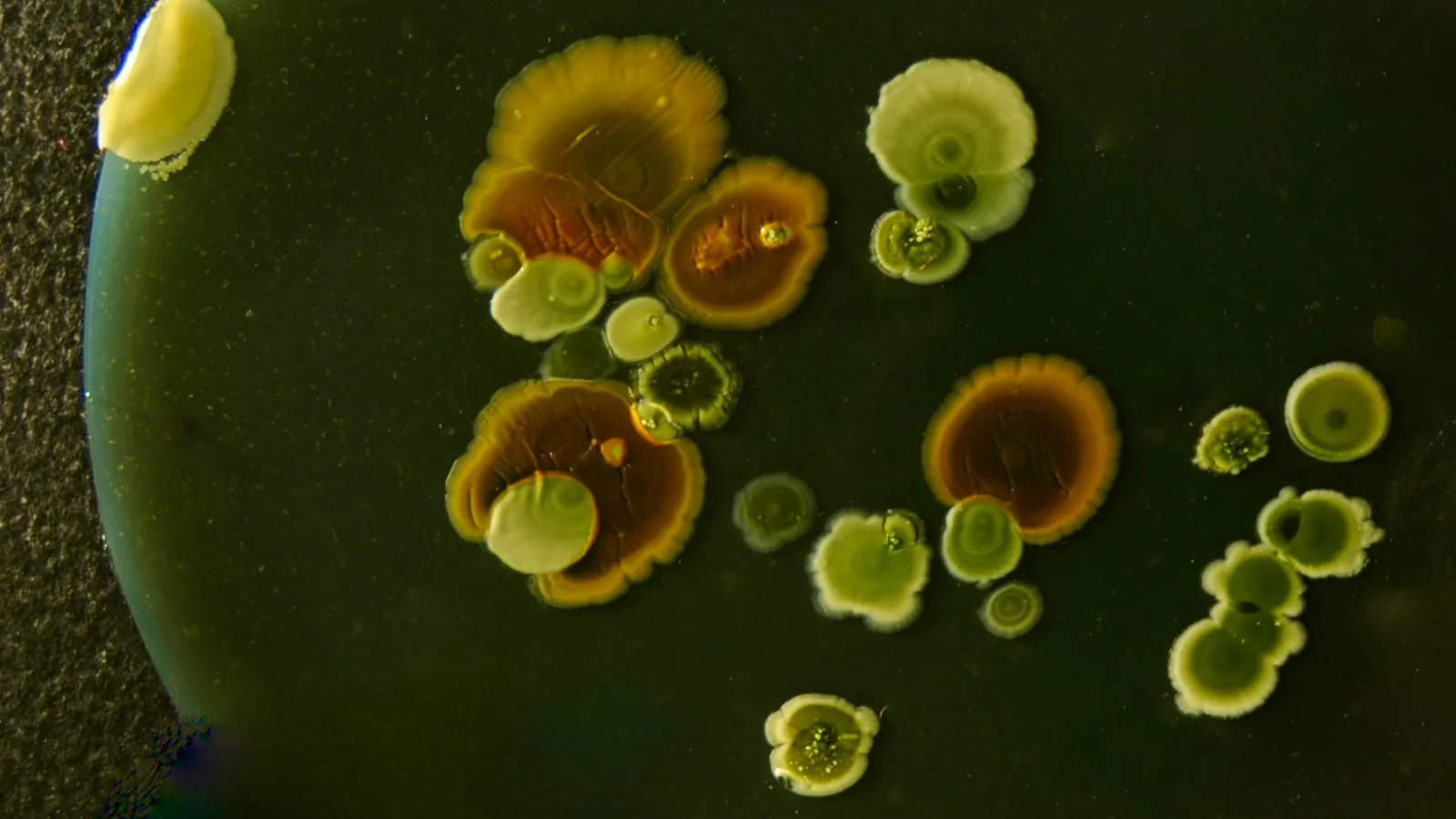
After moving to the Imperial Health Office in Berlin in 1880, Koch and his assistants developed methods for growing pure cultures on solid media such as potato and agar, using the flat dish invented by his colleague Petri, and new staining methods that made bacteria easier to see, the Nobel biography records. Pure culture on solid media meant one type of bacterium could be separated from all the others, which is what the rest of his work depended on.
What did Koch find about tuberculosis?
About two years after arriving in Berlin, Koch identified the tubercle bacillus and a way to grow it in pure culture. The US Centers for Disease Control and Prevention notes that on 24 March 1882 he announced the discovery of *Mycobacterium tuberculosis*, and that in 1882 TB killed one in seven people in the United States and Europe. The date is now World TB Day.
In 1883 he led a commission to Egypt that identified the bacterium that causes cholera, and he also studied cholera in India. In 1905 he received the Nobel Prize in Physiology or Medicine "for his investigations and discoveries in relation to tuberculosis" (NobelPrize.org).
Not everything worked. His tuberculin, made from cultures of the bacillus, was hoped to cure TB. The Nobel biography says its healing power was "greatly exaggerated", though it later proved useful in diagnosis.
What are Koch's postulates?
The Nobel biography says Koch laid down the conditions that must be met before a particular bacterium can be accepted as the cause of a particular disease. They are usually taught in this form:
The microbe is found in every case of the disease.
It can be isolated from the sick host and grown in pure culture.
The pure culture causes the same disease when introduced into a healthy, susceptible host.
The same microbe can be isolated again from that newly infected host.
Where do the postulates fall short?
Fredricks and Relman (1996) describe how the postulates created the scientific standard for proving that microbes cause disease, but also how many pathogens cannot be grown in culture, so newer molecular methods, such as identifying a microbe by its DNA sequence, needed updated guidelines.
Tuberculosis itself shows another limit. The WHO tuberculosis fact sheet estimates that about a quarter of the world's population has been infected with TB bacteria, but most people with TB infection do not feel sick, and only about 5 to 10% go on to develop TB disease. So the microbe can be present without the disease, which strains the first postulate as Koch's era understood it.
Why does TB still matter in India?
WHO's fact sheet reports that an estimated 10.7 million people fell ill with TB in 2024, and that India accounted for 25% of new cases, the largest share of any country. TB is preventable and curable, but treatment usually means daily medicine for 4 to 6 months, and WHO warns that stopping early can make the bacteria resistant.
For NEET-UG, the syllabus unit "Human health and disease" covers pathogens and basic immunology (NEET (UG) 2026 syllabus); check the current year's list of named diseases. Our guide to human health and immunity for NEET covers it in exam form.
What can you learn from Koch?
Make "cause" testable. He turned a vague belief into steps anyone could repeat.
Build the tools first. Pure culture and staining came before his biggest discoveries.
Admit failures. Tuberculin did not work as he claimed, and the record says so.
If pathogens, immunity and vaccines feel like separate lists to memorise, the Fermi Concept Library covers every concept in physics, chemistry, biology, mathematics and computing, so you can see how they link.
Try this now: pick one disease from the NEET syllabus list and write how each of Koch's four steps would apply to it, and where it might fail.