On this page
Most students who try the Feynman technique skip the useful part: writing down exactly where their explanation falls apart. Here are all four steps run on one Class 11 concept, Newton's third law, plus a notebook template. For the history, see our profile of the Feynman technique and what Feynman actually did.
Why does explaining a concept show you what you don't know?
Across 12 studies, Leonid Rozenblit and Frank Keil found that people feel they understand complex phenomena "with far greater precision, coherence, and depth than they really do", an effect they named the illusion of explanatory depth. The illusion was stronger for explanations than for facts or procedures, and explanations are what physics and chemistry questions ask for.
Explaining is also a way to learn. In a 1994 study by Michelene Chi and colleagues, eighth-graders prompted to explain a text on the circulatory system to themselves gained more from pretest to posttest than a group who read it twice (Cognitive Science). A 2013 review of 10 study techniques rated self-explanation as moderate utility: promising, but not yet well tested in classrooms (Dunlosky and colleagues).
In a chapter reviewing learning-by-teaching research, Logan Fiorella describes a follow-up study in which students who explained a lesson from memory did better on a delayed test than those who taught with notes in front of them.
What are the four steps of the Feynman technique?
Choose one concept and write its name on a blank page.
Book closed, explain it in plain words to an imagined Class 8 student, using no term you cannot define.
Mark every spot where you got stuck or hid behind a word. Reread the textbook for those spots only.
Rewrite it more simply, with one example, then test it on a new question.
How does it work on a real Class 11 physics concept?
Step 1: concept. Newton's third law, from the Laws of Motion chapter of NCERT Class 11 Physics.
Step 2: explain, book closed. A first attempt might read: "Every action has an equal and opposite reaction. The horse pulls the cart, the cart pulls the horse back. So the forces cancel. But then how does the cart move?"
Step 3: find the gaps. Mark three things:
"Action" is never defined.
"The forces cancel" doesn't say on which object.
The last question has no answer, the clearest sign of a gap.
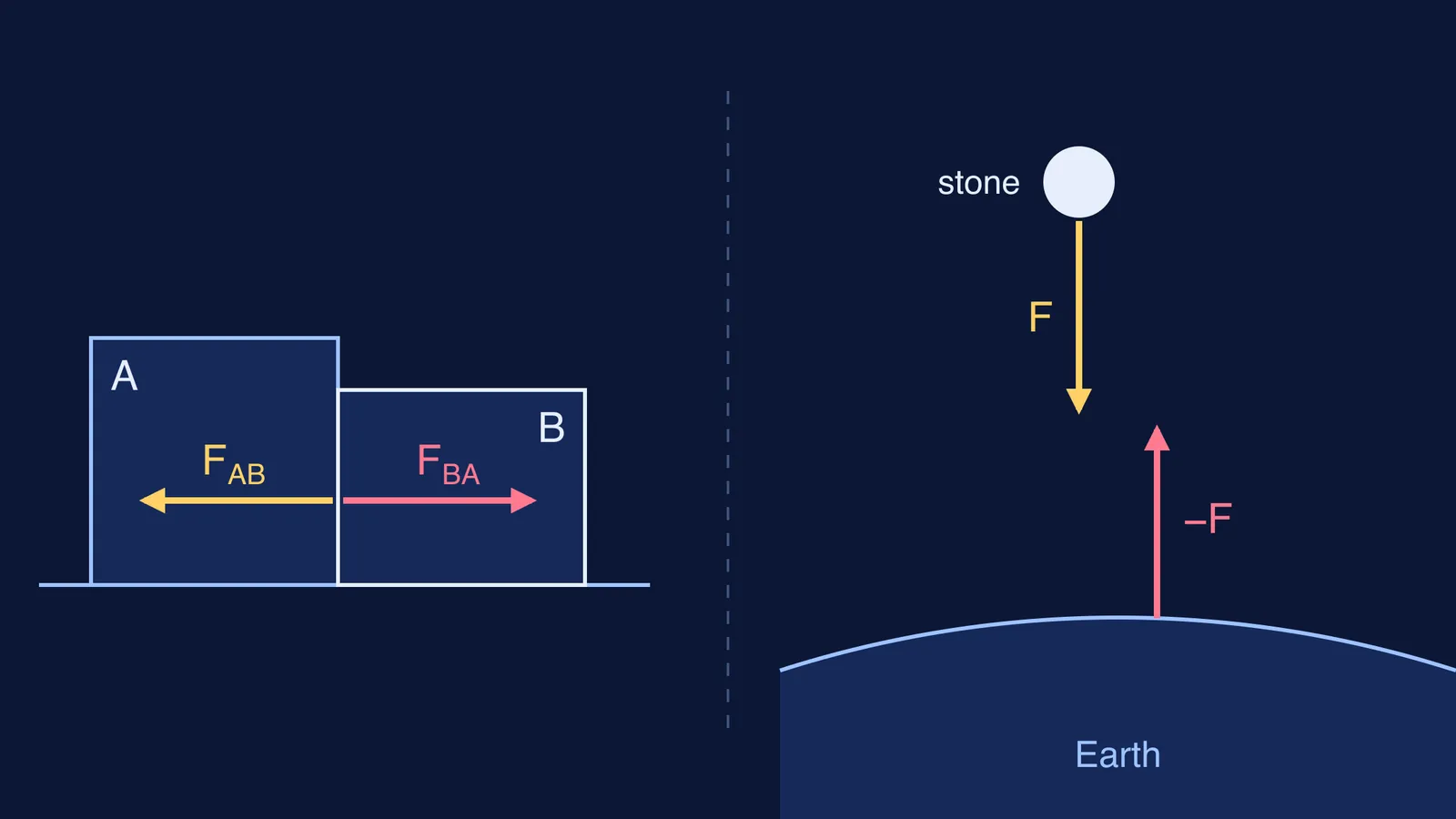
Now open the book at those spots only. The NCERT Laws of Motion chapter (section 4.6) says that action and reaction "mean nothing else but 'force'", and states the law as: "Force on a body A by B is equal and opposite to the force on the body B by A." The two forces "act on different bodies, not on the same body", and the book names the mistake directly: "It is an error to add up the two forces and claim that the net force is zero."
Sometimes the gap sits underneath the chapter, say, you can't define net force. The Fermi Concept Library gives each concept its own lesson and its place in the map, so you can go back one level.
Step 4: simplify and test. The rewrite: "Forces come in pairs between two objects. If the horse pulls the cart, the cart pulls the horse just as hard. The pair never cancels, because the forces act on different objects. To know whether the cart speeds up, add only the forces on the cart."
Test it on a new question: does a falling stone pull on the Earth? The rewrite predicts yes, equally hard. NCERT agrees, and says we don't notice because the Earth is so massive that the effect on its motion is negligible.
Does the Feynman technique work for chemistry too?
Yes. In chemistry, gaps hide behind rules you can state but not justify. From Class 11 Equilibrium: why doesn't a catalyst shift equilibrium? "It just doesn't" repeats the rule. An explanation says why: a catalyst speeds up the forward and backward reactions alike, so equilibrium arrives sooner at the same composition.
A template to spot gaps in your understanding
Copy this into your notebook, one page per concept:
Concept, chapter and section:
My explanation, book closed, five to eight sentences:
Gaps: circle words I can't define, put "?" where I jumped a step, underline "basically"
What the book says at each gap, with page number:
New explanation in under 100 words, with one example:
A new question, and my answer:
Recheck date, a few days later, from memory:
Step 2 works better with a listener who asks questions back. Fermi's AI tutor notices where a student is stuck and decides whether to explain, ask or show, so you get questions back, not just answers. For worked examples, try the self-explanation method for studying worked examples; if rereading feels like enough, read why rereading feels like learning, and what to do instead.
Tonight, pick one concept from this week's classes and fill in one page of the template.