On this page
If your study chatbot pitches answers too high or ignores your syllabus, there are two ways to fix it. You can change what you ask, which is prompting. Or someone can retrain the model, which is fine-tuning. You can do the first tonight; the second is usually the model builder's job.
What is the difference between fine-tuning and prompting?
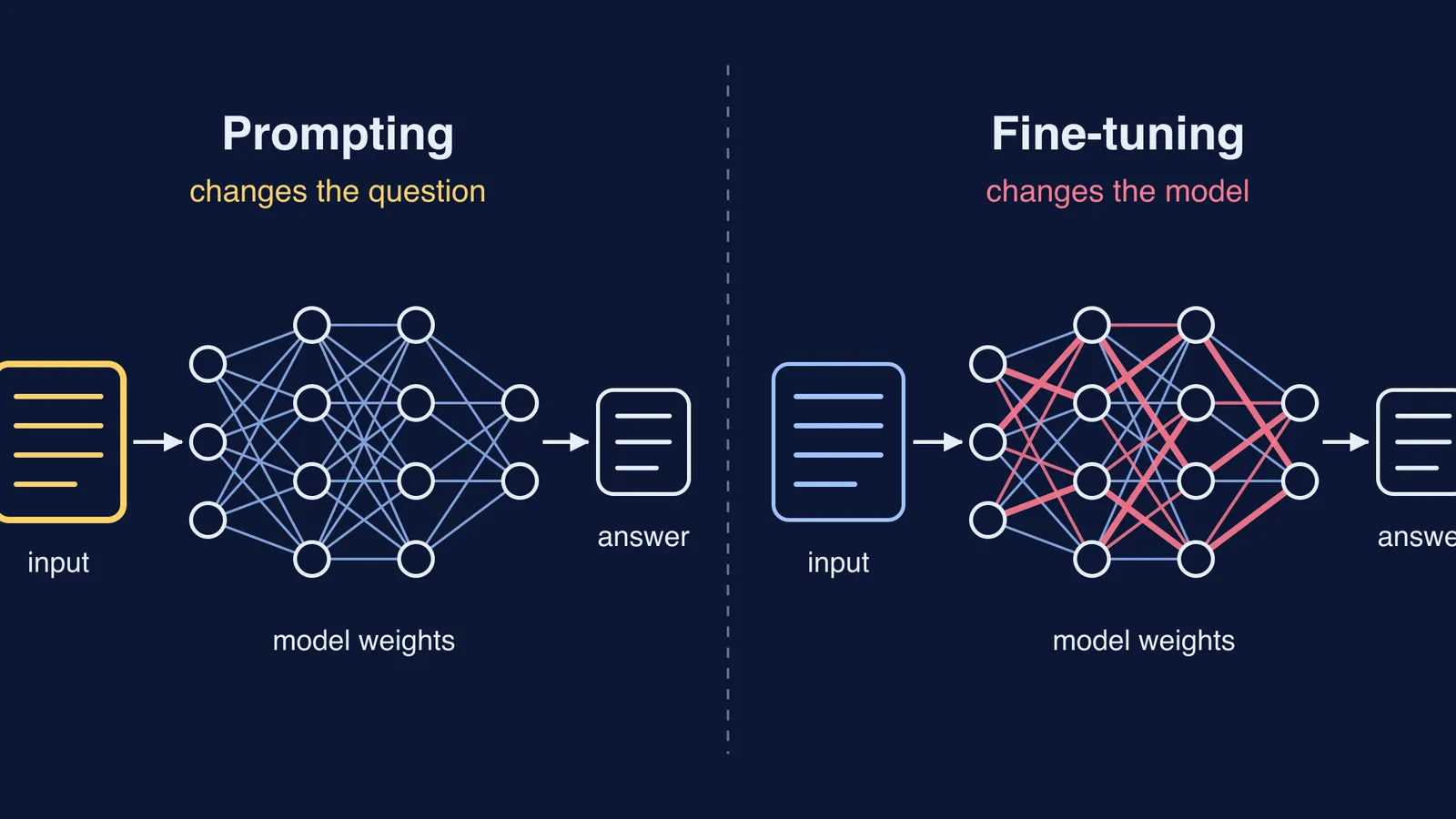
A language model is a huge set of numbers, called parameters or weights, set during training. Its answers come from those numbers plus the text you send.
Prompting means changing the text you send: your question, instructions, examples or a passage to work from. Google's Machine Learning Crash Course puts it plainly: "Prompt engineering doesn't alter the model's parameters."
Fine-tuning means training an existing model a bit more on examples of a specific task. The same Google course explains that standard fine-tuning updates the weight and bias of every parameter, and that engineers can sometimes fine-tune on just a few hundred or a few thousand training examples. It also warns that standard fine-tuning "is often computationally expensive".
OpenAI's developer guide describes fine-tuning as giving a base model "the kinds of inputs and outputs you expect in your application" to get a model that does those tasks well, and notes that prompt engineering "may be all you need" (OpenAI model optimization guide).
A simple analogy: the exam paper and the student
Think of the model as a student who has already studied for years.
Prompting is rewriting the question paper. Same student, same brain. But "Explain projectile motion" and "Explain, for a Class 11 student, why the horizontal velocity of a projectile stays constant, with one worked example" get very different answers.
Fine-tuning is sending the student back for another term of practice on one kind of question. The student's brain changes. They get more consistent at that task, but the change applies to every answer they give afterwards.
Prompting can go surprisingly far. In the 2020 paper that introduced GPT-3, the authors ran every task "without any gradient updates or fine-tuning", with the task and a few examples given purely as text (Brown et al., arXiv).
Retraining also has a cost. A 2017 paper on "catastrophic forgetting" noted that deep neural networks, "unlike humans", are unable to learn several tasks one after another, and proposed protecting the weights that mattered for earlier tasks (Kirkpatrick et al., PNAS).
Can fine-tuning teach a chatbot my syllabus?
Usually not well. Research suggests fine-tuning is a weak way to add new facts to a model.
A 2023 study compared two ways of giving a model new knowledge: fine-tuning it on the text, or retrieving the relevant text and putting it in front of the model at question time (retrieval-augmented generation, or RAG). Across a range of knowledge-heavy tasks, it found that RAG "consistently outperforms" unsupervised fine-tuning, and that models "struggle to learn new factual information" that way (Ovadia et al., arXiv).
So a simple way to make a chatbot stick to your NCERT chapter is to paste the paragraph you are studying and ask it to work only from that. In a very long chat it can still lose track of early messages, as we explain in why AI chatbots forget things in long chats.
Which one fixes my study chatbot's problem?
Use this checklist.
Too advanced, too long or too basic: prompt. Give your class, your exam and the length you want.
It hands you the answer when you wanted to try: prompt. Say "Give me one hint at a time and wait for my attempt." To avoid repeating this, set it once in custom instructions for your study chatbot.
It doesn't use your textbook's wording or method: give it the source text and say "Use only this passage."
It gets this year's exam dates or pattern wrong: don't ask a chatbot. Check the official NTA, CBSE or board website.
It behaves the same unhelpful way for every user, every time: that is a model-level habit. Only the developer can change it, through fine-tuning or other training such as how chatbots learn from human feedback.
Here is a worked example.
Weak prompt: "Explain projectile motion."
Stronger prompt: "I'm in Class 11, preparing for JEE Main. Explain why the horizontal velocity of a projectile stays constant, using one numerical example with g = 10 m/s². Then ask me one question to check I understood, and don't give the answer until I try."
The model didn't change between the two. Only the question did.
What does this mean when you choose a study tool?
Built-in instructions and training are decided by whoever makes the tool, so two apps on similar models can behave very differently. Fermi's AI tutor is built to teach rather than answer: it works out what you already know, builds a plan for the session and checks your understanding as it goes. If your trouble is a method that keeps going wrong, the Fermi Problem Library has worked problems with a step-by-step solver that explains the reasoning rather than printing an answer.
Whatever tool you use, start with the question. Rewrite it once before you decide the AI can't help.