On this page
If you are preparing for JEE or your boards, you have probably heard two opposite pieces of advice: study the solved examples first, and stop reading solutions and just solve. Both are right, for different students at different times. Knowing which side of the switch you are on, topic by topic, tells you how to spend your next study hour.
What is the expertise reversal effect?
The expertise reversal effect occurs when a learning method that works well for beginners becomes ineffective for more knowledgeable learners, as defined by Kalyuga and Sweller in the Journal of Educational Psychology (2004). A year earlier, Slava Kalyuga, Paul Ayres, Paul Chandler and John Sweller had reviewed the evidence in The expertise reversal effect.
Worked examples are the clearest case. When a topic is new, a full solution shows you what comes next. Once you know the steps, rereading them adds little and takes away the practice of producing them yourself. For the wider research, see our explainer on worked examples versus solving from scratch.
When do worked examples stop helping?
One study's title answers the question: When problem solving is superior to studying worked examples, by Kalyuga, Chandler, Tuovinen and Sweller (2001). Inexperienced mechanical trade apprentices either studied a series of worked examples or solved problems. The beginners did better after the worked examples, and rated the mental load as lower. With more experience in the same domain, the worked examples became redundant and problem solving gave better results.
In practice, that suggests worked examples stop helping, topic by topic, at about the point where you could write most of the solution without them.
How can you tell which stage you are at?
In the first-step method, learners see a task for a limited time and write only their first step towards the solution, as described by Slava Kalyuga in a 2005 Cognitive Science Society paper. An expert may write the final answer straight away, an intermediate learner writes the first small operation, and a novice starts a random search. With high-school algebra and geometry, scores on this rapid test correlated with traditional tests at up to .92 while cutting test time by factors of 2.5 to 4.9, Kalyuga and Sweller reported.
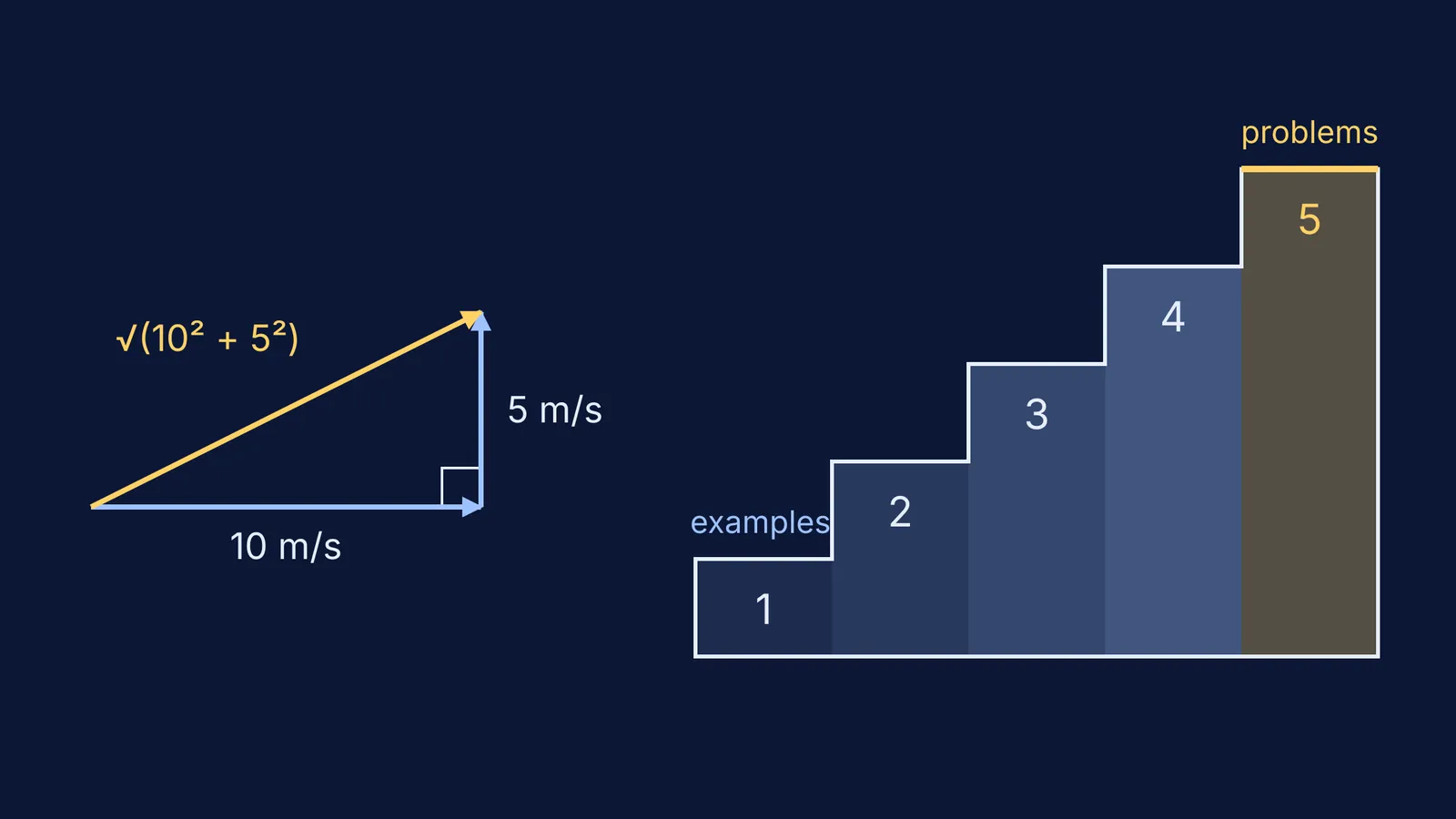
Kalyuga's own physics task works well as a self-test. A ship travels at 10 m/s and a passenger runs across the deck at 5 m/s, perpendicular to the ship's motion. What is the passenger's velocity relative to the sea? Give yourself about 20 seconds and write only what comes first:
Nothing useful, or a formula you are guessing at: you are at the start.
Two perpendicular arrows: you know a vector approach is needed, but not the procedure.
The arrows with 10 and 5 marked, or the triangle drawn: the procedure is forming.
v = √(10² + 5²) written straight away, with no diagram: you are close to fluent.
About 11.2 m/s at roughly 27° to the ship's direction: you are fluent on this problem type.
In Kalyuga's scoring, each step you skip correctly counts in your favour, so a correct final answer scores highest. Try three or four problems from one chapter and note the level you reach most often.
What should you do at each stage?
Levels 1 and 2: study full worked examples, then try a near-identical problem straight after each one.
Level 3: use faded examples, where the first steps are shown and you finish the rest.
Levels 4 and 5: close the solution book. Solve first, then compare only the step where your method differed.
This ladder mirrors the training in Kalyuga's 2005 study: novices got fully worked examples, with parts removed as their knowledge grew. With 16 Year 11 students, a version that used quick checks to place each student took significantly less training time than one where everyone did every stage; its learning gains were higher but not statistically significant.
If a chapter leaves you at level 1, the Fermi Problem Library has worked problems with a step-by-step solver that explains the reasoning rather than printing an answer. At level 3, our guide to making faded worked examples with AI shows how to remove steps one at a time. At levels 4 and 5, decide in advance how long to stay stuck before opening a solution.
What can parents say?
If your child says they no longer need solved examples, ask them to show you:
Pick a fresh question from their current chapter.
Say: write only your first step, and be quick.
If they jump to the formula or the answer, agree that problems are the better use of their time there.
If they stall, suggest two or three worked examples first, then the same check tomorrow.
When it is hard to tell where you stand across a chapter, Fermi's AI tutor works out what you already know and builds a plan for the session, so you start with examples or problems as your level needs.
Tonight, write the first step for four problems from one chapter, and let your level decide whether you open the solutions.