On this page
You are 20 minutes into a problem and nothing is moving. The solution is at the back of the book. Should you look? Yes, but not straight away, and not all at once. Here is a ladder with rough times, and a way to log the problem so the struggle isn't wasted.
Is it bad to look at the solution too early?
It can be. Bastani and colleagues ran a field experiment with nearly a thousand high school maths students and published it in PNAS in 2025. Students given unrestricted access to a ChatGPT-style GPT-4 tool got 48% better grades on practice problems. Once it was taken away, their grades were 17% lower than those of students who never had it. The researchers wrote that students tried to use it as a "crutch". A tutor version with prompts designed to safeguard learning largely avoided the drop.
Trying first can also help on its own. A meta-analysis of 53 studies by Sinha and Kapur in Review of Educational Research found that, when learning a new concept, solving problems before instruction beat instruction-first teaching, with a moderate effect size of Hedges' g 0.36. The same review found the opposite for younger children (second to fifth graders), so this applies most to older students. We cover the study in more detail in our post on productive failure.
There is a limit, though. Once you have no new ideas, extra minutes add frustration, not learning.
How long should you try a problem before seeing the solution?
No study gives a magic number. These times are our rule of thumb for a board or JEE-level practice question; stretch them for olympiad problems.
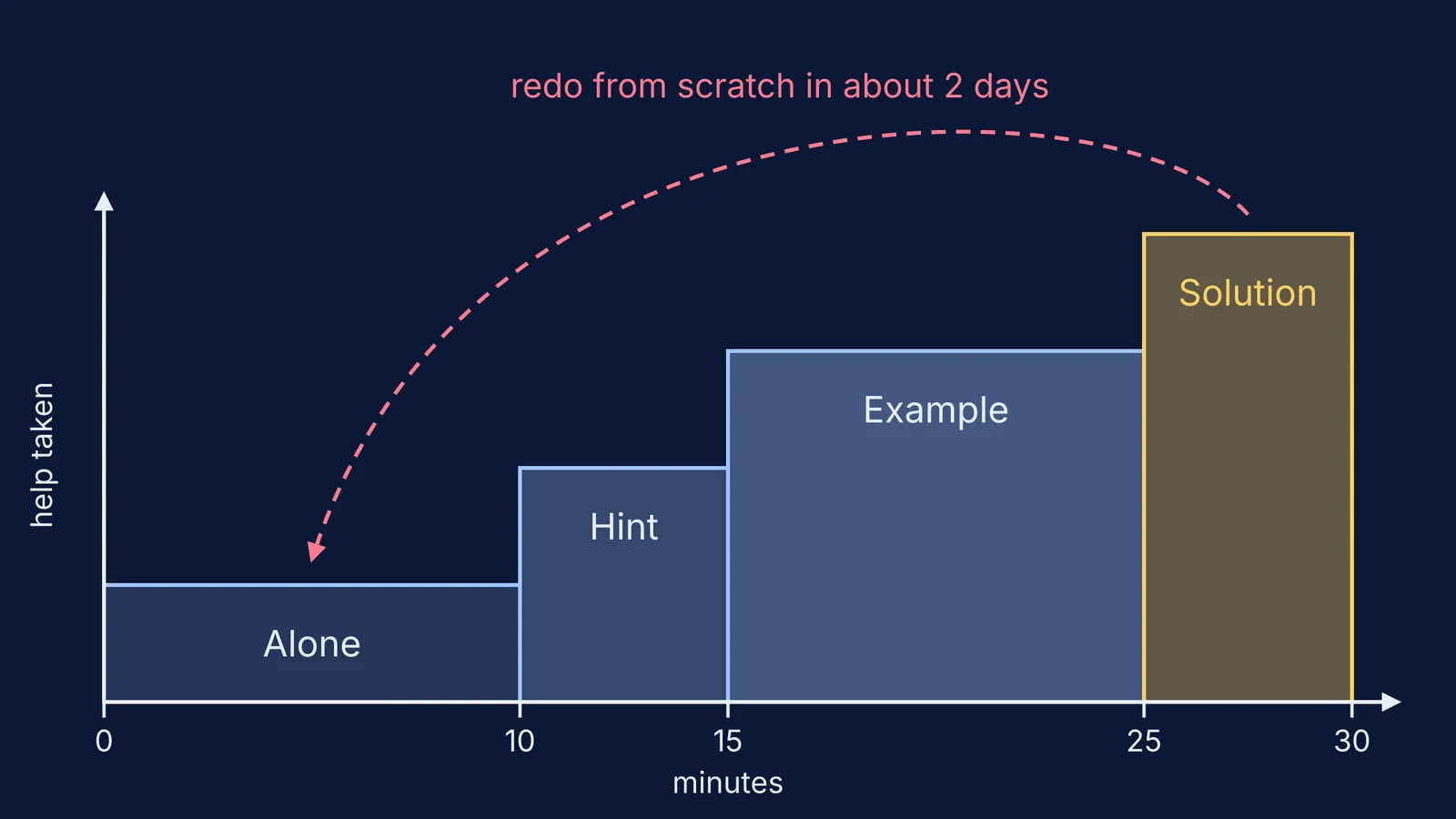
0 to 10 minutes: alone. Write down what is given and asked, draw the figure, and try at least two approaches, even wrong starts.
About 10 minutes: hint check. Read only the first line of the solution, or ask for one hint. Then close it and carry on alone.
About 15 minutes: related example. Find a solved example in your textbook that uses the same idea. Study it, then go back to your problem.
About 25 minutes: the full solution. Read it slowly, then close it and write the solution again from memory.
The "go back" in step 3 matters. In Contemporary Educational Psychology, van Gog, Kester and Paas found that for novices, studying an example and then solving a problem beat problem solving alone, but solving first and studying the example afterwards did not. So always finish with a problem yourself, and on a brand-new topic, start with an example. More in our piece on worked examples versus problem solving.
What does climbing the ladder look like?
Here is a Class 11 problem: a ball is thrown at 20 m/s at 30° to the ground (take g = 10 m/s²). Find its maximum height.
Minutes 0 to 10. You use v² = u² − 2gH with u = 20 and get H = 20 m. The answer key says 5 m. Your arithmetic is fine.
Hint check. The first line of the solution reads: "Vertical component of velocity = 20 sin 30° = 10 m/s." You close the book. Only the vertical part of the velocity is slowed by gravity.
You finish alone. 0 = 10² − 2(10)H, so H = 5 m. You never needed the example or the full solution.
When you reach the solution step, the Fermi Problem Library has a step-by-step solver that explains the reasoning rather than printing an answer. Read one step, then try the next yourself.
How do you log a problem for a redo?
The redo is where the learning sticks. In Psychological Science, Roediger and Karpicke found that students who tested themselves on prose passages remembered substantially more two days and one week later than students who reread them, even though rereading made them feel more confident. Reading a solution is a lot like rereading. Redoing the problem is the test.
Keep a stuck log in the back of your notebook. Give each problem one line:
the source (book, chapter, question number)
the step you reached (alone, hint, example or solution)
the missing idea, in one sentence ("only the vertical velocity changes")
the redo date, and a tick when you solve it cold
When should you redo it? A study of more than 1,350 people in Psychological Science found that the best gap between first learning and a review depends on how long you need to remember. For a test one week away, it was about 20 to 40% of that week. So redo the problem about two days later without notes, then again before your next test. Our spaced revision schedule shows how to fit this into your week.
If a whole topic keeps coming back to the log, the gap is probably a concept rather than a trick. Fermi's AI tutor notices where a student is stuck and decides whether to explain, ask or show, so you work through the idea instead of collecting answers.
Tonight, pick one problem you skipped this week, set a 10-minute timer and start climbing.